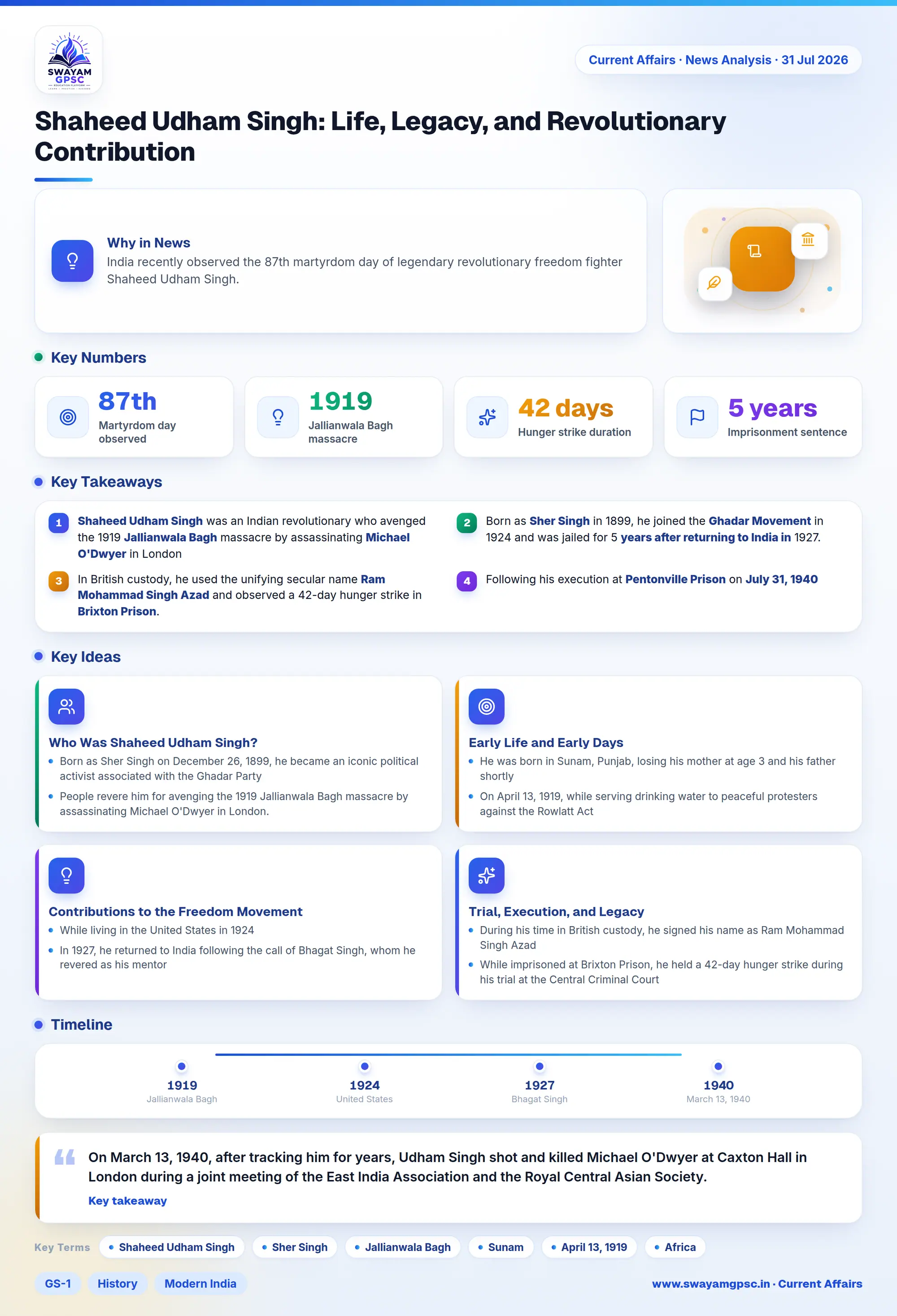
Shaheed Udham Singh: Life, Legacy, and Revolutionary Contribution
#GS-1 #History #Modern India #Freedom Struggle #GS-3 #Current Events #National
Key takeaways
- Shaheed Udham Singh was an Indian revolutionary who avenged the 1919 Jallianwala Bagh massacre by assassinating Michael O'Dwyer in London on March 13, 1940.
- Born as Sher Singh in 1899, he joined the Ghadar Movement in 1924 and was jailed for 5 years after returning to India in 1927.
- In British custody, he used the unifying secular name Ram Mohammad Singh Azad and observed a 42-day hunger strike in Brixton Prison.
- Following his execution at Pentonville Prison on July 31, 1940, his mortal remains were brought back to India in 1974 for cremation with full state honors in Sunam.
Why in News
- India recently observed the 87th martyrdom day of legendary revolutionary freedom fighter Shaheed Udham Singh.
Who Was Shaheed Udham Singh?
- Born as Sher Singh on December 26, 1899, he became an iconic political activist associated with the Ghadar Party and the Hindustan Socialist Republican Association (HSRA).
- People revere him for avenging the 1919 Jallianwala Bagh massacre by assassinating Michael O'Dwyer in London.
Early Life and Early Days
- He was born in Sunam, Punjab, losing his mother at age 3 and his father shortly after, leading to his upbringing at the Central Khalsa Orphanage in Amritsar where he received the name Udham Singh.
- On April 13, 1919, while serving drinking water to peaceful protesters against the Rowlatt Act, he personally witnessed the horrific Jallianwala Bagh massacre ordered by Brigadier-General Reginald Dyer and backed by Lieutenant Governor Sir Michael O'Dwyer.
- To dodge British intelligence agencies, he traveled across Africa, Europe, Mexico, and the United States using false names like Frank Brazil and Ude Singh.
Contributions to the Freedom Movement
- While living in the United States in 1924, he joined the Ghadar Movement to organize Indian workers and distribute anti-colonial revolutionary literature.
- In 1927, he returned to India following the call of Bhagat Singh, whom he revered as his mentor, to smuggle arms and revolutionary literature into the country, which led to his arrest and a 5-year prison sentence.
- On March 13, 1940, after tracking him for years, Udham Singh shot and killed Michael O'Dwyer at Caxton Hall in London during a joint meeting of the East India Association and the Royal Central Asian Society.
Trial, Execution, and Legacy
- During his time in British custody, he signed his name as Ram Mohammad Singh Azad, creating a unified identity representing Hinduism, Islam, and Sikhism, with Azad symbolizing a liberated nation.
- While imprisoned at Brixton Prison, he held a 42-day hunger strike during his trial at the Central Criminal Court, stating that giving his life for national freedom brought him no fear.
- British authorities executed him by hanging at London's Pentonville Prison on July 31, 1940, and later in 1974, Punjab Chief Minister Giani Zail Singh arranged to bring his mortal remains back to India for cremation with full national honors at Sunam.