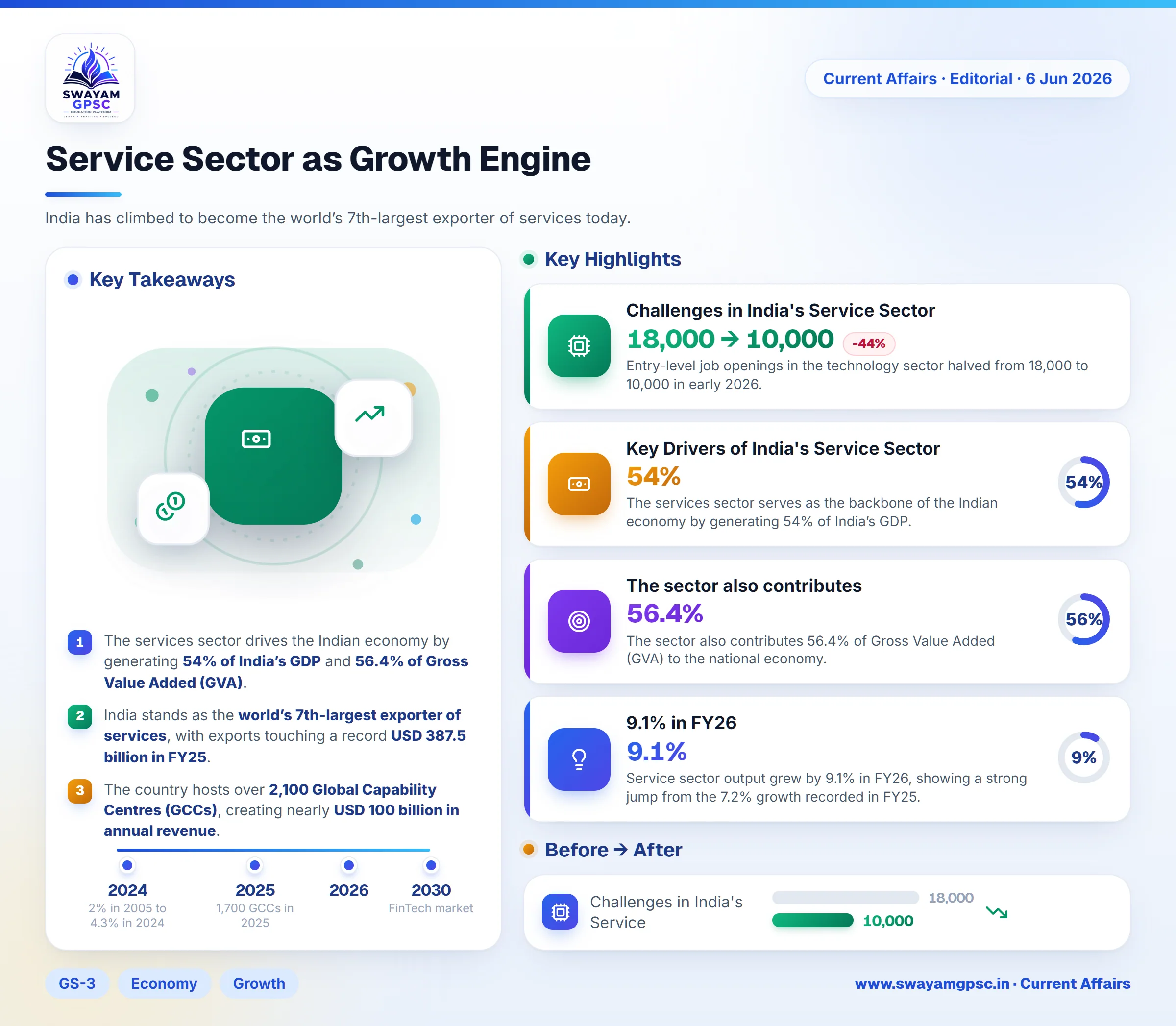
Service Sector as Growth Engine
#GS-3 #Economy #Growth #Employment #Infrastructure #Planning #Inclusive Growth
Key takeaways
- The services sector drives the Indian economy by generating 54% of India’s GDP and 56.4% of Gross Value Added (GVA).
- India stands as the world’s 7th-largest exporter of services, with exports touching a record USD 387.5 billion in FY25.
- The country hosts over 2,100 Global Capability Centres (GCCs), creating nearly USD 100 billion in annual revenue.
- Service sector employment reached 29.7% with 188 million workers in 2023-24, yet formal job creation struggles against automation.
- The India Skills Report 2025 reveals that only 54.8% of graduates possess the skills required by modern industries.
Why in News
- A recent editorial in The Financial Express examines the growing importance of the services sector in India.
- The sector plays a major role in influencing the overall GDP and employment numbers across the country.
- Experts argue that India needs better tools and data to monitor service sector trends and guide economic policies effectively.
Key Drivers of India's Service Sector
- The services sector serves as the backbone of the Indian economy by generating 54% of India’s GDP.
- The sector also contributes 56.4% of Gross Value Added (GVA) to the national economy.
- Service sector output grew by 9.1% in FY26, showing a strong jump from the 7.2% growth recorded in FY25.
- India has climbed to become the world’s 7th-largest exporter of services today.
- India's share in global commercial services exports doubled from 2% in 2005 to 4.3% in 2024.
- Services exports acted as a vital cushion against the trade deficit, hitting a record USD 387.5 billion in FY25.
- India now hosts over 2,100 Global Capability Centres (GCCs), growing rapidly from 1,700 GCCs in 2025.
- These Global Capability Centres (GCCs) generate nearly USD 100 billion in annual revenue and employ over 2.5 million professionals.
- The Financial, Real Estate, and Professional Services segment grew remarkably by 10.4% in FY26.
- The Gross Non-Property Asset (GNPA) ratio of Scheduled Commercial Banks dropped to a historic low of 2.15% by September 2025.
- India's digital payments system UPI consistently processes over 18 billion transactions per month.
- The FinTech market in India was valued at approx. USD 689 billion as of 2023 and is projected to reach USD 2.1 trillion by 2030.
- India improved its ranking on the Global Innovation Index (2025) to 38th place, rising sharply from 66th place in 2019.
- Service sector employment expanded to 29.7%, accounting for 188 million workers during the 2023-24 period.
Challenges in India's Service Sector
- The services sector suffers from a Paradox of Jobless Growth, where rising revenues do not translate into mass job creation.
- Major IT firms like TCS, Infosys, Wipro, HCLTech, and Tech Mahindra saw reduced headcounts despite growing revenues.
- TCS alone reduced its total workforce by more than 23,000 employees due to automation.
- Entry-level job openings in the technology sector halved from 18,000 to 10,000 in early 2026.
- The ASUSE 2025 survey reveals that 55.7% of service workers are self-employed own-account workers operating informally.
- Almost two out of every five regular service workers lack basic social security benefits.
- NITI Aayog’s 2025 findings show that four states, namely Karnataka, Maharashtra, Tamil Nadu, and Telangana, account for nearly 40% of total services output.
- GVA per worker in the informal sector grew by only 4.5% in 2025, while wage growth slowed down to 3.9%.
- India's service exports remain heavily dependent on demand from western economies like the US and EU markets.
- Services exports are projected to touch USD 465-475 billion in FY26, making the economy vulnerable to global shocks.
- The India Skills Report 2025 highlights that only 54.8% of graduates meet current industry standards.
- The Economic Survey 2025-26 points out that gig workers make up 2% of the workforce and this share may rise to 6.7% by 2029-30.
- Roughly 40% of gig workers earn less than ₹15,000 per month without formal social protection.
Way Forward
- India must establish a Unified Emerging Services Regulatory Authority (UESRA) to streamline oversight across different digital sectors.
- The government should replace outdated educational models with a public-private Cognitive Apprenticeship framework to improve job-readiness.
- Policymakers must promote spatial decentralization by building digital-ready infrastructure in Tier-2 and Tier-3 cities.
- Micro-enterprises in the informal sector should be integrated into digital platforms like the Open Network for Digital Commerce (ONDC).
- India must diversify its export markets by targeting non-traditional regions across Latin America, Africa, and Southeast Asia.
- The government needs to fully operationalize a centralized digital social security registry tied to the e-Shram portal under the Code on Social Security, 2020.