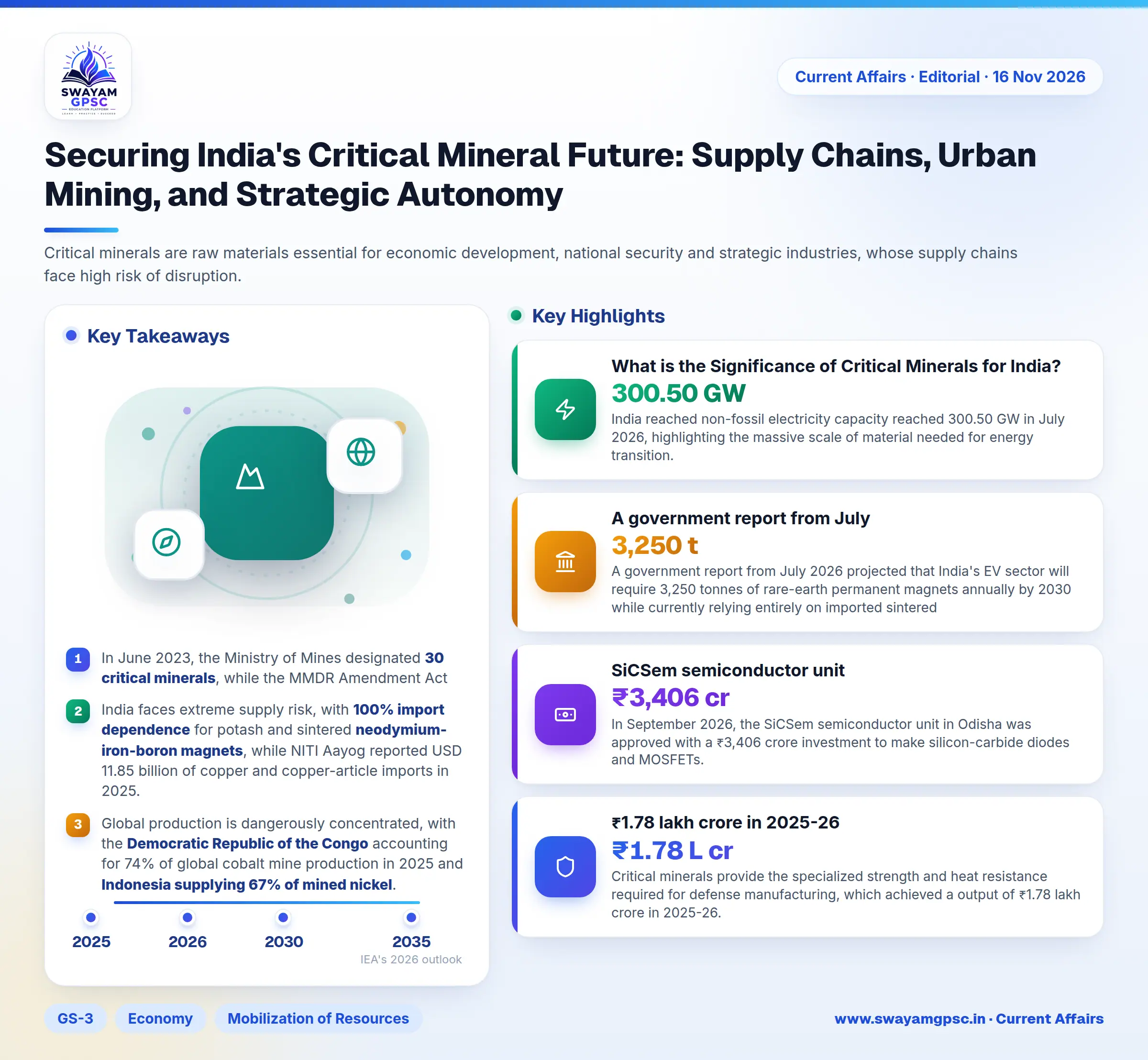
Securing India's Critical Mineral Future: Supply Chains, Urban Mining, and Strategic Autonomy
#GS-3 #Economy #Mobilization of Resources #Infrastructure #Agriculture #Science & Technology #Defence #Environment #Sustainable Development #GS-1 #Geography #Distribution of Key Natural Resources
Key takeaways
- In June 2023, the Ministry of Mines designated 30 critical minerals, while the MMDR Amendment Act, 2023 classified 24 critical and strategic mineral entries in Part D of the First Schedule to boost domestic security.
- India faces extreme supply risk, with 100% import dependence for potash and sintered neodymium-iron-boron magnets, while NITI Aayog reported USD 11.85 billion of copper and copper-article imports in 2025.
- Global production is dangerously concentrated, with the Democratic Republic of the Congo accounting for 74% of global cobalt mine production in 2025 and Indonesia supplying 67% of mined nickel.
- The government introduced the National Critical Mineral Mission in 2025 alongside a recycling scheme expecting 40,000 tonnes of annual critical-mineral production and 70,000 jobs.
Why in News
- India recently implemented a ban on exporting lithium-ion black mass, which helps retain valuable secondary minerals within the country and fixes a major policy gap.
- These critical minerals are essential for clean energy, electric mobility, semiconductors, defence, and agriculture, but they face heavy supply concentration and processing bottlenecks.
- To build strong supply resilience, India must combine domestic exploration, circular urban mining, strategic stockpiles, and international partnerships.
What are Critical Minerals?
- Critical minerals are raw materials essential for economic development, national security and strategic industries, whose supply chains face high risk of disruption.
- Any sudden shortage of these minerals can stall manufacturing, increase production costs, and delay major national infrastructure projects.
- These minerals power essential technologies including electric vehicles, battery storage, renewable electricity, and modern power grids.
- Lithium and graphite form the core of lithium-ion batteries, while nickel and cobalt are vital for advanced battery chemistry.
- Rare-earth elements like neodymium are essential to make permanent magnets for electric vehicle motors and wind turbines.
- Copper is indispensable for electrical wiring and power grids, while silicon serves as the main material for solar cells.
- Titanium and tungsten provide high-strength performance required in defense equipment and heavy industry.
- Potash and phosphorus-bearing minerals serve as irreplaceable raw materials for manufacturing agricultural fertilizers.
- Governments evaluate mineral criticality based on economic importance, supply risk, import dependence, lack of substitutes, and recycling potential.
- A mineral also becomes vulnerable due to by-product dependence, where its output relies entirely on mining other primary metals.
- The term critical represents an economic and strategic classification, whereas rare-earth elements refer to a specific geological group of seventeen elements.
- Criticality is country-specific and dynamic, changing over time with new technology, fresh mineral discoveries, and evolving trade relations.
- In June 2023, the Ministry of Mines identified 30 critical minerals or mineral groups to focus national efforts on securing supply.
- The MMDR Amendment Act, 2023 created a special category of 24 critical and strategic mineral entries in Part D of the First Schedule.
- The government approved the National Critical Mineral Mission in 2025 to cover exploration, mining, processing, overseas acquisitions, and stockpiling.
- The mission places strong emphasis on recovering valuable metals from end-of-life products to promote a sustainable circular economy.
What is the Significance of Critical Minerals for India?
- Securing these minerals enables India to construct reliable storage systems, transmission networks and power electronics for green energy integration.
- India reached non-fossil electricity capacity reached 300.50 GW in July 2026, highlighting the massive scale of material needed for energy transition.
- These minerals directly determine India's ability to manufacture key EV components domestically, strengthening overall production continuity, vehicle costs and domestic value addition.
- A government report from July 2026 projected that India's EV sector will require 3,250 tonnes of rare-earth permanent magnets annually by 2030 while currently relying entirely on imported sintered neodymium-iron-boron magnets.
- Access to high-purity mineral-derived materials is essential for establishing domestic semiconductor fabrication and high-tech manufacturing.
- In September 2026, the SiCSem semiconductor unit in Odisha was approved with a ₹3,406 crore investment to make silicon-carbide diodes and MOSFETs.
- Critical minerals provide the specialized strength and heat resistance required for defense manufacturing, which achieved a output of ₹1.78 lakh crore in 2025-26.
- In July 2026, researchers at ARCI Hyderabad successfully combined stainless steel with a nickel-based superalloy using additive manufacturing for aerospace use.
- A steady supply of critical minerals protects balanced crop nutrition, farm-input affordability, and long-term national food security.
- Official data from July 2025 confirmed total import dependence for muriate of potash requirement, with Canada supplying nearly 25% of its MOP requirement in early 2026.
- Domestic processing and recycling allow India to capture higher industrial value addition while protecting the economy from global price spikes.
- According to NITI Aayog's 2026 report, India imported USD 11.85 billion of copper and copper-article imports in 2025 alongside full import dependence for lithium, cobalt, and nickel.
- Securing minerals creates new avenues for resource diplomacy, overseas investment, and technology partnerships with foreign mineral producers.
- In March 2025 parliamentary reply, KABIL secured an agreement for five lithium-brine blocks covering 15,703 hectares in Argentina alongside exploration links with Australia.
- Establishing secondary recovery industries creates high-skilled opportunities in urban mining, chemical processing, and quality testing.
- India's critical-mineral recycling incentive scheme approved in September 2025 targets 40,000 tonnes of annual critical-mineral production and 70,000 jobs.
Challenges
- Global mining production is heavily concentrated in a few nations, making global supply chains vulnerable to single-country disruptions.
- Data from UNCTAD shows the Democratic Republic of the Congo produced 74% of global cobalt mine production in 2025, while Indonesia supplied 67% of mined nickel.
- Governments across the world are increasingly using export taxes, licensing requirements, quotas and prohibitions to keep raw materials at home.
- An OECD's 2026 inventory revealed that 70% of global cobalt and manganese exports faced restrictive trade measures between 2022-24.
- Developing a new mine takes years due to extensive resource verification, feasibility studies, approvals, and infrastructure build-up.
- The IEA's 2026 outlook warns that copper projects may leave global supply 25% below primary requirements in 2035 under its Stated Policies Scenario.
- Sharp price fluctuations make investors hesitant to fund new mining projects, leading to chronic underinvestment across the sector.
- The IEA reported that critical-mineral investment fell by 9% in 2025, with battery material investments dropping by 20%.
- Extracting raw ore does not guarantee the ability to produce battery-grade chemicals, semiconductor-grade materials, or refined components.
- According to NITI Aayog's 2026 critical-mineral assessment, India relies heavily on foreign suppliers for polysilicon for crystalline-silicon wafer manufacturing despite low silicon ore dependence.
- Transporting and processing critical minerals depends on vulnerable supply routes and essential chemical feedstocks.
- The IEA's 2026 assessment highlighted that half of global seaborne sulphur trade passes through the Strait of Hormuz, creating a major risk for sulphuric acid production.
- Projects often face local resistance and delays due to water competition, pollution, biodiversity damage and disputes over community rights.
- A 2026 United Nations University report noted that 16% of critical-mineral extraction occurs in areas already experiencing high water stress, leading to regulatory action like Indonesia revoking four nickel-mining permits in Raja Ampat in June 2025.
- Recycling efforts are slowed by complex collection, feedstock quality, battery chemistry, and high processing costs.
- A 2026 study in Applied Energy revealed that repurposing lithium-iron-phosphate batteries is often more economical than recycling them, delaying secondary mineral supply.
Way Forward
- The Ministry of Mines and customs officials must map supply chain risks by material quality, processing hubs, and shipping routes.
- India should establish risk-based stockpiles of refined metals, processing chemicals, and magnets with clear emergency release mechanisms.
- The IEA's 2026 stockpiling guidance recommends matching national strategic reserves directly to domestic industrial needs.
- The Geological Survey of India should partner with private explorers through competitive funding linked to verified drilling results.
- Geological databases must record both successful and unsuccessful exploration data to prevent future projects from wasting funds.
- Exploration programs must evaluate recoverability and processing costs alongside physical deposits to ensure commercial viability.
- State agencies like KABIL, Indian manufacturers and development-finance institutions must invest jointly in overseas mining and refining operations.
- International deals should mix equity participation, long-term offtake, technology cooperation and producer-country value addition to benefit both nations.
- Procurement officers should verify beneficial ownership and processing origin so factories can switch suppliers quickly during crises.
- India should pilot two-way contracts for difference to protect new mining projects against sudden drops in market prices.
- Price support mechanisms should include fiscal ceilings, sunset clauses and productivity milestones to protect public money.
- Research hubs like CSIR laboratories, engineering firms and downstream manufacturers must build pilot plants to test processing methods on an industrial scale.
- Government research grants should be tied directly to recovery rates, impurity limits, equipment reliability and customer-approved output.
- Domestic battery and electronics manufacturers must sign long-term supply agreements with certified battery recyclers.
- Implementing Digital material passports and return incentives will boost collection rates and feedstock quality for recyclers.
- State research programs should offer cash incentives for achieving high element-wise recovery, purity and domestic reuse of hard-to-recycle materials.
- India should fund targeted research challenges to replace scarce inputs with cheaper alternatives like sodium-ion storage demonstrations.
- Government procurement policies must evaluate total lifetime cost, mineral intensity and supply concentration instead of just lowest upfront price.
- State authorities must mandate catchment-level water budgets, cumulative impact assessments and independently monitored tailings systems before granting mine expansions.
- Mining companies must invest in local water recycling, green infrastructure, and transparent community grievance channels.
- Local development planning under Mineral Foundation planning must focus on verified water availability and sustainable community livelihoods.
Conclusion
- Securing critical minerals requires a shift from simple import dependence to strategic, full-value-chain industrial planning.
- Combining export restrictions with domestic processing capability, price support, and sustainable mining will protect India's clean energy transition and economic stability.