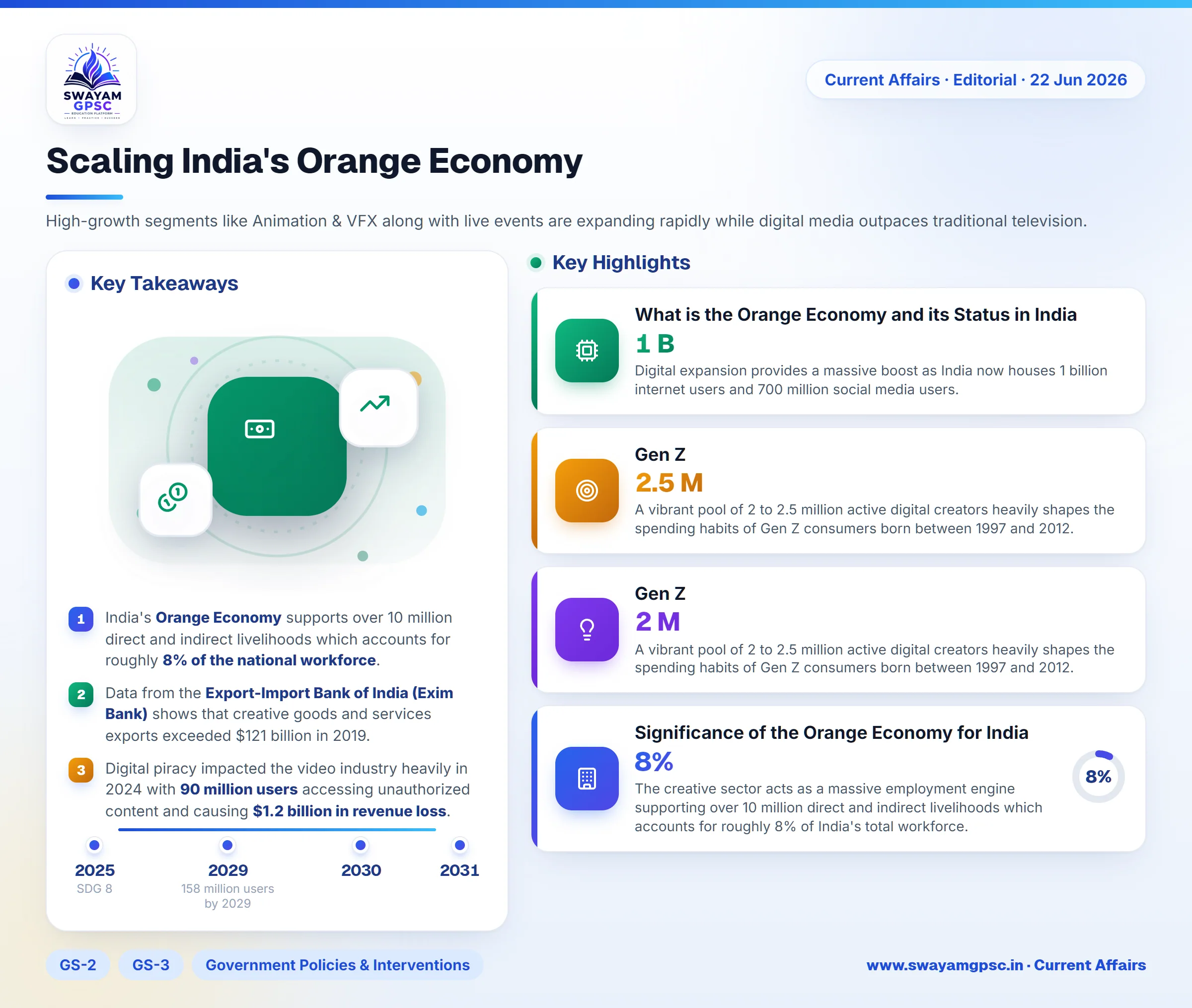
Scaling India's Orange Economy
#GS-2 #GS-3 #Government Policies & Interventions #Issues Relating to Development #Growth & Development #Infrastructure #Economy #Employment
Key takeaways
- India's Orange Economy supports over 10 million direct and indirect livelihoods which accounts for roughly 8% of the national workforce.
- Data from the Export-Import Bank of India (Exim Bank) shows that creative goods and services exports exceeded $121 billion in 2019.
- Digital piracy impacted the video industry heavily in 2024 with 90 million users accessing unauthorized content and causing $1.2 billion in revenue loss.
- The Union Budget 2026-27 aims to build AVGC content creator labs across 15,000 secondary schools and 500 colleges to boost skill development.
What is the Orange Economy and its Status in India
- The Orange Economy represents economic activities where individual creativity, skill, and intellectual property (IP) serve as the main drivers for generating wealth and jobs.
- This sector anchors India's ongoing transition from a service-oriented economy toward a knowledge-driven powerhouse focused on mental output.
- Key segments include media, entertainment, design, arts, technology, gaming, animation, and traditional cultural heritage systems like Ayurveda.
- Digital expansion provides a massive boost as India now houses 1 billion internet users and 700 million social media users.
- High-growth segments like Animation & VFX along with live events are expanding rapidly while digital media outpaces traditional television.
- A vibrant pool of 2 to 2.5 million active digital creators heavily shapes the spending habits of Gen Z consumers born between 1997 and 2012.
- The Union Budget 2026-27 prioritizes this sector by proposing AVGC (Animation, Visual Effects, Gaming, and Comics) content creator labs across 15,000 secondary schools and 500 colleges.
- The Ministry of Culture has created a dedicated creative economy vertical to improve market access and boost cultural exports.
- Specialized institutions like the Indian Institute of Creative Technology, Mumbai aim to bridge the expected demand for 2 million AVGC professionals by 2030.
- Heritage branding efforts are actively converting historic locations like Lothal, Sarnath, and Leh Palace into interactive tourist hubs.
Significance of the Orange Economy for India
- The creative sector acts as a massive employment engine supporting over 10 million direct and indirect livelihoods which accounts for roughly 8% of India's total workforce.
- Creative occupations offer better financial returns by paying about 88% higher than standard non-creative jobs.
- Creative wealth extends far beyond major cities since 6 out of the top 10 creative districts are non-metro regions like Badgam, Panipat, and Imphal (Manipur).
- This decentralization promotes balanced regional development by letting local crafts and textile industries contribute to national economic output without triggering mass urban migration.
- The AVGC-XR sector allows India to leapfrog traditional industrial stages and emerge as a global leader in next-generation entertainment and immersive solutions.
- Cultural exports crossed $121 billion in 2019 alongside a $16 billion trade surplus in creative goods according to data from the Export-Import Bank of India (Exim Bank).
- The Ministry of Information and Broadcasting launched WaveX as a national media-tech accelerator alongside the National Film Development Corporation (NFDC).
- Institutions like T-Hub Hyderabad and IIT Delhi are helping expand a network of 10 institutional innovation hubs across the country.
- Digital distribution channels like Prasar Bharati’s 'Creator’s Corner' and the WAVES OTT platform offer micro-influencers secure monetization and export access.
- Formalizing this sector supports SDG 8 on decent work and SDG 11 on sustainable communities backed by a ₹1 Lakh Crore Urban Challenge Fund spanning 2025 to 2031.
Challenges
- Rampant digital piracy has shifted from physical bootlegs to sophisticated streaming and IPTV networks which severely damages legitimate revenue streams.
- In 2024 about 90 million users accessed pirated video content causing $1.2 billion in revenue loss which equals 10% of the legal video market.
- Without intervention piracy could reach 158 million users by 2029 pushing cumulative losses up to $2.4 billion.
- India functions largely as an outsourced service provider rather than an owner of original intellectual property.
- The animation and post-production segment remains mostly work-for-hire where owned IP monetization is just 10% to 15% while foreign studios capture long-term profits.
- Formal educational systems fail to supply industry-ready professionals at the speed required to meet the target of 2 million AVGC professionals by 2030.
- Independent creators depend heavily on a few global tech giants for audience reach making them vulnerable to sudden algorithmic shifts.
- Traditional artisans and handloom weavers often miss out on fair financial returns due to a lack of formal market access and protection.
- The Prada-Kolhapuri chappal controversy highlighted how traditional Indian cultural assets remain exposed to global appropriation without fair trade reciprocity.
- Organizing live cultural events involves heavy bureaucratic hurdles including securing 10 to 15 different No-Objection Certificates (NOCs) from overlapping agencies.
- Creative capital and corporate studio networks remain heavily concentrated in Tier-1 metropolitan hubs leading to rural talent drain.
Way Forward
- India can adapt its digital public infrastructure model to launch the Open Network for Creative Exchange (ONCE) for direct and friction-free digital licensing.
- An institutional IP Fractionalization Framework managed by SEBI and the Ministry of Culture can allow investors to acquire micro-equity in creative franchises.
- Establishing Creative Enterprise Zones (CEZs) in secondary cities like Indore and Kochi with shared cloud rendering infrastructure will help decentralize creative growth.
- Codifying a clear right to creative persona protection will ensure artists receive automated micro-royalties when AI models use their work.
- Restructuring corporate tax rules to offer an IP-Accumulation Tax Holiday can encourage domestic studios to retain original Indian IP rights.
- Integrating GI-tagged artisan clusters like Pochampally Ikat and Jaipur Blue Pottery into global luxury networks will boost authentic export demand.
- Upgrading academic programs at the Indian Institute of Creative Technologies will equip students with both technical skills and commercial acumen.