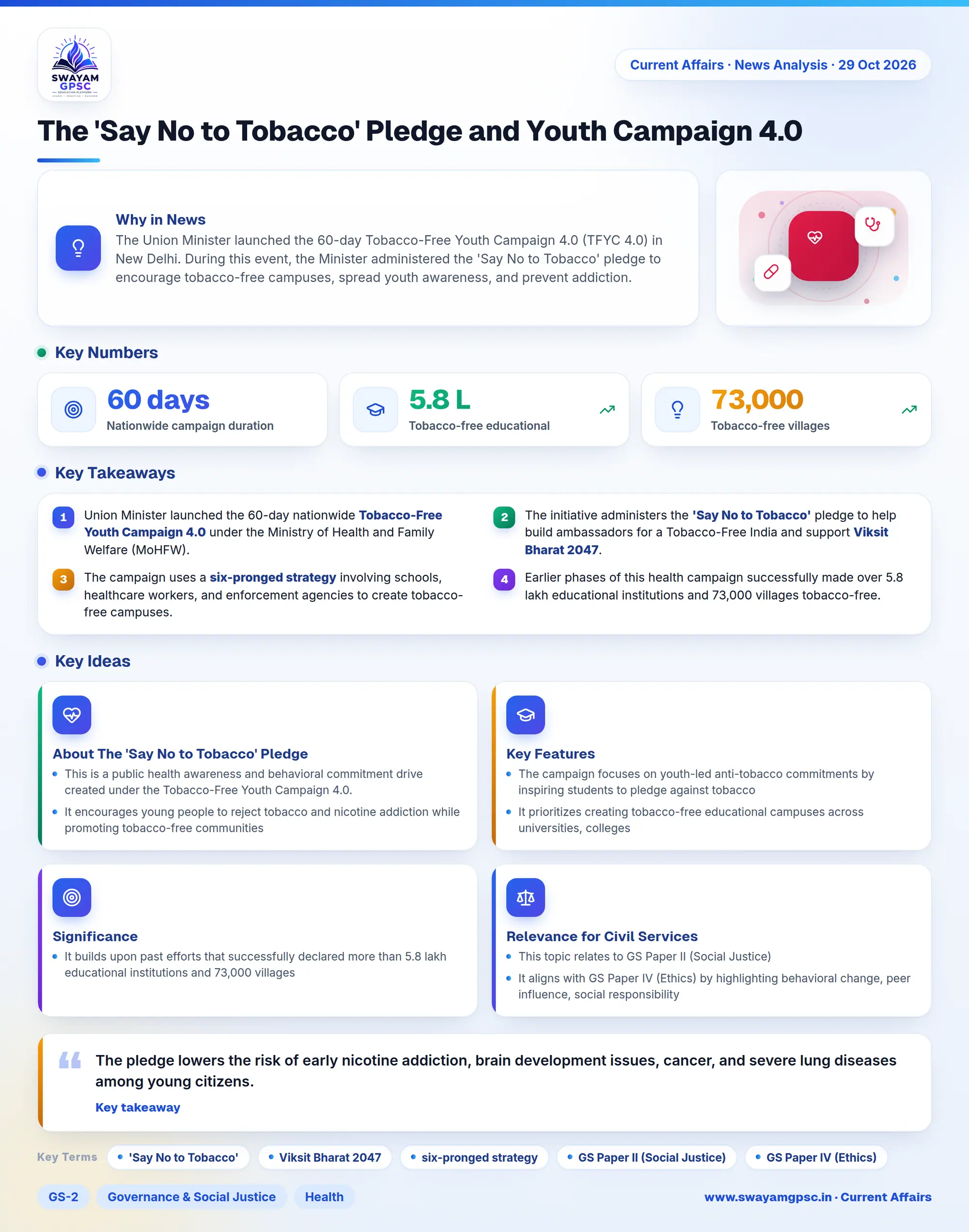
The 'Say No to Tobacco' Pledge and Youth Campaign 4.0
#GS-2 #Governance & Social Justice #Health #GS-4 #Ethics #Social Justice #Public Health #MoHFW #Tobacco Control
Key takeaways
- Union Minister launched the 60-day nationwide Tobacco-Free Youth Campaign 4.0 under the Ministry of Health and Family Welfare (MoHFW).
- The initiative administers the 'Say No to Tobacco' pledge to help build ambassadors for a Tobacco-Free India and support Viksit Bharat 2047.
- The campaign uses a six-pronged strategy involving schools, healthcare workers, and enforcement agencies to create tobacco-free campuses.
- Earlier phases of this health campaign successfully made over 5.8 lakh educational institutions and 73,000 villages tobacco-free.
Why in News
- The Union Minister launched the 60-day Tobacco-Free Youth Campaign 4.0 (TFYC 4.0) in New Delhi.
- During this event, the Minister administered the 'Say No to Tobacco' pledge to encourage tobacco-free campuses, spread youth awareness, and prevent addiction.
About The 'Say No to Tobacco' Pledge
- This is a public health awareness and behavioral commitment drive created under the Tobacco-Free Youth Campaign 4.0.
- It encourages young people to reject tobacco and nicotine addiction while promoting tobacco-free communities across India.
- The initiative operates under the Ministry of Health and Family Welfare (MoHFW).
- The main goal is to stop youth from starting tobacco use, support addiction recovery, and build ambassadors for a Tobacco-Free India to help achieve Viksit Bharat 2047.
Key Features
- The campaign focuses on youth-led anti-tobacco commitments by inspiring students to pledge against tobacco and encourage healthy living among their peers.
- It prioritizes creating tobacco-free educational campuses across universities, colleges, and schools through targeted awareness drives.
- The initiative runs a 60-day nationwide campaign with intensive prevention efforts, cessation support, and community mobilization across all States and Union Territories.
- It works to strengthen tobacco control enforcement by ensuring stricter implementation of public health laws that shield children and teenagers from tobacco exposure.
- The effort uses a whole-of-government approach by involving schools, health experts, law enforcement agencies, and local communities in a coordinated six-pronged strategy.
Significance
- The pledge lowers the risk of early nicotine addiction, brain development issues, cancer, and severe lung diseases among young citizens.
- It builds upon past efforts that successfully declared more than 5.8 lakh educational institutions and 73,000 villages tobacco-free.
Relevance for Civil Services Examination
- This topic relates to GS Paper II (Social Justice), covering public health policies and targeted government actions for adolescent welfare.
- It aligns with GS Paper IV (Ethics) by highlighting behavioral change, peer influence, social responsibility, and ethical leadership in public health.