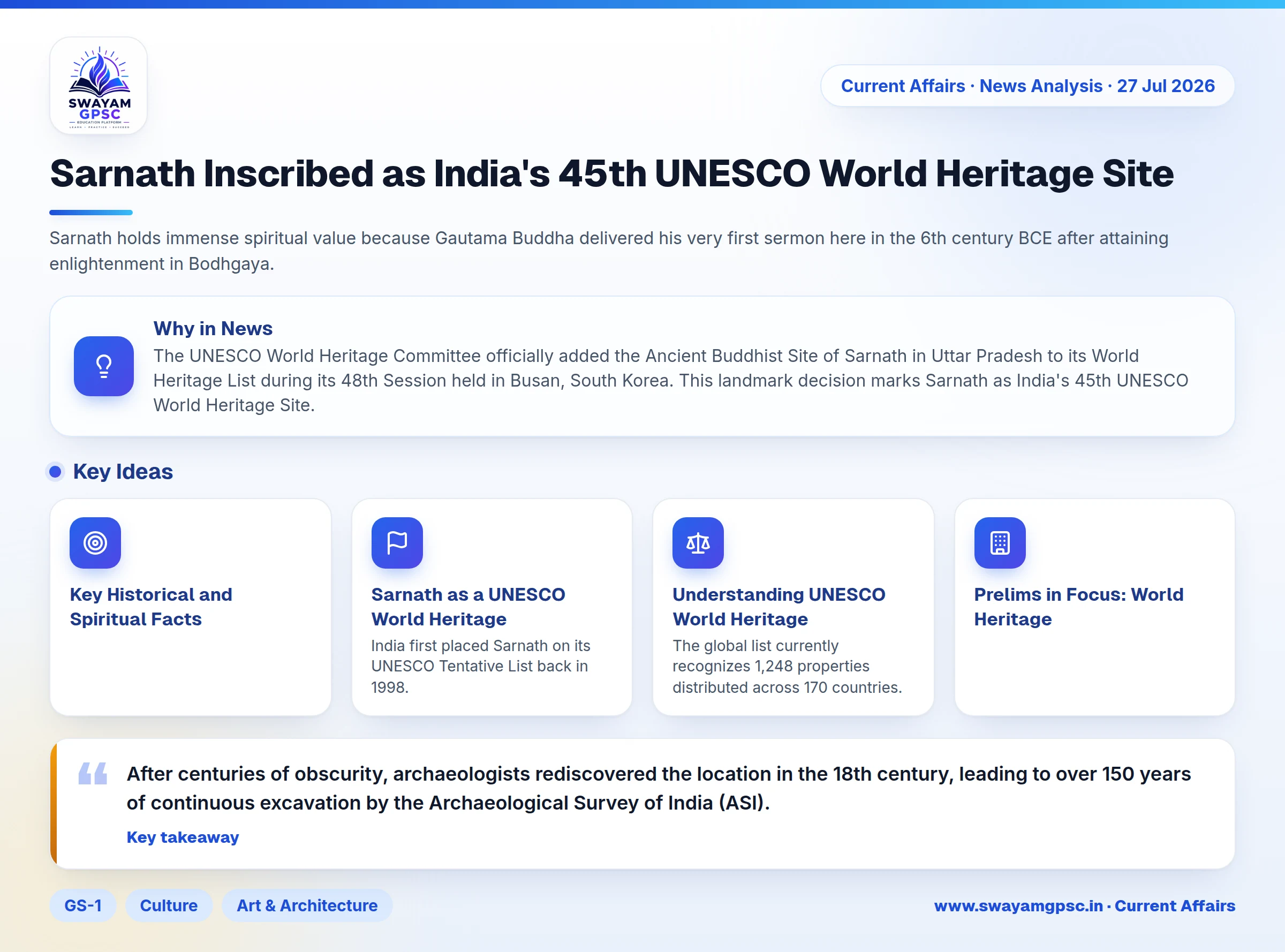
Sarnath Inscribed as India's 45th UNESCO World Heritage Site
#GS-1 #Culture #Art & Architecture #Heritage #GS-3 #Current Events #National #International #UNESCO World Heritage Site #Sarnath
Why in News
- The UNESCO World Heritage Committee officially added the **Ancient Buddhist Site of Sarnath** in **Uttar Pradesh** to its World Heritage List during its **48th Session** held in **Busan, South Korea**.
- This landmark decision marks Sarnath as India's **45th UNESCO World Heritage Site**.
- With this new listing, India now ranks **6th globally** and **2nd in the Asia-Pacific region** for its total number of recognized World Heritage properties.
Key Historical and Spiritual Facts About Sarnath
- Sarnath holds immense spiritual value because **Gautama Buddha** delivered his very first sermon here in the **6th century BCE** after attaining enlightenment in Bodhgaya.
- Buddhist tradition refers to this historical turning point as the **Dharmachakra Pravartana**, which translates to Turning the Wheel of the Law.
- At Sarnath, the Buddha gathered his first five disciples, establishing the formal Buddhist monastic order known as the **Sangha** and teaching the **Noble Eightfold Path**.
- The site stands as one of the four principal places of Buddhist pilgrimage, alongside **Lumbini**, **Bodhgaya**, and **Kushinagar**.
- Following Sarnath's inscription, three of these four major pilgrimage locations now enjoy legal protection as UNESCO World Heritage properties.
- Sarnath joins other celebrated Buddhist World Heritage locations across Asia, including **Sanchi**, **Nalanda**, and **Ajanta** in India.
- Ancient historical texts record Sarnath under several traditional names, including **Rishipatana**, **Ishipatana**, and **Mrigadava** or Deer Park.
- The complex expanded through continuous royal and lay patronage from the **5th century BCE** until its eventual destruction in the **12th century CE**.
- After centuries of obscurity, archaeologists rediscovered the location in the **18th century**, leading to over **150 years** of continuous excavation by the **Archaeological Survey of India (ASI)**.
- Excavations at the site uncovered the famous **Mauryan Lion Capital**, which was later adopted as the **National Emblem of India**, along with the iconic **Dharmachakra Pravartana Buddha statue**.
- Authorities house these valuable historical artifacts inside India's oldest site museum, which opened at Sarnath in **1904**.
Sarnath as a UNESCO World Heritage Property
- India first placed Sarnath on its UNESCO Tentative List back in **1998**.
- UNESCO inscribed the site under **Criterion (iii)** for its continuous spiritual tradition and **Criterion (vi)** for its direct link to Buddha's life, teachings, and the **Triratna**.
- The designated serial property consists of two primary components situated in **Varanasi, Uttar Pradesh**.
- The first component is the **Chaukhandi Stupa**, a towering brick structure marking the spot where Buddha first met his five followers.
- The second component encompasses the main archaeological cluster, which houses the **Dhamekh Stupa**, **Dharmarajika Stupa**, **Mulagandhakuti Vihara**, and the **Ashokan Pillar**.
- The massive cylindrical **Dhamekh Stupa** marks the exact place where Buddha delivered his first sermon to his disciples.
- Emperor Ashoka originally commissioned the **Dharmarajika Stupa** to enshrine sacred physical relics of the Buddha.
- The **Mulagandhakuti Vihara** marks the location where Buddha resided during his very first rainy season retreat, known as **Varshavasa**.
- Emperor Ashoka erected a polished sandstone **Ashokan Pillar** here in the **3rd century BCE**, which featured the famous **Lion Capital**.
- The complex preserves the remains of ancient temples, shrines, and monasteries that showcase over two millennia of structural evolution.
Understanding UNESCO World Heritage Framework
- A World Heritage Site receives international legal protection under the **1972 World Heritage Convention** managed by UNESCO.
- The global list currently recognizes **1,248 properties** distributed across **170 countries**.
- India ratified this international treaty in **1977**, served on the World Heritage Committee from **2021 to 2025**, and hosted the **46th Session** in **New Delhi** in **July 2024**.
- India currently maintains **69 sites** on its UNESCO Tentative List, which serves as an essential requirement before official nomination.
- Under current guidelines, each country can submit only **one nomination per year** for evaluation by the World Heritage Committee.
- The **Archaeological Survey of India (ASI)** operates as the official nodal agency for all UNESCO World Heritage matters across the nation.
- UNESCO divides designated properties into three main categories: **Cultural**, **Natural**, and **Mixed** properties.
- The organization also maintains the List of World Heritage in Danger to highlight sites facing acute risks like armed conflict or urbanization.
- The **Emergency Nomination Procedure** permits fast-track evaluation for endangered properties that need immediate global protection.
- Inclusion on the World Heritage List brings global prestige and funding opportunities, though it requires managing problems like over-tourism.
Prelims in Focus: World Heritage in Danger List
- South Sudan's **Boma-Badingilo Migratory Landscape** received an emergency listing due to severe threats from poaching, infrastructure growth, and conflict.
- Lebanon's **Mount Amel Castles** entered the emergency list because ongoing military fighting caused significant architectural destruction.
- Palestine's **Sebastia** site received an emergency listing due to regional conflict, development pressures, and archaeological degradation.
- Ukraine's **Ancient City of Tauric Chersonese and its Chora** joined the endangered list following military occupation and unapproved construction.
- Suriname's **Historic Inner City of Paramaribo** entered the danger list because inappropriate modern construction damaged its historical setting.
- Lebanon's historic city of **Tyre** was added to the endangered list due to active regional hostilites that threaten its conservation.