Role and Challenges of UAVs in Modern Warfare
#GS-2 #GS-3 #Governance & Social Justice #Defence Technology #Science & Technology #Defence #Artificial Intelligence #Robotics #Current Events #National #UAVs #Border Security
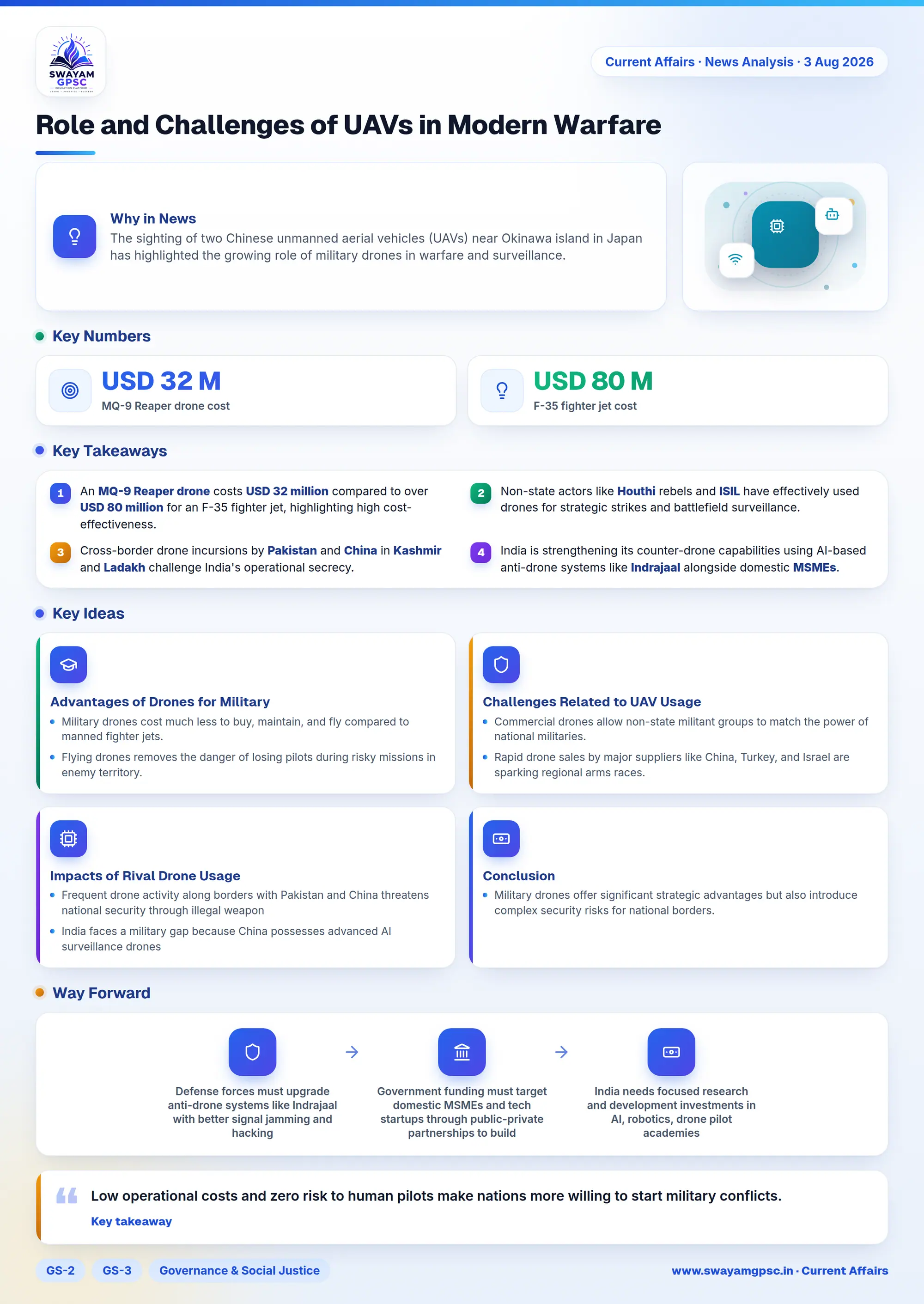
Key takeaways
- An MQ-9 Reaper drone costs USD 32 million compared to over USD 80 million for an F-35 fighter jet, highlighting high cost-effectiveness.
- Non-state actors like Houthi rebels and ISIL have effectively used drones for strategic strikes and battlefield surveillance.
- Cross-border drone incursions by Pakistan and China in Kashmir and Ladakh challenge India's operational secrecy.
- India is strengthening its counter-drone capabilities using AI-based anti-drone systems like Indrajaal alongside domestic MSMEs.
Why in News
- The sighting of two Chinese unmanned aerial vehicles (UAVs) near Okinawa island in Japan has highlighted the growing role of military drones in warfare and surveillance.
Advantages of Drones for Military Operations
- Military drones cost much less to buy, maintain, and fly compared to manned fighter jets. For example, an MQ-9 Reaper drone costs USD 32 million, whereas an F-35 fighter jet costs over USD 80 million.
- Flying drones removes the danger of losing pilots during risky missions in enemy territory. When Iran shot down an American drone over the Strait of Hormuz in 2019, the US avoided military escalation because no human pilot died.
- Drones can hover over war zones for long hours to collect real-time intelligence for commanders. Modern drones with AI technology can even identify and strike targets automatically without waiting for human approval.
- Drones provide high operational flexibility because forces can use them individually or in large swarms for intelligence gathering and precision bombing. During the Nagorno-Karabakh conflict, Azerbaijan used Turkish Bayraktar and kamikaze drones to defeat the Armenian army easily.
- Drones work exceptionally well in counter-terrorism operations where armed forces must eliminate specific targets without causing wider collateral damage. Countries like the US and Turkey frequently deploy drones across the Middle East and Africa to eliminate terrorist leaders.
- Operating drones requires far fewer resources compared to traditional air forces since they do not need massive airbases or complex pilot support systems. For instance, Russia quickly deployed Iranian Shahed-136 drones to weaken defenses across Ukraine.
Challenges Related to UAV Usage
- Low operational costs and zero risk to human pilots make nations more willing to start military conflicts. For example, the widespread use of American drones in the Ukraine conflict shows how easily countries can participate in foreign wars.
- Commercial drones allow non-state militant groups to match the power of national militaries. Houthi rebels used cheap drones to attack major Saudi oil plants, while ISIL used off-the-shelf drones for battlefield intelligence.
- Rapid drone sales by major suppliers like China, Turkey, and Israel are sparking regional arms races. American drone strikes conducted in Afghanistan from bases in Pakistan created severe political backlash and increased terror attacks inside Pakistan.
- Governments can hide their direct involvement in foreign attacks because drone strikes are hard to trace back immediately. Nations fuel proxy wars by supplying advanced UAVs to allied rebel groups while maintaining complete official deniability.
- Civilian deaths caused by inaccurate drone attacks create widespread anger among local populations. American drone strikes in the Middle East unintentionally pushed many local youths toward radical groups, making conflicts last much longer.
Impacts of Rival Drone Usage Against India
- Frequent drone activity along borders with Pakistan and China threatens national security through illegal weapon and drug smuggling. Enemy drones with AI capabilities monitor Indian troop positions in Kashmir and Ladakh, reducing India's operational secrecy.
- India faces a military gap because China possesses advanced AI surveillance drones, and Pakistan buys these systems from China. Although India built the Indrajaal anti-drone framework, overall defense preparation still lags behind Chinese capabilities.
- Electronic jamming and drone hacking incidents near border regions expose serious cybersecurity vulnerabilities in Indian defense systems. Protecting military communications against sophisticated electronic warfare continues to be a major hurdle.
- Buying foreign platforms like the American MQ-9B drone creates supply chain dependencies and limits true military self-reliance. Foreign supply lines can easily be cut during international crises or diplomatic disputes.
Way Forward
- Defense forces must upgrade anti-drone systems like Indrajaal with better signal jamming and hacking abilities. Military research should improve battery backup for high-altitude Himalayan conditions and expand trained eagles to catch low-flying enemy drones physically.
- Government funding must target domestic MSMEs and tech startups through public-private partnerships to build military drones locally. Developing physical countermeasures like specialized drone nets can safely disable flying enemy rotors mid-flight.
- India needs focused research and development investments in AI, robotics, drone pilot academies, and swarm technology. Developing high-altitude autonomous drones will ensure long-term aerial dominance along contested boundaries.
Conclusion
- Military drones offer significant strategic advantages but also introduce complex security risks for national borders. India must boost native manufacturing, upgrade anti-drone defenses, and invest in AI technologies to secure its airspace effectively.