Roadmap for a Resilient Indian Mineral Economy
#GS-3 #Economy #Infrastructure #GS-1 #Geography #Resources #GS-2 #Governance & Social Justice #Regulatory Bodies
Key takeaways
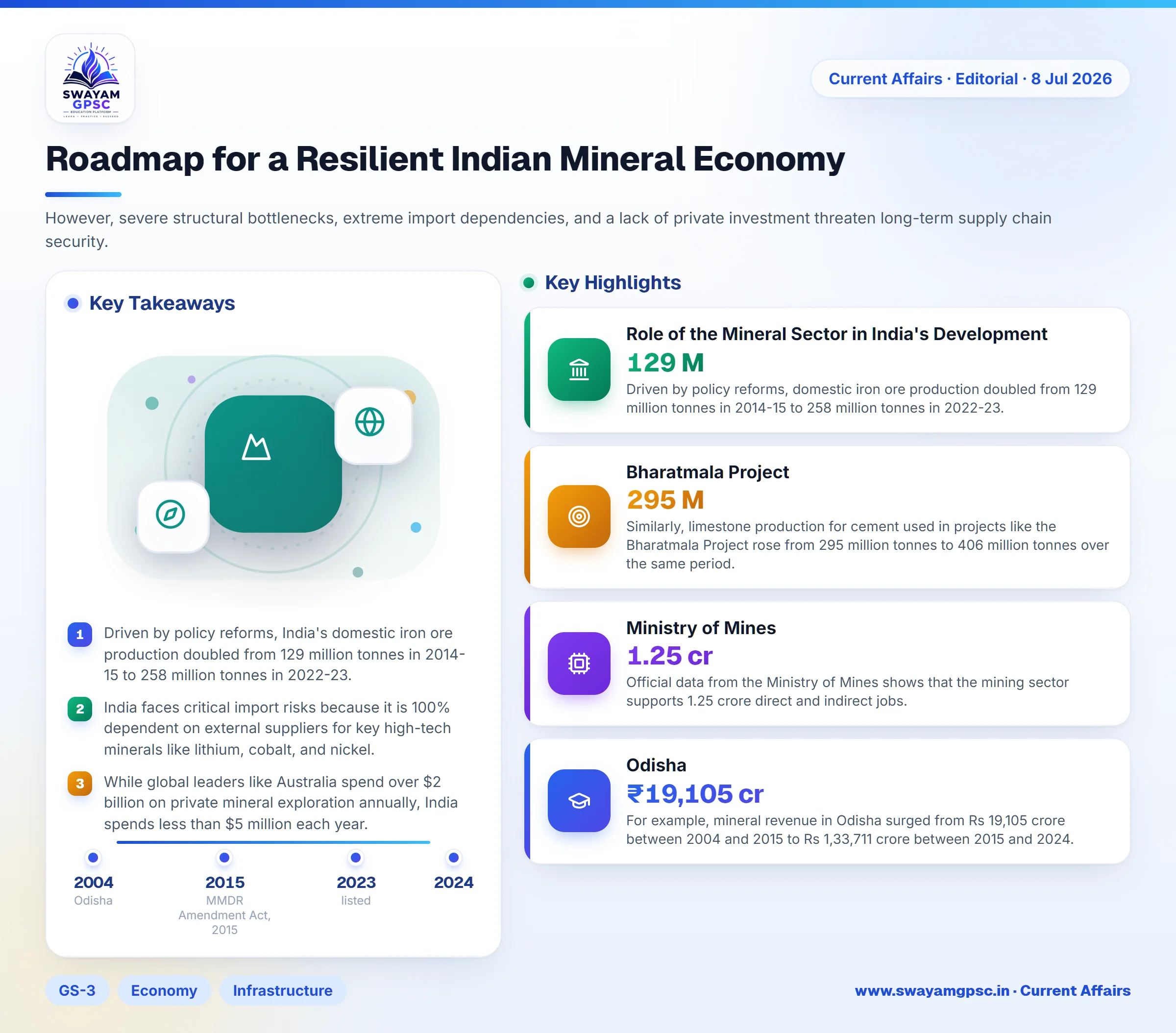
- Driven by policy reforms, India's domestic iron ore production doubled from 129 million tonnes in 2014-15 to 258 million tonnes in 2022-23.
- India faces critical import risks because it is 100% dependent on external suppliers for key high-tech minerals like lithium, cobalt, and nickel.
- While global leaders like Australia spend over $2 billion on private mineral exploration annually, India spends less than $5 million each year.
- To address resource scarcity, the government designated 24 critical minerals under the Mines and Minerals (Development and Regulation) Amendment Act, 2023 for exclusive central auctioning.
Why in News
- Experts suggest that India needs to redesign its current mining framework to attract private risk capital and eliminate heavy reliance on critical mineral imports.
- The nation must secure its high-tech manufacturing sector by offering tenure security and first-mover incentives instead of using rigid auction models.
- The mining sector serves as a vital economic pillar that drives infrastructure, employment, and fiscal revenue while supporting the clean energy transition.
- However, severe structural bottlenecks, extreme import dependencies, and a lack of private investment threaten long-term supply chain security.
- To build resilience, India must adopt advanced reforms such as Mining 4.0, deep-ocean harvesting, circular economic frameworks, and technology-driven resource substitution.
Role of the Mineral Sector in India's Development
- The domestic mineral sector provides critical raw materials to core upstream industries like iron, steel, power generation, and cement.
- India currently ranks as the 2nd largest producer of crude steel globally, which depends entirely on extracting domestic iron ore.
- Driven by policy reforms, domestic iron ore production doubled from 129 million tonnes in 2014-15 to 258 million tonnes in 2022-23.
- Similarly, limestone production for cement used in projects like the Bharatmala Project rose from 295 million tonnes to 406 million tonnes over the same period.
- Mining is highly labor-intensive, making it a powerful tool for socio-economic growth in rural and tribal regions that lack service sector jobs.
- Official data from the Ministry of Mines shows that the mining sector supports 1.25 crore direct and indirect jobs.
- Major mining clusters in resource-rich states like Odisha, Chhattisgarh, and Jharkhand create a localized multiplier effect where one direct job generates 10 indirect livelihoods.
- As India targets net-zero carbon goals, the mineral sector is shifting focus toward critical and deep-seated minerals needed for high-tech electronics and electric vehicles.
- The Mines and Minerals (Development and Regulation) Amendment Act, 2023 listed 24 critical and strategic minerals under Part D of the First Schedule.
- This legal amendment empowers the Central Government to exclusively auction mining leases and composite licenses to speed up domestic exploration.
- The new Exploration Licence framework channels private investment to map deep-seated deposits, like the lithium reserves discovered in Reasi, Jammu & Kashmir.
- Moving from administrative allocations to market-driven mechanisms has transformed the mineral sector into a massive revenue source for state governments.
- Following mandatory e-auctions introduced by the MMDR Amendment Act, 2015, the government has successfully auctioned over 385 major mineral blocks.
- For example, mineral revenue in Odisha surged from Rs 19,105 crore between 2004 and 2015 to Rs 1,33,711 crore between 2015 and 2024.
- The mining sector features an integrated social safety net designed to reduce local negative impacts and develop mining-affected regions.
- Under the Pradhan Mantri Khanij Kshetra Kalyan Yojana, statutory bodies called District Mineral Foundations collect a portion of royalties directly from miners.
- These local funds are legally mandated to be spent on drinking water, healthcare, education, and environmental restoration within the mining districts.
- These funds have successfully built regional healthcare units and piped water networks in backward districts like Sundargarh and Korba.
- A strong domestic mining industry protects India from global price volatility, supply chain shocks, and geopolitical tensions, supporting the Aatmanirbhar Bharat mission.
- The government removed end-use restrictions and allowed captive mines to sell up to 50% of their annual mineral production in the open market.
- Unlocking domestic merchant mining has significantly reduced import bills for non-coking coal, helping stabilize the nation's current account deficit.
- The concentrated nature of mineral wealth in India creates distinct regional economic engines, allowing resource-rich states to generate high industrial income.
- The Economic Survey 2024-25 highlights that the top five mineral states account for roughly 60% of the total mining Gross State Value Added.
- These five resource-rich states are Assam, Chhattisgarh, Gujarat, Maharashtra, and Odisha.
- These clusters act as geographic growth poles, attracting heavy capital expenditure, power grids, and dedicated logistics pipelines like freight corridors.
- To sustain economic expansion, the sector is driving the technological modernization of geological exploration, shifting focus from surface mining to deep-seated deposits.
- The Geological Survey of India has identified an Obvious Geological Potential area of 6.88 lakh sq. km.
- The government launched the National Geoscience Data Repository portal to integrate legacy data with baseline geoscience maps.
- Funded by the National Mineral Exploration Trust, strategic mineral exploration projects increased from 251 in 2021-22 to 450 projects to uncover hidden resources.
Challenges in India's Mineral Supply Chain
- While India has large deposits of bulk commodities like iron ore, it lacks critical electrochemical minerals needed for clean energy and electric vehicles.
- India is 100% import-dependent for key minerals like lithium, cobalt, and nickel, creating high strategic vulnerabilities.
- Furthermore, six essential minerals including bismuth, lithium, silicon, titanium, tellurium, and graphite have import dependency rates over 40%.
- Despite discovering 5.9 million tonnes of inferred lithium resources in Reasi, Jammu & Kashmir, the project remains stalled in early exploration.
- India faces systemic risks because global mineral mining and processing are concentrated in just a few nations, exposing industries to export controls.
- The Lithium Triangle, consisting of Chile, Argentina, and Bolivia, along with Australia, accounts for over 75% of global lithium extraction.
- The Democratic Republic of the Congo controls over 70% of global cobalt mining, while nickel extraction is concentrated in Indonesia and the Philippines.
- China controls over 90% of global rare earth processing, 95% of graphite processing, and 79% of refined cobalt production, creating geoeconomic risks.
- Moving millions of tonnes of bulk minerals from eastern mining belts to western and southern industrial hubs strains India's transport infrastructure.
- A study by NITI Aayog on rail freight shows that bulk commodities like coal and iron ore make up over 60% of total rail freight traffic.
- Logistical delays often deplete power plant stocks because rail transit times lag 2 to 3 days behind road transport due to wagon delays.
- Moving minerals from pits to ports or mines to sidings relies on high-cost, polluting road trucks instead of automated transit networks.
- The Smart Coal Logistics Plan from the Ministry of Coal highlights that smaller mines lack enclosed conveyor belts and rapid loading systems.
- This absence of automated systems leads to mineral leakage, environmental fines, and severe multi-modal handling delays.
- There is a large gap in domestic exploration funding, as private sector spending on mineral exploration in India is under $5 million annually.
- In contrast, countries like Australia and Canada each see more than $2 billion in annual private exploration spending.
- Frontier exploration requires years of high-risk geological investigation, but India lacks a framework to attract private risk capital.
- India relies on an auction process to award exploration licenses, which works for proven reserves but fails to attract interest in unproven lands.
- If a private explorer finds a deposit, the government retakes the area to auction the lease, making companies risk losing their mining rights.
- India has not yet built a strong secondary supply chain to recover critical minerals from scrap metal, industrial slag, and electronic waste.
- Currently, India recycles less than 5% of its total e-waste and end-of-life vehicle batteries through formal technology channels.
- The remaining waste goes to the informal sector where primitive burning destroys valuable traces of cobalt, neodymium, and rare earth elements.
Way Forward
- When land-based reserves are limited, the ocean floor offers an untapped frontier, especially the Central Indian Ocean Basin which holds critical minerals.
- India must accelerate the commercialization of its Samudrayaan Mission using the indigenous deep-submergence vehicle called Matsya 6000.
- These sea nodules contain high concentrations of nickel, cobalt, copper, and manganese to secure domestic energy needs.
- By using artificial intelligence and quantum computing, India can design alternative materials using abundant domestic elements.
- The Ministry of Science and Technology can set up a Materials Genome Cell to discover high-performance alternatives to scarce inputs.
- Indian companies are already developing sodium-ion batteries and rare earth-free permanent magnets to replace lithium-ion systems.
- India can deploy bio-metallurgy, using micro-organisms to extract metals, and phytomining, using hyperaccumulating plants to absorb metals through roots.
- Applying bio-leaching to slag dumps at Hindustan Copper Limited or old gold tailings at Kolar Gold Fields can recover copper and zinc.
- The government can introduce a regulatory framework for Mineral-as-a-Service to keep ownership rights with a national consortium.
- Under this model, minerals are leased to manufacturers, and the physical material must return to refining centers at the end of its life.
- The Ministry of Finance and the Reserve Bank of India can set up a Sovereign Mineral Hedging Fund to manage price risks.
- By locking in prices on international exchanges 3 to 5 years in advance, India can protect its manufacturing sector from price spikes.
- India should mandate the integration of digital twins, which are real-time virtual replicas of physical mining operations, powered by IoT sensors.
- State-run firms like Coal India and the National Mineral Development Corporation can use these models to optimize blast patterns and monitor ore grades.
Conclusion
- Moving India's industrial growth forward requires shifting from simple surface extraction to an integrated, technology-driven resource strategy.
- By bridging the private exploration risk-capital gap and adopting deep-ocean mining, India can successfully secure its mineral supply chains.
Frequently Asked Questions
- The MMDR Amendment Act, 2023 designated 24 critical and strategic minerals under Part D of the First Schedule to allow exclusive central auctions.
- District Mineral Foundations support local communities by funding healthcare, clean drinking water, and environmental restoration in mining areas.
- India is vulnerable because it relies on imports for 100% of its lithium, cobalt, and nickel, exposing it to geopolitical supply chain shocks.