The Roadmap to Make Green Urea Production a Reality
#GS-3 #Economy #Agriculture #Infrastructure #Environment #Sustainable Development #Science & Technology #Energy
Key takeaways
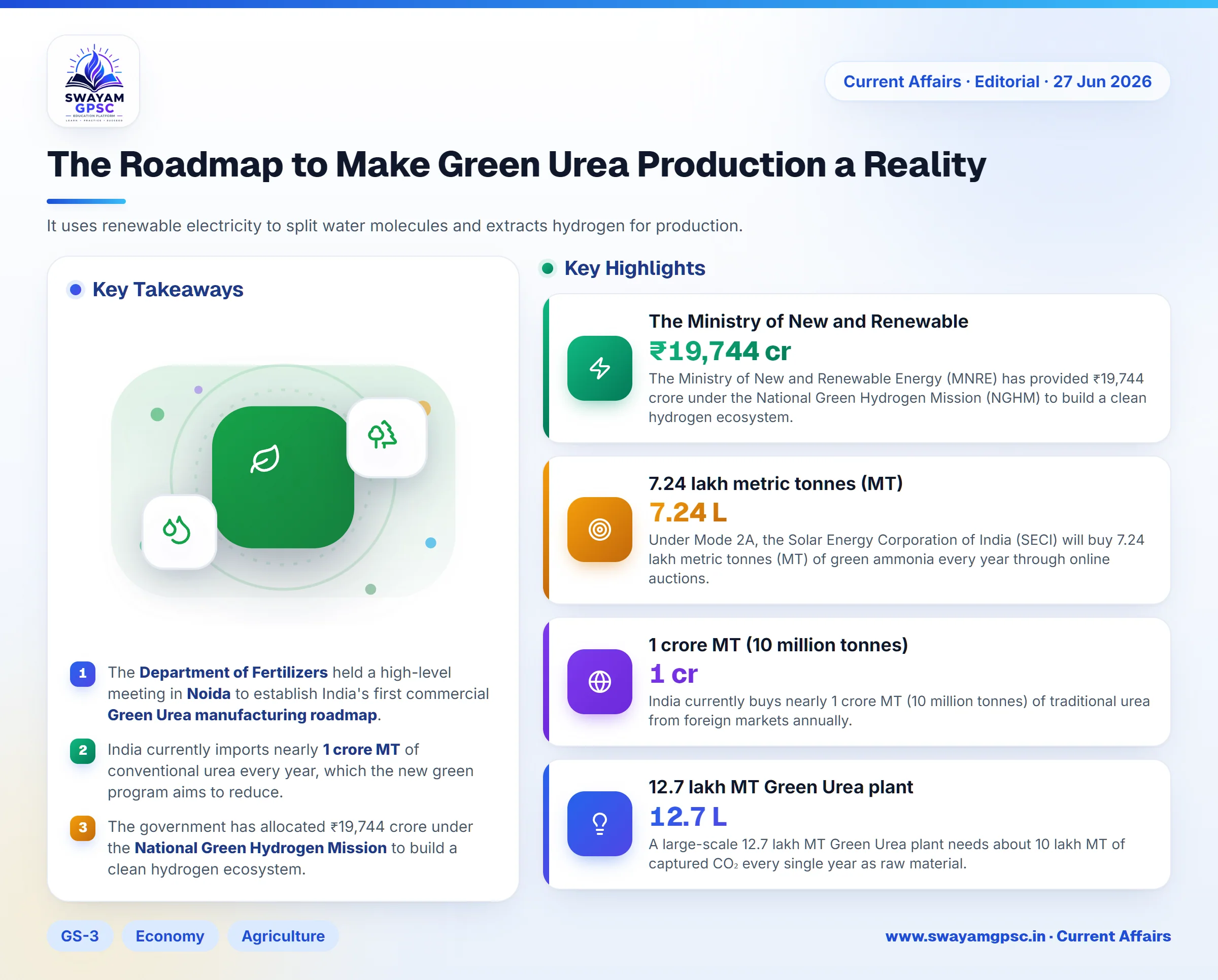
- The Department of Fertilizers held a high-level meeting in Noida to establish India's first commercial Green Urea manufacturing roadmap.
- India currently imports nearly 1 crore MT of conventional urea every year, which the new green program aims to reduce.
- The government has allocated ₹19,744 crore under the National Green Hydrogen Mission to build a clean hydrogen ecosystem.
- A world-scale 12.7 lakh MT Green Urea plant requires about 10 lakh MT of captured CO₂ annually as feedstock.
- The state provides financial certainty through 10-year binding Green Ammonia Procurement Agreements (GAPA).
Why in News
- The Department of Fertilizers (DoF) recently held a high-level meeting at the PDIL headquarters in Noida.
- Officials gathered to plan India’s first commercial Green Urea manufacturing roadmap.
About Green Urea
- Green Urea is a sustainable fertilizer made using green hydrogen and green ammonia instead of fossil fuels.
- It uses renewable electricity to split water molecules and extracts hydrogen for production.
- Manufacturers combine this hydrogen with atmospheric nitrogen and captured industrial CO₂ to build eco-friendly fertilizer.
Key Data and Statistics
- The Ministry of New and Renewable Energy (MNRE) has provided ₹19,744 crore under the National Green Hydrogen Mission (NGHM) to build a clean hydrogen ecosystem.
- Under Mode 2A, the Solar Energy Corporation of India (SECI) will buy 7.24 lakh metric tonnes (MT) of green ammonia every year through online auctions.
- India currently buys nearly 1 crore MT (10 million tonnes) of traditional urea from foreign markets annually.
- A large-scale 12.7 lakh MT Green Urea plant needs about 10 lakh MT of captured CO₂ every single year as raw material.
The Imperative Need for a Roadmap
- Traditional fertilizer production releases huge amounts of carbon.
- Shifting to green processes helps India reach its target of net-zero emissions by 2070.
- Many domestic chemical plants are over 30 years old and need massive upgrades or complete replacements.
- Integrated fertilizer hubs provide a ready market for factories to sell their captured carbon dioxide (CCUS).
- Local production protects Indian farmers from wild price jumps in foreign natural gas and shipping delays.
Key Initiatives Taken So Far
- NETRA, the research wing of NTPC, built the Pudimadaka 150-TPD Pilot Plant in Andhra Pradesh.
- This 150 tonnes-per-day facility sets a benchmark by combining water electrolysis with carbon reuse.
- Under the Offtaker-Side Differential Subsidy, SECI buys green ammonia and sells it to factories at standard market prices while the DoF pays the cost difference.
- The government guarantees financial support for 10 years through binding Green Ammonia Procurement Agreements (GAPA).
- The ministry launched the Srijan and Srijan DEEP digital registries to connect local technology providers and equipment makers.
Challenges
- Green ammonia costs much more to manufacture than standard grey ammonia because renewable power and electrolyzers are expensive.
- Transporting 10 lakh MT of CO₂ from scattered factories to a central hub requires a massive, complex pipeline network.
- Wind and solar power change constantly, making it hard to run a continuous chemical plant without costly battery storage.
- Retrofitting three-decade-old fertilizer plants to use pure green hydrogen requires huge financial investments.
Way Forward
- The government must quickly execute SECI reverse auctions to secure clean feedstock for investors.
- Authorities should build carbon capture hubs near industrial clusters to ensure a steady supply of CO₂.
- Financial institutions like the Sagarmala Finance Corporation Limited should offer low-cost loans for clean fertilizer projects.
- The state must build high-voltage green energy corridors to supply uninterrupted power directly to manufacturing plants.
Conclusion
- Investing ₹19,744 crore alongside smart subsidies protects local industries from early financial shocks.
- Expanding carbon networks and clean hydrogen hubs will reduce imports and secure India's farming future before 2070.