Revising India's Outdated Census Town Classification Criteria
#GS-3 #Geography #Population #GS-2 #Governance & Social Justice #Good Governance #Current Events #National #Census Town #Urbanisation
Key takeaways
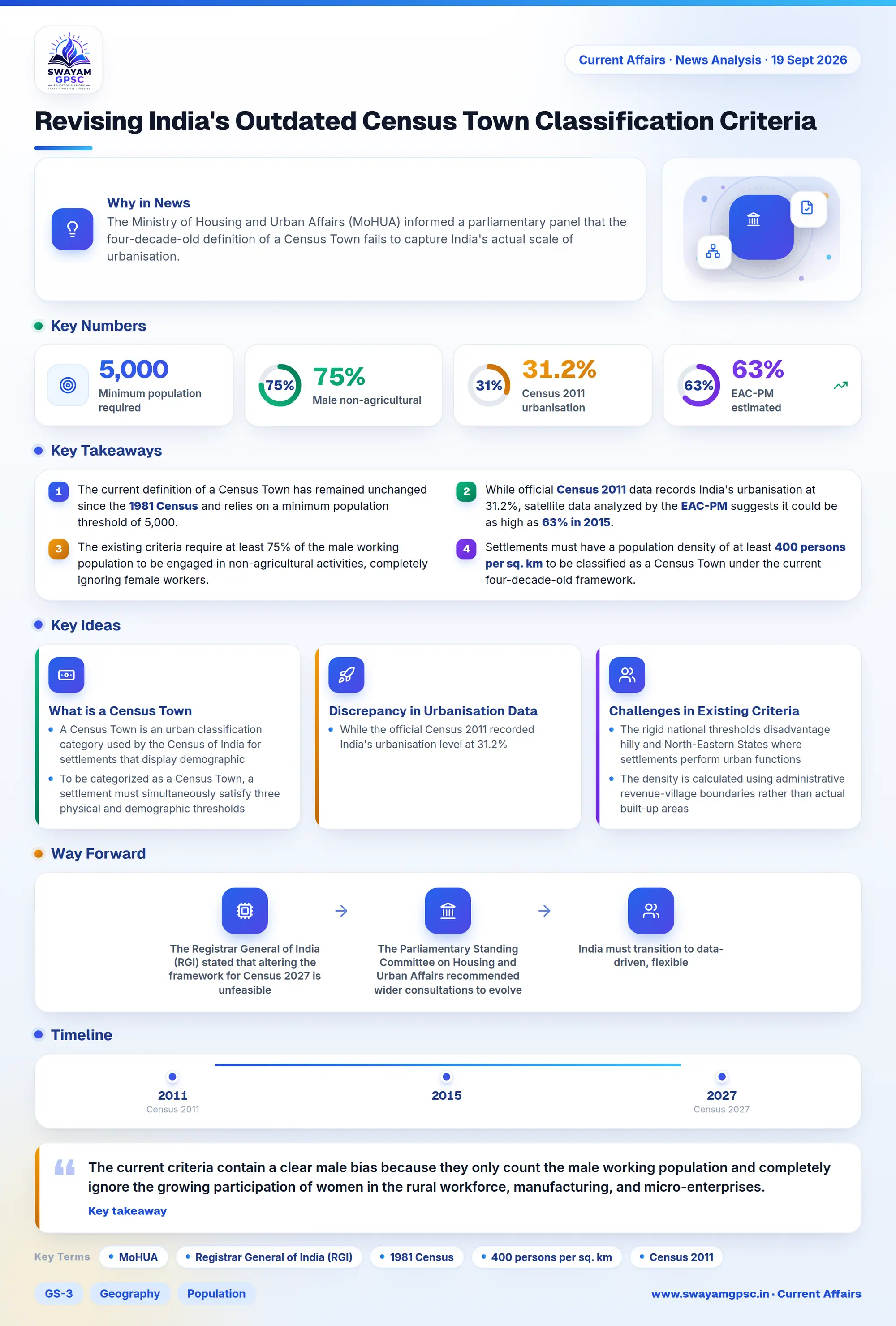
- The current definition of a Census Town has remained unchanged since the 1981 Census and relies on a minimum population threshold of 5,000.
- While official Census 2011 data records India's urbanisation at 31.2%, satellite data analyzed by the EAC-PM suggests it could be as high as 63% in 2015.
- The existing criteria require at least 75% of the male working population to be engaged in non-agricultural activities, completely ignoring female workers.
- Settlements must have a population density of at least 400 persons per sq. km to be classified as a Census Town under the current four-decade-old framework.
- The Parliamentary Standing Committee has recommended wider consultations to update these metrics before future census exercises like Census 2027.
Why in News
- The Ministry of Housing and Urban Affairs (MoHUA) informed a parliamentary panel that the four-decade-old definition of a Census Town fails to capture India's actual scale of urbanisation.
- The ministry highlighted the urgent need to replace outdated classification metrics with modern, data-driven approaches.
- The ministry informed the Parliamentary Standing Committee that the criteria used by the Registrar General of India (RGI) to classify these towns are outdated and fail to reflect India's actual urban transformation.
What is a Census Town
- A Census Town is an urban classification category used by the Census of India for settlements that display demographic and economic characteristics of an urban area but continue to be administered as rural settlements under Panchayati Raj institutions.
- To be categorized as a Census Town, a settlement must simultaneously satisfy three physical and demographic thresholds unchanged since the 1981 Census, starting with a minimum population of 5,000 persons.
- At least 75% of the male main working population must be engaged in non-agricultural pursuits.
- The settlement must have a population density of at least 400 persons per sq. km.
Discrepancy in Urbanisation Data
- While the official Census 2011 recorded India's urbanisation level at 31.2%, satellite data analyzed by the Economic Advisory Council to the Prime Minister (EAC-PM) estimates that the actual urbanisation level could be as high as 63% in 2015.
Challenges in Existing Criteria
- The current criteria contain a clear male bias because they only count the male working population and completely ignore the growing participation of women in the rural workforce, manufacturing, and micro-enterprises.
- The rigid national thresholds disadvantage hilly and North-Eastern States where settlements perform urban functions despite having smaller populations and lower densities.
- The density is calculated using administrative revenue-village boundaries rather than actual built-up areas, which artificially lowers the apparent density and causes compact settlements to be misclassified as rural.
- The rigid rural-urban binary overlooks peri-urban growth corridors, ribbon development, and regional economic diversity, leading to a massive underestimation of India's urban footprint.
Implications of Outdated Classification
- Rapidly urbanising settlements remain under Panchayats, which lack the municipal staff, planning powers, and building regulations needed to manage urban growth.
- These settlements miss out on urban funding while rural funds remain highly insufficient for building complex infrastructure like sewerage, piped water, and public transport.
- The lack of municipal master planning encourages haphazard construction, wetland encroachment, poor waste management, and vulnerable peripheral settlements.
Way Forward
- The Registrar General of India (RGI) stated that altering the framework for Census 2027 is unfeasible because field deployment and enumeration blocks are already finalized, but future digital censuses can explore updated parameters.
- The Parliamentary Standing Committee on Housing and Urban Affairs recommended wider consultations to evolve updated criteria for future census exercises.
- India must transition to data-driven, flexible, and gender-inclusive metrics to capture the true scale of its urban transition and ensure planned development.