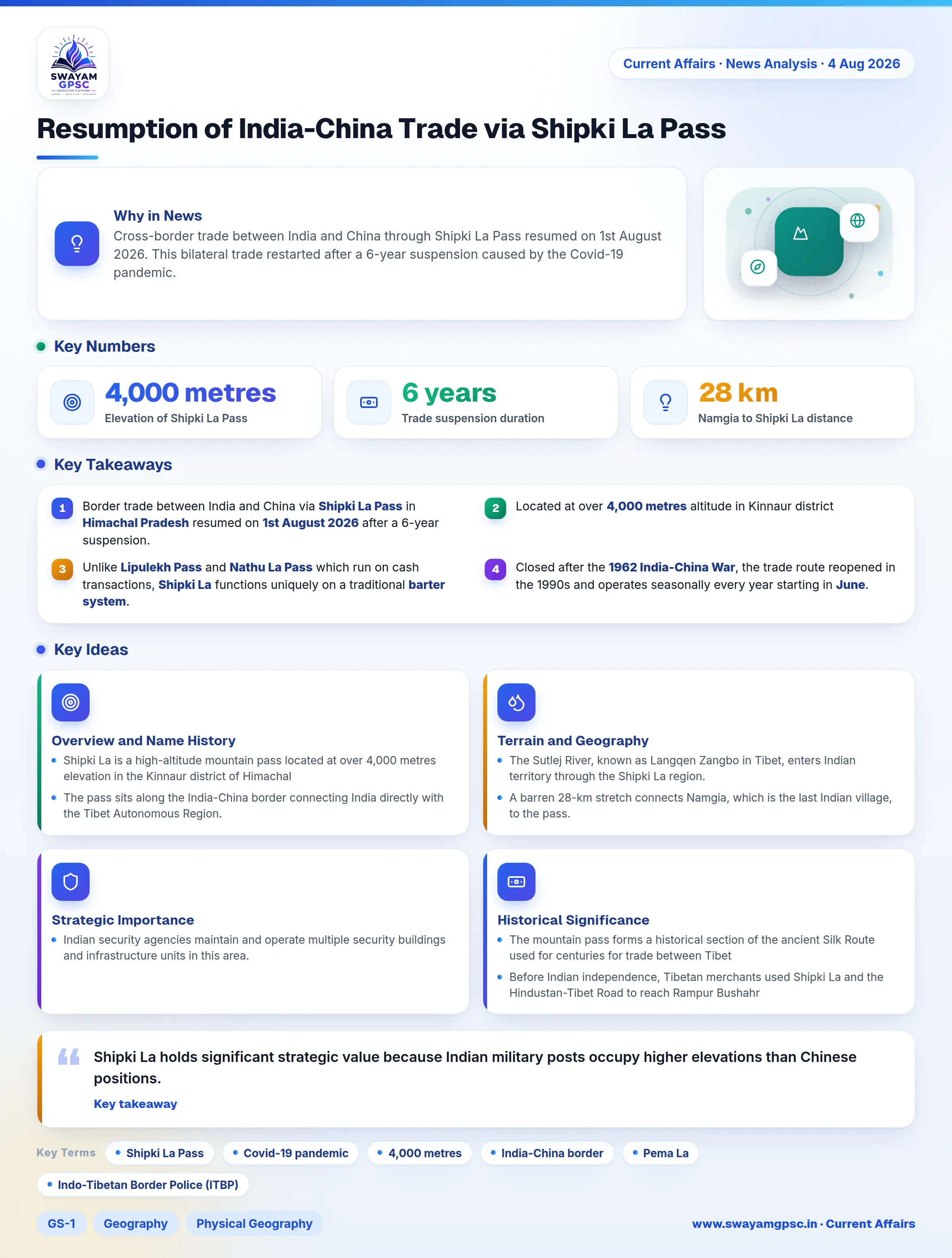
Resumption of India-China Trade via Shipki La Pass
#GS-1 #Geography #Physical Geography #GS-3 #Current Events #National #International
Key takeaways
- Border trade between India and China via Shipki La Pass in Himachal Pradesh resumed on 1st August 2026 after a 6-year suspension.
- Located at over 4,000 metres altitude in Kinnaur district, Shipki La is the geographical entry point of the Sutlej River into India from Tibet.
- Unlike Lipulekh Pass and Nathu La Pass which run on cash transactions, Shipki La functions uniquely on a traditional barter system.
- Closed after the 1962 India-China War, the trade route reopened in the 1990s and operates seasonally every year starting in June.
Why in News
- Cross-border trade between India and China through Shipki La Pass resumed on 1st August 2026.
- This bilateral trade restarted after a 6-year suspension caused by the Covid-19 pandemic.
Overview and Name History
- Shipki La is a high-altitude mountain pass located at over 4,000 metres elevation in the Kinnaur district of Himachal Pradesh.
- The pass sits along the India-China border connecting India directly with the Tibet Autonomous Region.
- Traders previously referred to this mountain route as Pema La or Shared Gate.
- The Indo-Tibetan Border Police (ITBP) formally renamed the route Shipki La following the 1962 border conflict.
Terrain and Geography
- The Sutlej River, known as Langqen Zangbo in Tibet, enters Indian territory through the Shipki La region.
- A barren 28-km stretch connects Namgia, which is the last Indian village, to the pass.
- Severe snowfall during winter months completely blocks the pass and cuts off traffic.
Strategic Importance
- Shipki La holds significant strategic value because Indian military posts occupy higher elevations than Chinese positions.
- Indian security agencies maintain and operate multiple security buildings and infrastructure units in this area.
Historical Significance
- The mountain pass forms a historical section of the ancient Silk Route used for centuries for trade between Tibet and Himachal Pradesh.
- Before Indian independence, Tibetan merchants used Shipki La and the Hindustan-Tibet Road to reach Rampur Bushahr for the annual Lavi Fair.
Trade Dynamics and Barter System
- Border trade stopped after the 1962 India-China War and restarted in the early 1990s following a formal bilateral agreement.
- Trading activity occurs seasonally for a few months starting every June once snow melts from the pass.
- Imports into India mainly consist of wool, livestock, yak products, religious items, and various minerals.
- Exports from India include food grains, spices, tobacco products, timber, and metal tools.
- Shipki La is unique among border trading points because merchants conduct trade through a traditional barter system instead of using money.
- In contrast, trade through Lipulekh Pass in Uttarakhand and Nathu La Pass in Sikkim relies on standard currency transactions.