Resetting India-China Economic and Strategic Ties
#GS-2 #India and its Neighbourhood #Groupings & Agreements Involving India and/or Affecting India's Interests #Effect of Policies & Politics of Countries on India's Interests #Economy #Infrastructure #Environment #International
Key takeaways
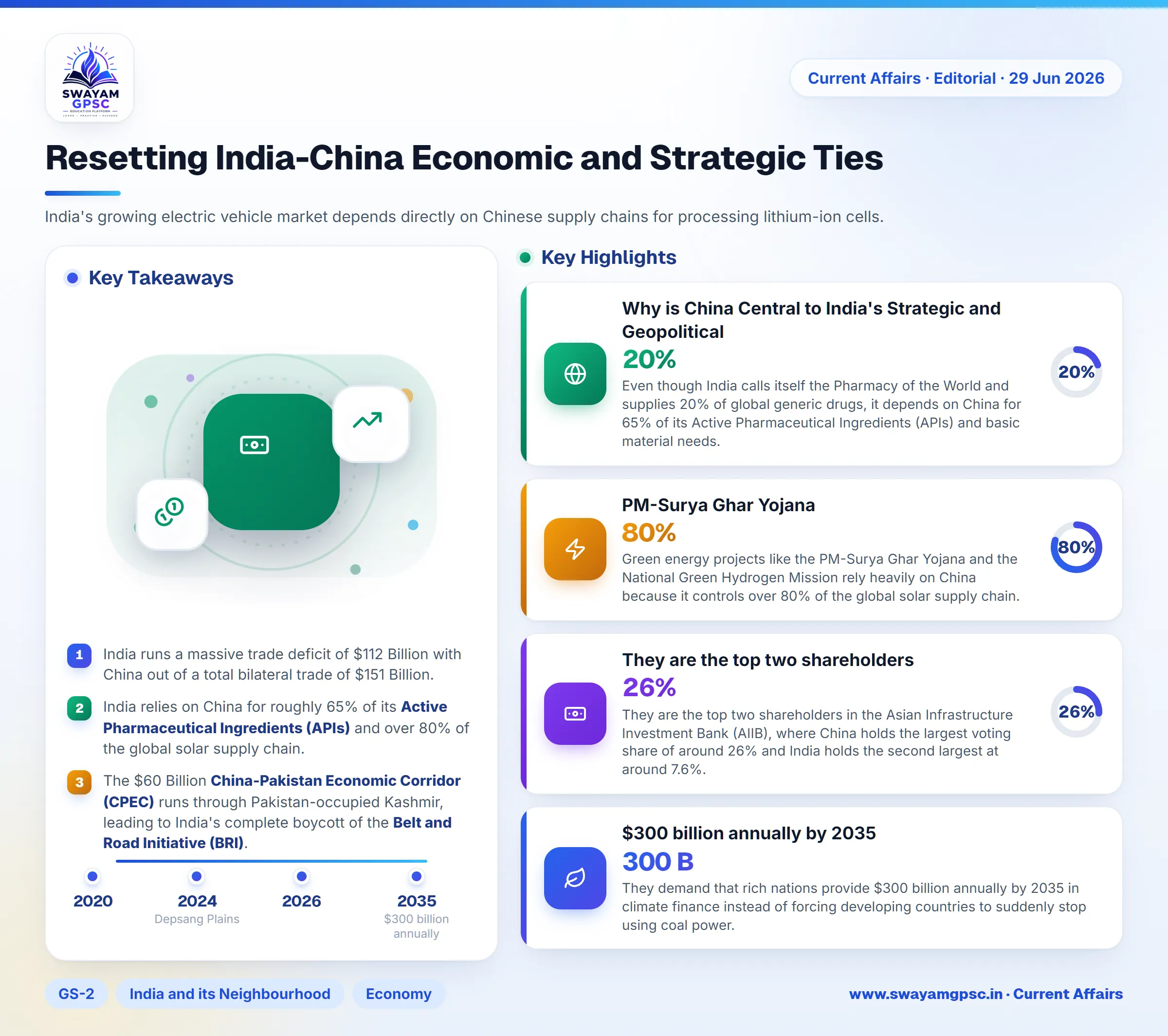
- India runs a massive trade deficit of $112 Billion with China out of a total bilateral trade of $151 Billion.
- India relies on China for roughly 65% of its Active Pharmaceutical Ingredients (APIs) and over 80% of the global solar supply chain.
- The $60 Billion China-Pakistan Economic Corridor (CPEC) runs through Pakistan-occupied Kashmir, leading to India's complete boycott of the Belt and Road Initiative (BRI).
- China remains the only permanent member of the UNSC that blocks India from securing a permanent seat.
Introduction
- Recent high-level meetings between India and China show signs of a shift toward economic talks rather than only focusing on border disputes.
- Despite military tensions and uneven trade, both countries agree on key global issues like moving away from the US dollar, fighting climate change, and cooperating on security.
- Fixing the relationship requires smart economic engagement, permanent peace rules along the border, and teamwork in energy and technology.
Why is China Central to India's Strategic and Geopolitical Calculus?
- Even though India calls itself the Pharmacy of the World and supplies 20% of global generic drugs, it depends on China for 65% of its Active Pharmaceutical Ingredients (APIs) and basic material needs.
- Green energy projects like the PM-Surya Ghar Yojana and the National Green Hydrogen Mission rely heavily on China because it controls over 80% of the global solar supply chain.
- India's growing electric vehicle market depends directly on Chinese supply chains for processing lithium-ion cells.
- Both India and China want to change the current financial system to reduce Western control over global credit and funding.
- They are the top two shareholders in the Asian Infrastructure Investment Bank (AIIB), where China holds the largest voting share of around 26% and India holds the second largest at around 7.6%.
- BRICS countries are exploring the use of local currencies or a new currency to bypass the US dollar.
- This de-dollarization effort helps countries avoid US financial penalties, such as Russia and Iran being blocked from the SWIFT network.
- As major developing nations, India and China take the same side in climate negotiations.
- They push back against Western emission limits that could slow down their industrial growth.
- Working through the BASIC bloc, both countries strongly support the principle of Common but Differentiated Responsibilities (CBDR) under the UNFCCC Paris Agreement 2015.
- They demand that rich nations provide $300 billion annually by 2035 in climate finance instead of forcing developing countries to suddenly stop using coal power.
- Both nations use the Shanghai Cooperation Organisation (SCO) to maintain regional stability and fight cross-border threats.
- India works with China in the Regional Anti-Terrorist Structure (RATS) of the SCO.
- This teamwork involves sharing intelligence and holding anti-terror drills to stop violence from spreading into Jammu & Kashmir or Xinjiang.
- Both countries rely heavily on vital shipping routes and sea lanes like the Strait of Hormuz, the Strait of Malacca, and the Bab-el-Mandeb Strait.
- They share a strong interest in keeping West Asia stable because it supplies most of their crude oil needs.
- India and China have vital agreements to share river water data during the monsoon season for the Brahmaputra and Sutlej rivers.
- This data helps India act early against floods in its northeastern states.
- Cultural ties continue through border trade points like Nathu La and organized events like the Kailash Mansarovar Yatra.
What are the Key Areas of Divergence between India and China?
- The 3,488 km Line of Actual Control (LAC) remains the most dangerous trigger for military conflict.
- Even though the October 2024 Border Patrol Agreement restored patrolling rights in the Depsang Plains and Demchok, deep military tension remains.
- Important friction points like the Galwan Valley, Pangong Tso, and Hot Springs remain inside heavily guarded buffer zones.
- Trade data shows China is India's largest trading partner with bilateral trade reaching around $151 Billion in 2025-26, but India's trade deficit hit a record high of around $112 Billion.
- A report by the Economic Advisory Council to the Prime Minister (EAC-PM) noted that Indian exporters face unfair trade rules and non-tariff barriers in China.
- The $60 Billion China-Pakistan Economic Corridor (CPEC) runs through Pakistan-occupied Kashmir, causing India to officially boycott the Belt and Road Initiative (BRI).
- India views Chinese weapons supplies to Pakistan as part of a dangerous two-front military threat.
- Competition between the two nations has spread from the Himalayas into the Indian Ocean Region.
- India worries about China's String of Pearls strategy, which includes ports like Hambantota, Gwadar, and a military base in Djibouti.
- India uses its Necklace of Diamonds strategy to counter this encirclement.
- The Indian Navy closely watches Chinese tracking ships, such as the Yuan Wang class, when they dock in the Indian Ocean.
- China's building of massive dams on the Tibetan Plateau threatens India's water security downstream.
- India fears China could use water control to cause sudden floods in Assam and Arunachal Pradesh.
- China has previously stopped sharing monsoon river data during border tensions, such as during the Doklam standoff in 2017.
- China is the only permanent member of the United Nations Security Council (UNSC) that blocks India from getting a permanent seat.
- China also stops India from joining the Nuclear Suppliers Group (NSG) by using the consensus rule.
- China uses its financial power in South Asian nations like the Maldives, Nepal, and Bangladesh to reduce India's regional influence.
- In June 2026, Bangladesh's Prime Minister bypassed India to visit Malaysia and China first.
- Since June 2020, India has banned over 300 Chinese mobile apps to protect its data security after border clashes.
What Measures can India Adopt to Strengthen its Ties with China?
- India can allow Chinese investments only if those firms partner with local companies to set up factories under Production Linked Incentive (PLI) schemes.
- This forces Chinese companies to make goods inside India, helps local workers learn advanced skills, and reduces the trade deficit.
- Both nations should restart the India-China Strategic Economic Dialogue (SED) which has been frozen since 2020.
- India and China need to set up a strict timeline and framework to disengage troops and build trust along the LAC.
- The Indian Navy and the Chinese Navy should negotiate an Incidents at Sea (INCSEA) agreement to prevent accidents between warships in the Indian Ocean.
- Both countries should create a joint research center to study melting Himalayan glaciers and manage natural disasters like Glacial Lake Outburst Floods (GLOFs).
- India and China can form an Asian energy buyers group to negotiate better oil prices and avoid extra charges from OPEC.
- They can pilot a trading corridor linking the Digital Rupee and the Digital Yuan for non-strategic goods to bypass the SWIFT payment system.
Conclusion
- The relationship between India and China is at a very important turning point.
- Solving border problems, reviving economic talks, and working together on climate issues can turn this rivalry into a stable partnership.