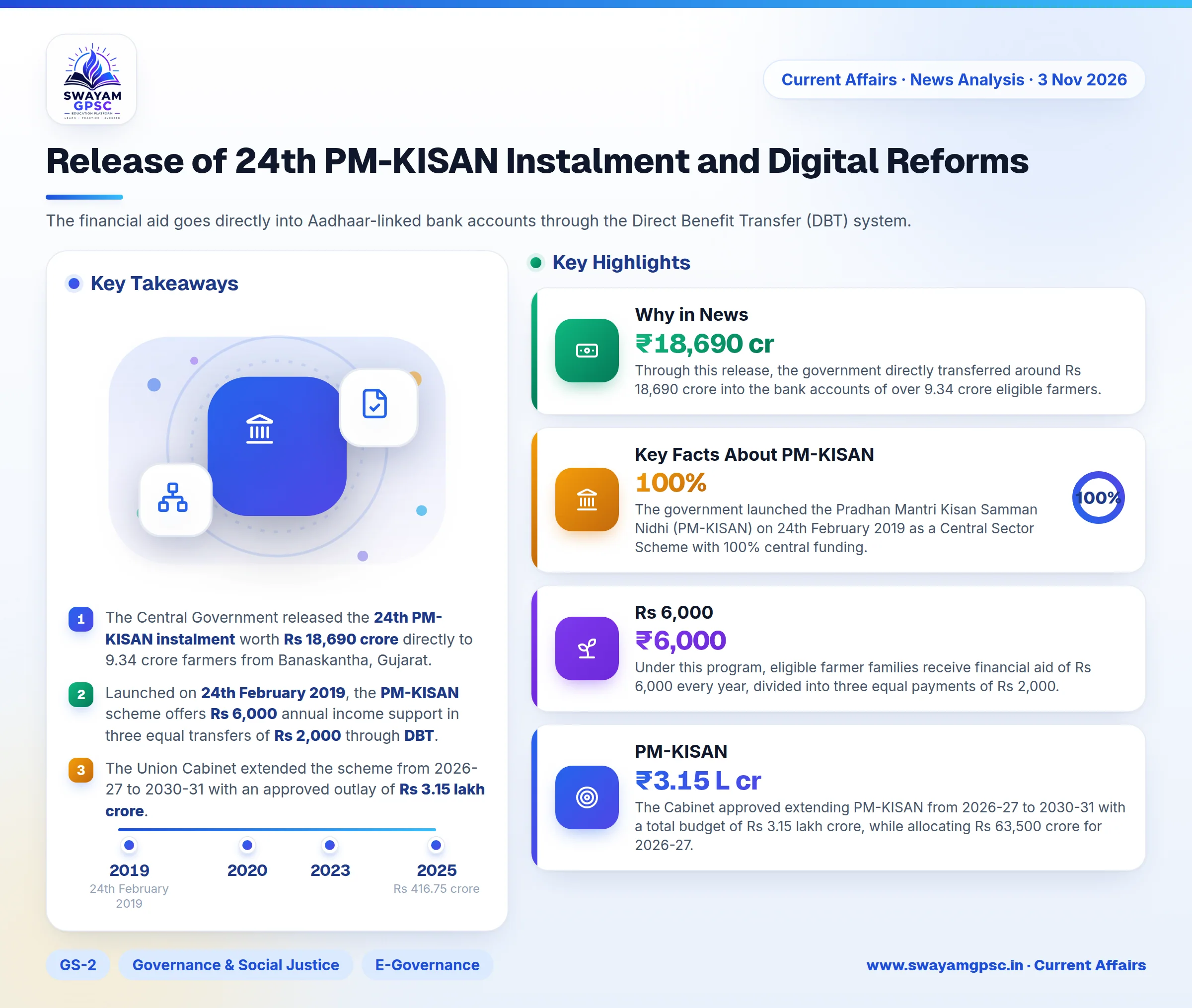
Release of 24th PM-KISAN Instalment and Digital Reforms
#GS-2 #Governance & Social Justice #E-Governance #Welfare Schemes #GS-3 #Economy #Agriculture #Government Policies & Interventions
Key takeaways
- The Central Government released the 24th PM-KISAN instalment worth Rs 18,690 crore directly to 9.34 crore farmers from Banaskantha, Gujarat.
- Launched on 24th February 2019, the PM-KISAN scheme offers Rs 6,000 annual income support in three equal transfers of Rs 2,000 through DBT.
- The Union Cabinet extended the scheme from 2026-27 to 2030-31 with an approved outlay of Rs 3.15 lakh crore.
- Digital tools like the Kisan-eMitra AI chatbot, launched in September 2023, provide assistance in 11 languages to enhance accessibility.
- Authorities recovered Rs 416.75 crore from ineligible beneficiaries up to December 2025 to ensure system transparency.
Why in News
- The Central Government recently released the 24th instalment of the PM-KISAN scheme during an event held in Banaskantha, Gujarat.
- Through this release, the government directly transferred around Rs 18,690 crore into the bank accounts of over 9.34 crore eligible farmers.
Key Facts About PM-KISAN
- The government launched the Pradhan Mantri Kisan Samman Nidhi (PM-KISAN) on 24th February 2019 as a Central Sector Scheme with 100% central funding.
- Although launched in early 2019, the scheme's operations officially began retrospectively from 1st December 2018.
- The Ministry of Agriculture and Farmers Welfare oversees the scheme's execution through its Department of Agriculture and Farmers Welfare.
- Under this program, eligible farmer families receive financial aid of Rs 6,000 every year, divided into three equal payments of Rs 2,000.
- The financial aid goes directly into Aadhaar-linked bank accounts through the Direct Benefit Transfer (DBT) system.
- The initiative covers landholding farmer families with cultivable land, where a family unit consists of husband, wife, and minor children.
- This financial assistance helps small and marginal farmers cover seasonal crop expenses, buy seeds and fertilizers, and support everyday household needs.
- State and Union Territory governments verify local land records to identify eligible farmers, while the Central Government provides the money directly.
- To get these payments, farmers must link their land records, seed their bank accounts with Aadhaar, and complete e-KYC verification.
- The Cabinet approved extending PM-KISAN from 2026-27 to 2030-31 with a total budget of Rs 3.15 lakh crore, while allocating Rs 63,500 crore for 2026-27.
- Institutional landholders, constitutional post holders, political leaders, and serving or retired government employees cannot join the scheme, though Group D and multi-tasking staff remain eligible.
- Taxpayers, pensioners getting over Rs 10,000 monthly, and working professionals like doctors, lawyers, engineers, and chartered accountants are excluded.
- Local authorities display beneficiary lists in villages to maintain openness, and governments actively recover money paid to unqualified applicants.
- By December 2025, authorities had successfully recovered Rs 416.75 crore from ineligible individuals.
- Committees at national, state, and district levels monitor the scheme's execution, with the Cabinet Secretary heading the central review body.
- Farmers facing issues can submit grievances online through the official portal or the CPGRAMS platform.
Key Digital Initiatives Supporting PM-KISAN
- The central portal and mobile application serve as a single digital platform to record beneficiary details, verify eligibility, and monitor payments.
- Launched in 2020, the mobile app allows farmers to register themselves, track payment dates, and complete e-KYC without visiting government offices.
- In 2023, the ministry introduced face recognition feature in the mobile app, allowing e-KYC verification using a simple smartphone camera scan.
- The government launched the Kisan-eMitra artificial intelligence chatbot in September 2023 to answer farmer queries about registration and payment status.
- Technical teams built this AI tool with support from the EkStep Foundation and Digital India BHASHINI.
- The chatbot offers continuous voice and text assistance in 11 languages, making digital welfare access easy for rural communities.
- Mandatory Aadhaar authentication and e-KYC checks help eliminate duplicate entries and stop fake claims.
- Connecting the database with the Public Financial Management System (PFMS) ensures swift and traceable electronic transfers.
- Digital record-keeping improves governance standards, making data verification efficient across all states and Union Territories.
Conclusion
- Releasing the 24th instalment underlines how regular direct cash support protects agricultural income and improves financial stability in rural India.
- Updating land records, improving digital connectivity, resolving farmer complaints quickly, and expanding benefits to all eligible families will make this agricultural support system sustainable.