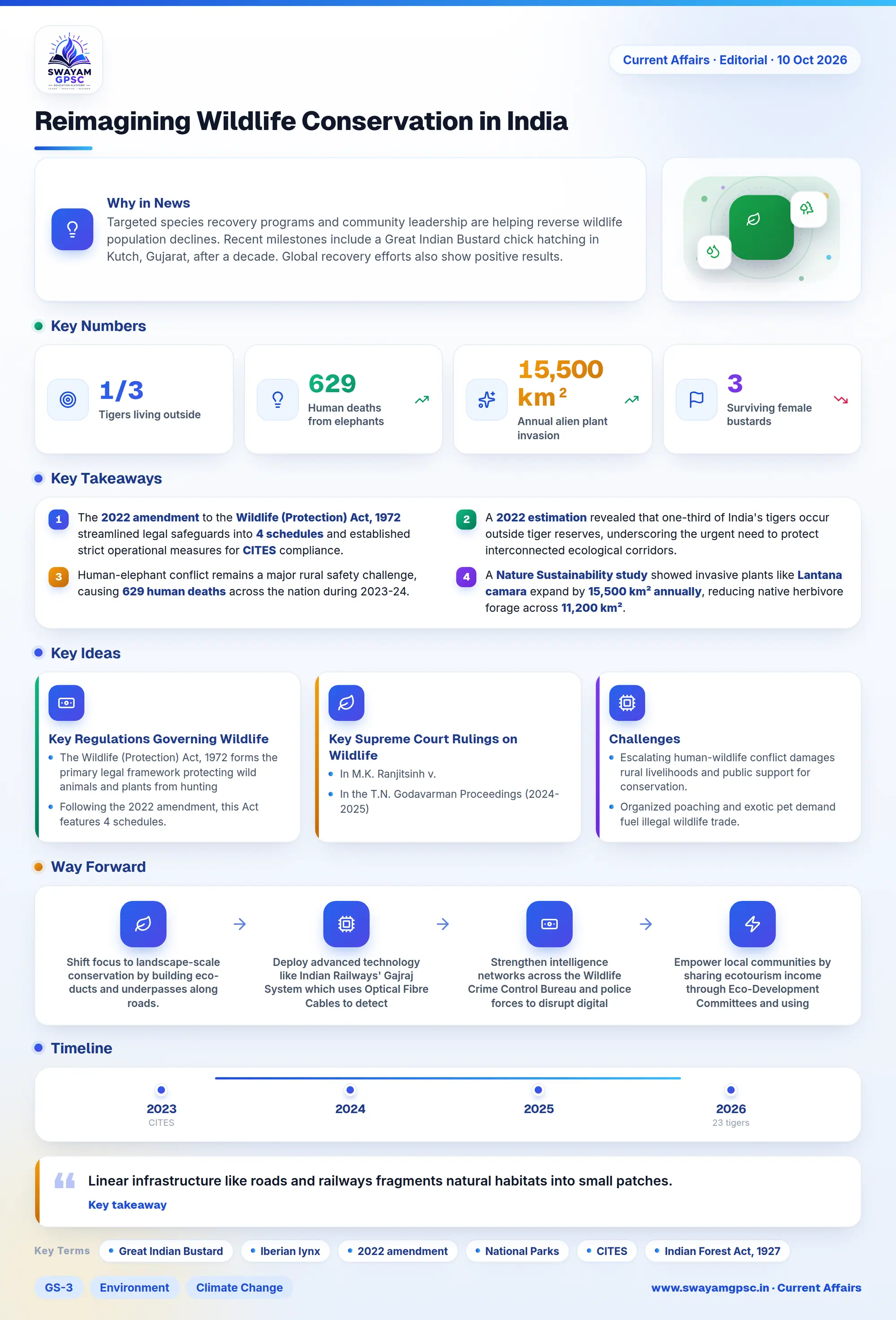
Reimagining Wildlife Conservation in India
#GS-3 #Environment #Climate Change #Biodiversity #Wildlife #Sustainable Development #Species Recovery Program #Great Indian Bustard #Conservation
Key takeaways
- The 2022 amendment to the Wildlife (Protection) Act, 1972 streamlined legal safeguards into 4 schedules and established strict operational measures for CITES compliance.
- A 2022 estimation revealed that one-third of India's tigers occur outside tiger reserves, underscoring the urgent need to protect interconnected ecological corridors.
- Human-elephant conflict remains a major rural safety challenge, causing 629 human deaths across the nation during 2023-24.
- A Nature Sustainability study showed invasive plants like Lantana camara expand by 15,500 km² annually, reducing native herbivore forage across 11,200 km².
- In March 2026, official reports indicated Gujarat's wild Great Indian Bustard population had fallen to only 3 females, making artificial breeding essential.
Why in News
- Targeted species recovery programs and community leadership are helping reverse wildlife population declines. Recent milestones include a Great Indian Bustard chick hatching in Kutch, Gujarat, after a decade.
- Global recovery efforts also show positive results. Examples include the Iberian lynx in Spain and Portugal, the scimitar-horned oryx in Chad, and the saiga antelope in Kazakhstan.
- However, expanding infrastructure, illegal wildlife trade, and climate change create serious challenges for animals. Protecting wildlife now requires modern technologies, bio-banking, community co-management, and connected forest corridors.
Key Regulations Governing Wildlife Conservation in India
- The Wildlife (Protection) Act, 1972 forms the primary legal framework protecting wild animals and plants from hunting and illegal trade.
- Following the 2022 amendment, this Act features 4 schedules. Schedule I offers the highest protection, Schedule II covers other protected species, Schedule III protects specified plants, and Schedule IV regulates CITES-listed specimens.
- This law also provides for creating National Parks, Wildlife Sanctuaries, Conservation Reserves, and Community Reserves.
- Chapter VB implements CITES to regulate international trade in endangered species through statutory authorities and permits. The International Trade of Specimens Rules, 2023 outline the exact operational steps.
- The Indian Forest Act, 1927 preserves forest land by classifying areas into Reserved Forests, Protected Forests, and Village Forests.
- Section 26 penalizes unauthorized activities like tree cutting and land clearing in reserved forests. Section 52 allows officials to seize forest produce and equipment used in crimes.
- The Van (Sanrakshan Evam Samvardhan) Adhiniyam, 1980 controls changes in forest land use and holds entities accountable for illegal land conversion.
- Its clearance framework evaluates project land needs, alternative sites, and mitigation plans. Project appraisals must address habitat fragmentation and corridor connectivity.
- Section 3B establishes liability for government officials who allow unlawful forest land conversion through consent or neglect.
- The Environment (Protection) Act, 1986 helps prevent external environmental harms to wildlife without direct land clearing.
- Sections 3 and 5 empower the Central Government to restrict harmful industrial activities. Rules created under this Act regulate various pollution types around natural habitats.
- The Noise Pollution (Regulation and Control) Rules, 2000 limit noise in silence zones to 50 dB(A) Leq during daytime and 40 dB(A) Leq at night.
- The Biological Diversity Act, 2002 regulates access to biological resources and mandates fair benefit-sharing with local communities.
- Amended in 2023, this Act works alongside the Biological Diversity Rules, 2024 and Access and Benefit Sharing Regulations, 2025.
- The institutional setup includes the National Biodiversity Authority, State Biodiversity Boards, and local Biodiversity Management Committees.
- The Scheduled Tribes and Other Traditional Forest Dwellers (Recognition of Forest Rights) Act, 2006 gives forest communities a formal role in ecosystem management.
- Section 5 empowers Gram Sabhas and village bodies to protect wildlife, forests, water sources, and local biodiversity.
- The Prevention of Cruelty to Animals Act, 1960 protects animals, including captive wild animals, from unnecessary pain and suffering.
- Section 3 orders animal handlers to ensure basic animal welfare. Section 11 punishes cruel actions like painful transport, tight confinement, and withholding food or water.
- Section 22 regulates performing animals and bans wild animals like bears, monkeys, tigers, panthers, and lions from commercial performances.
- The National Green Tribunal Act, 2010 offers specialized legal remedies for environmental damage affecting forests and wildlife.
- Section 15 allows the tribunal to order environmental restitution and financial compensation. Section 20 mandates decisions based on sustainable development and the precautionary principle.
- The NGT handles civil disputes involving substantial environmental questions under listed laws in Schedule I.
- While it cannot hear cases based solely on the Wildlife (Protection) Act, 1972, it addresses habitat damage linked to forest clearances and pollution laws.
Key Supreme Court Rulings on Wildlife Conservation
- In M.K. Ranjitsinh v. Union of India (2025), the Court mandated underground power lines and restrictions on renewable energy projects to protect the critically endangered Great Indian Bustard within two years.
- In the T.N. Godavarman Proceedings (2024-2025), the Court ordered ecological damage assessments for Corbett and later prohibited tiger safaris inside core tiger habitats in November 2025.
- In M.K. Ranjitsinh v. Union of India (2024), the Court recognized protection against adverse climate change impacts as a fundamental right under Articles 14 and 21.
- In Hospitality Association of Mudumalai v. In Defence of Environment and Animals (2020), the Court upheld Tamil Nadu's protection order for the Sigur Plateau elephant corridor.
- In Centre for Environment Law, WWF-I v. Union of India (2013), the Court ordered a second Asiatic lion population at Kuno, Madhya Pradesh to lower extinction risks.
- In Tarun Bharat Sangh, Alwar v. Union of India (1993), the Court ordered the closure of 262 mines in Sariska Tiger Reserve operating without central approval.
Challenges
- Linear infrastructure like roads and railways fragments natural habitats into small patches. Data from 2022 shows that one-third of India's tigers occur outside tiger reserves, while a 2025 review identified 77 high-risk areas along 3,452 km of railway lines.
- Escalating human-wildlife conflict damages rural livelihoods and public support for conservation. Elephant attacks caused 629 human deaths in 2023-24, leaving families with significant financial and emotional burdens.
- Organized poaching and exotic pet demand fuel illegal wildlife trade. Official records show seizures representing 23 tigers in early 2025, alongside foreign species like 5 orangutans seized in Balasore, Odisha in September 2026.
- Invasive alien plants deplete native forage and alter ecosystems. A 2025 Nature Sustainability study revealed that invasive weeds like Lantana camara spread across 15,500 km² annually, reducing food for herbivores across 11,200 km².
- Extreme weather and forest fires destabilize ecosystems. ISFR 2023 recorded 2,03,544 forest-fire detections in one season, while Lakshadweep has suffered 4 mass coral bleaching events since 1998.
- Toxic veterinary drugs enter wildlife food chains. Nonsteroidal anti-inflammatory drugs like nimesulide poison scavenging vultures, as confirmed by conservation coalition SAVE in January 2025.
- Critically low populations risk complete reproductive failure. A March 2026 government report noted that Gujarat's wild Great Indian Bustard population had dropped to only 3 females and no local males.
Way Forward
- Shift focus to landscape-scale conservation by building eco-ducts and underpasses along roads. Formally notify all 150 elephant corridors as Eco-Sensitive Zones under the Environment (Protection) Act, 1986.
- Deploy advanced technology like Indian Railways' Gajraj System which uses Optical Fibre Cables to detect elephant movements. Upgrade MSTrIPES with thermal drones and acoustic sensors to stop illegal encroachments.
- Strengthen intelligence networks across the Wildlife Crime Control Bureau and police forces to disrupt digital wildlife markets and trade routes.
- Empower local communities by sharing ecotourism income through Eco-Development Committees and using Traditional Ecological Knowledge for fire control and weed management.
- Build solar-powered water structures inside dry reserves and restore prey populations through planned translocations, similar to Project Cheetah at Kuno.
- Use advanced genetic tracking to prevent inbreeding in isolated species. Expand the LaCONES facility in Hyderabad to store animal gametes and set up a One Health network for disease tracking.
- Reduce human-wildlife conflicts using bio-fences like chili-bee hives and automated warning alerts via WhatsApp. Direct financial aid quickly to affected farmers and expand crop insurance under PMFBY.
- Raise funds for habitat restoration using the Green Credit Programme and CSR grants. Strengthen cross-border partnerships like the Terai Arc Landscape with Nepal to protect migratory routes.