Ladakh: Balancing Strategic Security and Local Governance Aspirations
#GS-2 #Indian Polity & Constitution #Federalism #Governance & Social Justice #Constitutional Bodies #GS-3 #Environment #Climate Change #Biodiversity #Security #Current Events #National
Key takeaways
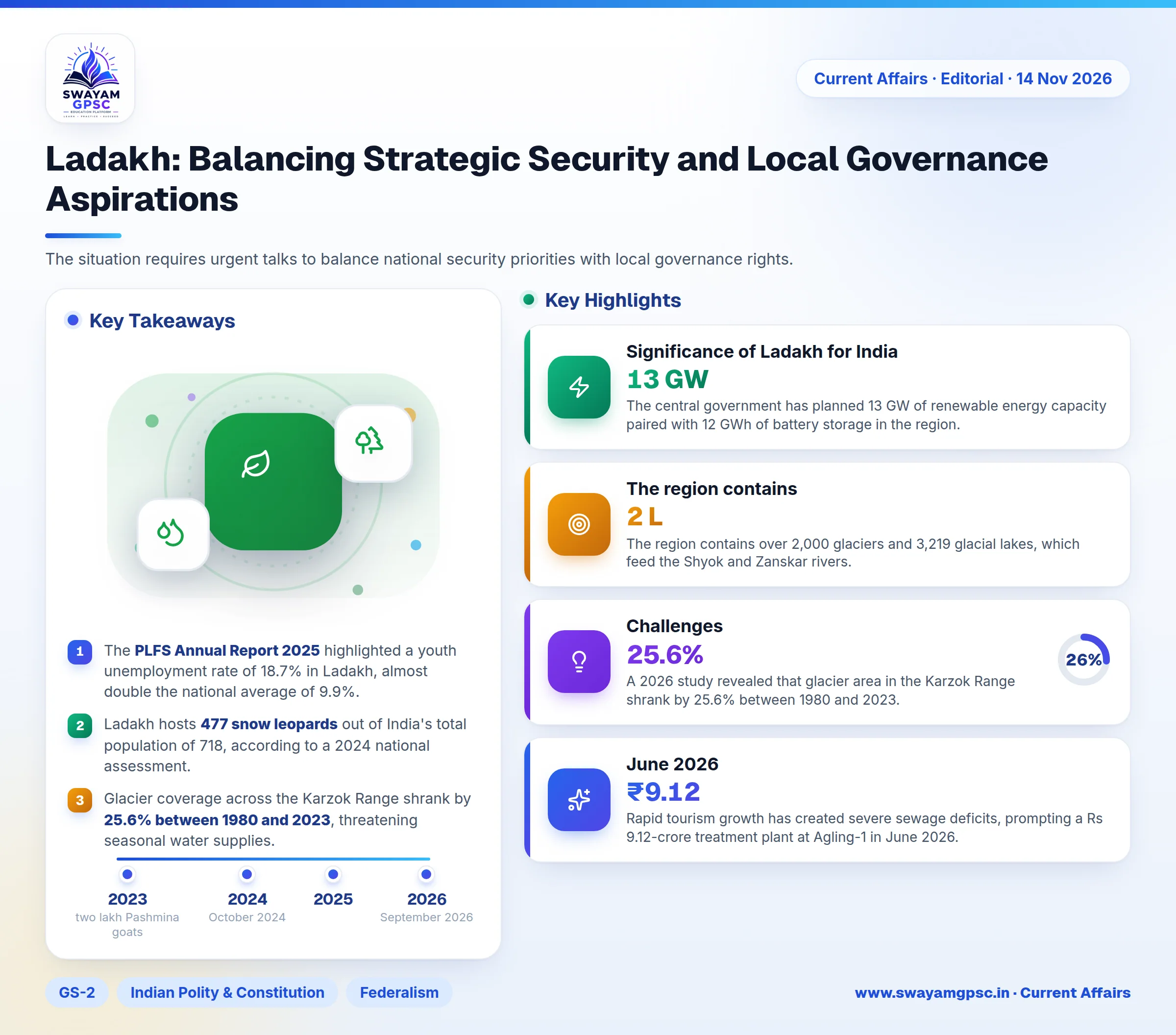
- The PLFS Annual Report 2025 highlighted a youth unemployment rate of 18.7% in Ladakh, almost double the national average of 9.9%.
- Ladakh hosts 477 snow leopards out of India's total population of 718, according to a 2024 national assessment.
- Glacier coverage across the Karzok Range shrank by 25.6% between 1980 and 2023, threatening seasonal water supplies.
- Tourist footfall grew sharply to 4,05,085 visitors between January and August 2026, compared to 2,69,390 during the same period in 2025.
- The central government has planned a massive 13 GW renewable energy project backed by 12 GWh of battery storage in the region.
Why in News
- The Ladakh administration recently announced elections for the 100-seat Ladakh Autonomous Hill Development Council (LAHDC).
- This announcement triggered a shutdown in Kargil and an election boycott in Leh.
- These protests highlight a growing democratic deficit in this strategically critical border region.
- The situation requires urgent talks to balance national security priorities with local governance rights.
Significance of Ladakh for India
- Ladakh lies along the Line of Actual Control (LAC) with China and faces Pakistan near the Siachen sector.
- The patrolling agreement signed in October 2024 covers key friction points at Depsang and Demchok.
- Strategic infrastructure projects like the Shyok Tunnel on the Darbuk-Shyok-Daulat Beg Oldie road enhance military logistics.
- The region contains over 2,000 glaciers and 3,219 glacial lakes, which feed the Shyok and Zanskar rivers.
- A 2024 assessment found 477 snow leopards in Ladakh, representing the majority of India's 718 total population.
- The Tso Kar wetland complex serves as an essential stopover for migratory birds along the Central Asian Flyway.
- The central government has planned 13 GW of renewable energy capacity paired with 12 GWh of battery storage in the region.
- Ladakh commissioned its first two geothermal wells in September 2026 to explore round-the-clock clean power.
- The MACE observatory at Hanle sits at 4,300 metres altitude to support high-energy astrophysics.
- ISRO set up the Himalayan Outpost for Planetary Exploration (HOPE) at Tso Kar in 2025 for space research.
- Around two lakh Pashmina goats raised by Changpa pastoralists sustain the local luxury wool industry, which gained GI protection in March 2023.
- Historic Buddhist sites like Alchi and Hemis monasteries strengthen India's regional cultural diplomacy.
- India opened its first Petroglyph Conservation Park in Leh in October 2026 to protect ancient rock art.
- Tourist arrivals reached 4,05,085 between January and August 2026, up from 2,69,390 during the same period in 2025.
Challenges
- Talks in October 2026 between the Centre and local leaders ended without agreement on an elected regional body or an Article 371K structure.
- In March 2025, India officially protested China's creation of two new counties in Hotan prefecture that claim Ladakhi land.
- A 2026 study revealed that glacier area in the Karzok Range shrank by 25.6% between 1980 and 2023.
- Rapid tourism growth has created severe sewage deficits, prompting a Rs 9.12-crore treatment plant at Agling-1 in June 2026.
- The PLFS Annual Report 2025 recorded youth unemployment in Ladakh at 18.7%, well above the 9.9% national average.
- Field studies in 2025 documented shrinking pastures for Changpa herders, while the Tribal Affairs Ministry reported no impact studies in July 2026.
- Severe winter weather causes long closures at Zojila, Penzila, and Namkila passes, isolating remote mountain villages.
- District hospitals face critical shortages of medical specialists, leading the administration to request 125 medical officers via UPSC in December 2025.
Key Demands of Ladakh
- The Leh Apex Body (LAB) and Kargil Democratic Alliance (KDA) jointly lead the protest for regional rights.
- Local groups demand full statehood for Ladakh with an elected state legislative assembly.
- They seek constitutional safeguards under the Sixth Schedule to protect local land, culture, and job rights.
- Protesters demand a dedicated Public Service Commission to secure state government jobs for local youth.
- They request two separate Lok Sabha seats to represent Leh and Kargil individually in Parliament.
Way Forward
- The government should negotiate a clear timeline for constitutional protections covering local land and employment authority.
- Local administrative bodies must create seasonal water budgets to manage meltwater and prevent seasonal water scarcity.
- Authorities should link commercial tourism licenses directly to verified local sewage and waste handling limits.
- Officials must map customary grazing corridors with Changpa pastoralists before approving any new land development.
- Skill training programs must offer guaranteed apprenticeships in local sectors like solar maintenance and eco-tourism.
- Infrastructure agencies should sign winter service contracts to guarantee fast snow clearance and emergency road access.
- Border authorities must establish clear liaison protocols to compensate villagers when security operations disrupt daily mobility.