Reimagining the India-Nepal Partnership and Boundary Issues
#GS-2 #Indian Polity & Constitution #Governance & Social Justice #Current Events #International #Bilateral Relations #Economy #Infrastructure
Key takeaways
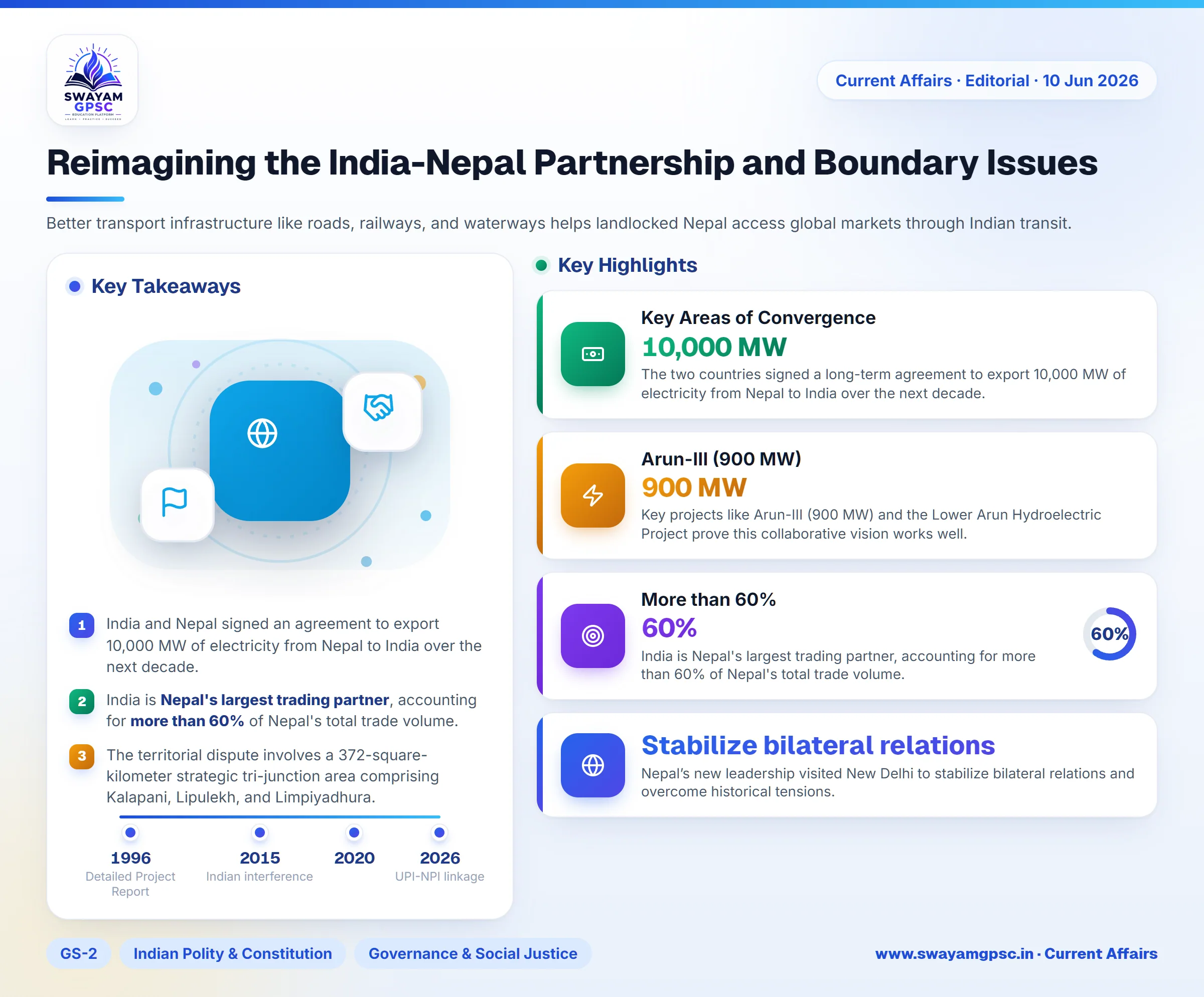
- India and Nepal signed an agreement to export 10,000 MW of electricity from Nepal to India over the next decade.
- India is Nepal's largest trading partner, accounting for more than 60% of Nepal's total trade volume.
- The territorial dispute involves a 372-square-kilometer strategic tri-junction area comprising Kalapani, Lipulekh, and Limpiyadhura.
- The open border spans 1,751 kilometers, presenting unique security and cross-border management challenges for both nations.
Why in News
- Nepal’s new leadership visited New Delhi to stabilize bilateral relations and overcome historical tensions.
- Both nations want to move past previous friction and build a stronger partnership focused on energy, trade, infrastructure, and border management.
Key Areas of Convergence
- Hydropower is a major economic opportunity because Nepal has untapped water resources and India needs clean energy for its net-zero climate goals.
- The two countries signed a long-term agreement to export 10,000 MW of electricity from Nepal to India over the next decade.
- Key projects like Arun-III (900 MW) and the Lower Arun Hydroelectric Project prove this collaborative vision works well.
- India and Nepal launched the UPI-NPI linkage in June 2026 to make cross-border payments faster, safer, and cheaper.
- Better transport infrastructure like roads, railways, and waterways helps landlocked Nepal access global markets through Indian transit.
- The Jayanagar-Kurtha cross-border railway and Integrated Check Posts (ICPs) at Raxaul-Birgunj and Jogbani-Biratnagar have sped up trade flows.
- The Bilateral Consultative Group (BCG) on Security Issues helps both countries coordinate defense training and combat shared threats like terrorism.
- India and Nepal conduct an annual joint military exercise named Surya Kiran and appoint each other's Army Chiefs as honorary Generals.
- The National Disaster Response Force (NDRF) works closely with Nepal to handle natural calamities like earthquakes and monsoon floods.
- The Ramayana Circuit project connects Ayodhya in India to Janakpur in Nepal, boosting religious tourism and cultural ties.
- India is Nepal's largest trading partner, accounting for more than 60% of Nepal's total trade volume.
- The 2025-26 Agricultural Cooperation Framework gives Nepal access to advanced climate-resilient seed varieties developed by ICAR.
- An MoU between Digital India Bhashini and Kathmandu University (KU) aims to build a Voice-First Language Translation Platform.
- Regional frameworks like BIMSTEC and the BBIN Motor Vehicles Agreement help improve logistics and regional integration.
Challenges
- The main territorial dispute centers on the Kalapani-Limpiyadhura-Lipulekh trijunction located at the northwestern tip of Nepal.
- Nepal relies on the 1816 Treaty of Sugauli to claim these territories based on the western source of the Kali River, while India relies on British-era maps from after 1847.
- Tensions peaked in 2020 when Nepal issued a new political map incorporating these disputed areas.
- Past events like the 2015 unofficial border blockade left deep-seated resentment and fueled accusations of Indian interference in Nepalese politics.
- Nepal's participation in China's Belt and Road Initiative (BRI) and projects like the Pokhara International Airport create strategic unease for India.
- Trade disputes include non-tariff barriers, such as Nepal banning Indian mangoes over excessive levels of chemical pesticides, and Nepal seeking access to ports like Mundra Port and Dhamra Port.
- The 1,751-km open border poses security challenges, illustrated by incidents such as the infiltration of Pakistan-based Jaish-e-Mohammed (JeM) terrorists in Bihar.
- Many in Nepal view the 1950 Treaty of Peace and Friendship as an unequal relic of the colonial era, specifically objecting to Article 5 and Articles 6-7.
- Water resource projects face delays, as seen with the stalled Detailed Project Report (DPR) for the Pancheshwar Multipurpose Project under the 1996 Mahakali Treaty.
- Sensationalist media coverage of events like India's road link to Lipulekh Pass for the Kailash Mansarovar Yatra often inflames public opinion.
Way Forward
- Deploy an Integrated Smart-Border System with biometric verification kiosks to maintain open community access while filtering out high-risk individuals.
- Shift toward an integrated economic corridor model by establishing manufacturing hubs in Nepal that utilize its hydropower and labor pool.
- Establish a Permanent Bilateral Boundary Commission made up of cartographers and hydrographers to depoliticize territorial disputes.
- Scale the digital bridge by integrating Nepal's digital identification system with Indian service portals for cross-border workers.
- Establish a Joint Himalayan Resilience Fund to finance climate-proof infrastructure and smart-grid systems in the region.
- Issue a Supplementary Protocol to the 1950 Treaty that preserves open border access while updating security and economic clauses.
- Create a Joint Technical Vocational Education and Training (TVET) Academy to train Nepalese workers in high-demand technical sectors.
- Form a Bilateral Youth Council to foster personal relationships among the next generation of leaders before they enter politics.
Prelims in Focus: The India-Nepal Boundary Issue
- The boundary dispute centers on a 372-square-kilometer strategic tri-junction area comprising Kalapani, Lipulekh, and Limpiyadhura.
- The region is critical because it overlooks the Lipulekh Pass, which serves as a vital trade route and corridor for the Kailash Mansarovar Yatra.
- The root of the dispute lies in the 1816 Treaty of Sugauli, which established the River Kali as the western boundary but lacked scientifically surveyed coordinate maps.
- Kathmandu argues the river originates at Limpiyadhura, while New Delhi maintains it begins near Kalapani based on maps drawn after 1847.
- Nepal's newly elected Prime Minister Balendra Shah Balen has shifted the diplomatic discourse toward a rational approach to resolving these disputes.
- The rise of leaders like Balendra Shah reflects youth demands for transparent governance focused on jobs, development, and anti-corruption reforms.