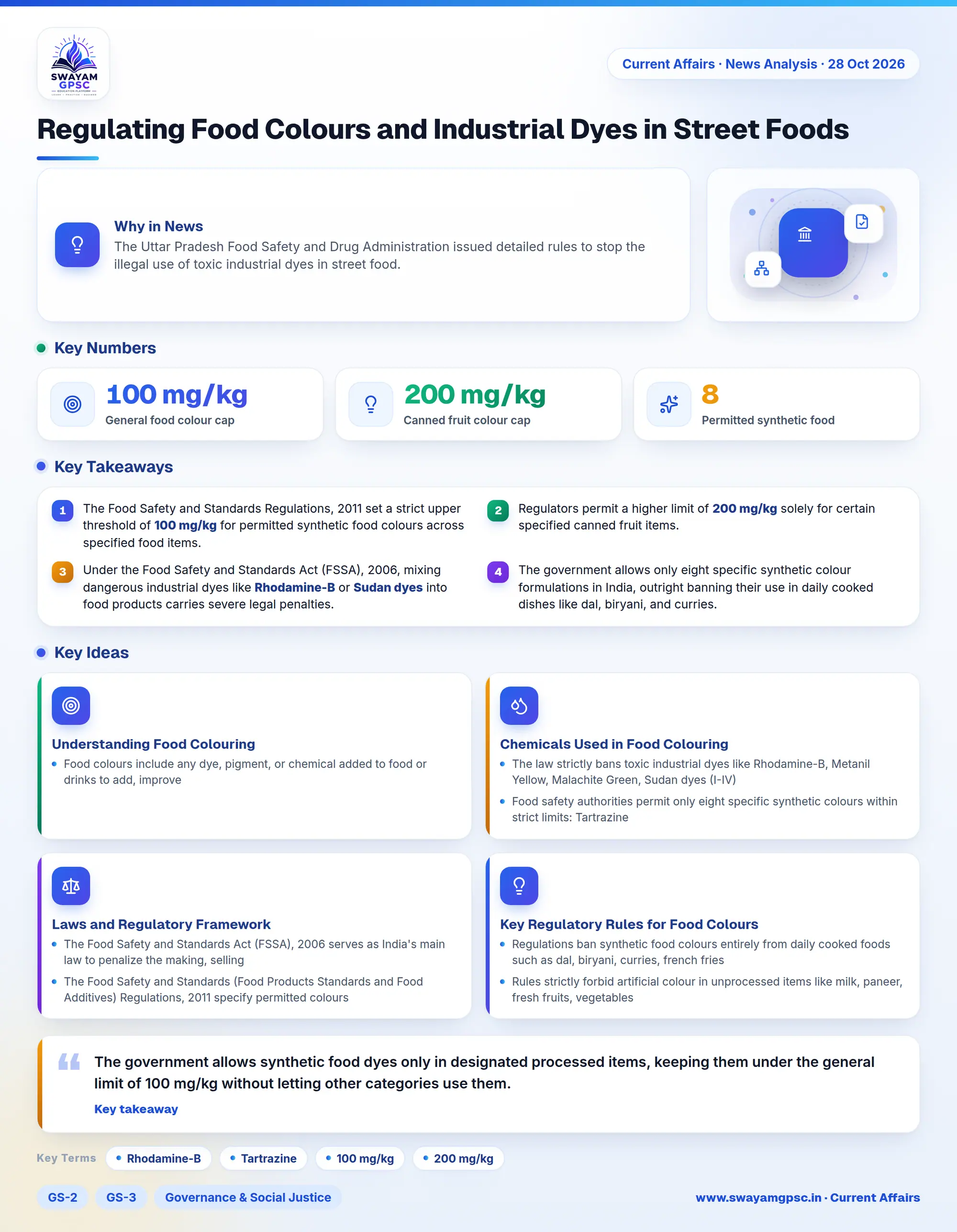
Regulating Food Colours and Industrial Dyes in Street Foods
#GS-2 #GS-3 #Governance & Social Justice #Health #Science & Technology #Food Safety #Regulatory Bodies #Current Events #National
Key takeaways
- The Food Safety and Standards Regulations, 2011 set a strict upper threshold of 100 mg/kg for permitted synthetic food colours across specified food items.
- Regulators permit a higher limit of 200 mg/kg solely for certain specified canned fruit items.
- Under the Food Safety and Standards Act (FSSA), 2006, mixing dangerous industrial dyes like Rhodamine-B or Sudan dyes into food products carries severe legal penalties.
- The government allows only eight specific synthetic colour formulations in India, outright banning their use in daily cooked dishes like dal, biryani, and curries.
Why in News
- The Uttar Pradesh Food Safety and Drug Administration issued detailed rules to stop the illegal use of toxic industrial dyes in street food.
Understanding Food Colouring
- Food colours include any dye, pigment, or chemical added to food or drinks to add, improve, or restore visual appearance. These substances fall into two main groups: natural colours from plants or minerals like beetroot and turmeric, and synthetic colours made in laboratories that are strictly regulated.
Chemicals Used in Food Colouring
- The law strictly bans toxic industrial dyes like Rhodamine-B, Metanil Yellow, Malachite Green, Sudan dyes (I-IV), Butter Yellow, Auramine, and Orange II because they are hazardous adulterants.
- Food safety authorities permit only eight specific synthetic colours within strict limits: Tartrazine, Sunset Yellow FCF, Carmoisine, Ponceau 4R, Erythrosine, Brilliant Blue FCF, Fast Green FCF, and Indigo Carmine.
Laws and Regulatory Framework
- The Food Safety and Standards Act (FSSA), 2006 serves as India's main law to penalize the making, selling, and distributing of adulterated food products.
- The Food Safety and Standards (Food Products Standards and Food Additives) Regulations, 2011 specify permitted colours, set Good Manufacturing Practices, and establish a maximum limit of 100 mg/kg, which can reach 200 mg/kg for certain canned fruits.
Key Regulatory Rules for Food Colours
- Regulations ban synthetic food colours entirely from daily cooked foods such as dal, biryani, curries, french fries, bread, and chutneys.
- Rules strictly forbid artificial colour in unprocessed items like milk, paneer, fresh fruits, vegetables, natural juices, whole spices, pulses, honey, and baby food.
- The government allows synthetic food dyes only in designated processed items, keeping them under the general limit of 100 mg/kg without letting other categories use them.
- Food makers must use digital precision scales, purchase colours only from licensed producers, maintain valid batch numbers, and keep all bills to ensure traceability.
Public Health and Safety Risks
- Banned dyes like Rhodamine-B and Sudan dyes can cause cancer and damage major vital organs like the liver and kidneys.
- Even permitted food colours like Tartrazine and Carmoisine can trigger skin hives, severe facial swelling, and asthma attacks in sensitive people.
- Children face severe health risks from brightly coloured street foods like cotton candy and ice pops, which can harm their growth and daily behaviour.