Registration of Births and Deaths Amendment Bill 2026 Passed
#GS-2 #Governance & Social Justice #Good Governance #E-Governance #Indian Polity & Constitution #Current Events #National #Government Policies & Interventions
Key takeaways
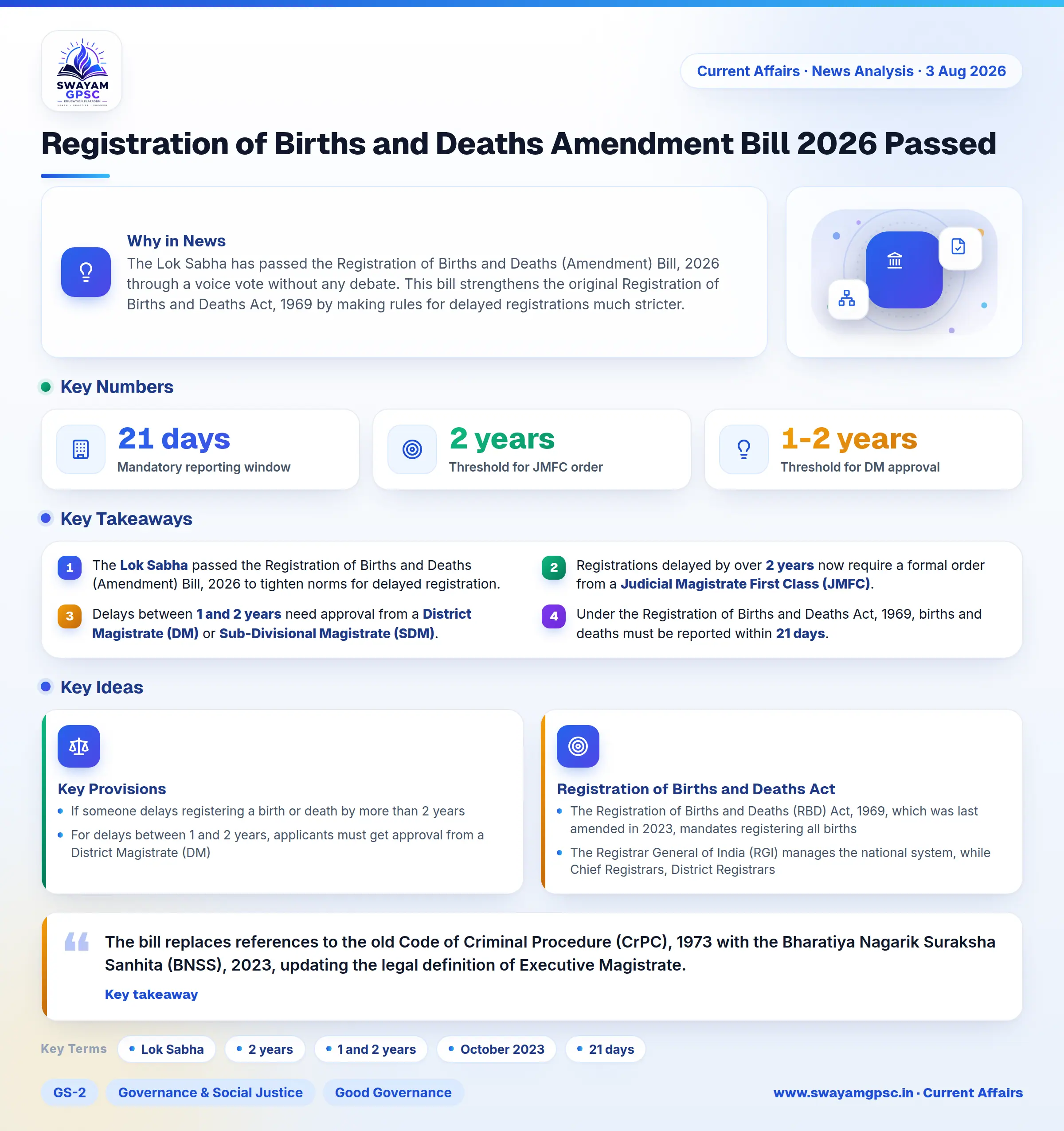
- The Lok Sabha passed the Registration of Births and Deaths (Amendment) Bill, 2026 to tighten norms for delayed registration.
- Registrations delayed by over 2 years now require a formal order from a Judicial Magistrate First Class (JMFC).
- Delays between 1 and 2 years need approval from a District Magistrate (DM) or Sub-Divisional Magistrate (SDM).
- Under the Registration of Births and Deaths Act, 1969, births and deaths must be reported within 21 days.
Why in News
- The Lok Sabha has passed the Registration of Births and Deaths (Amendment) Bill, 2026 through a voice vote without any debate.
- This bill strengthens the original Registration of Births and Deaths Act, 1969 by making rules for delayed registrations much stricter.
- It updates legal references to align with the new Bharatiya Nagarik Suraksha Sanhita (BNSS), 2023.
Key Provisions
- If someone delays registering a birth or death by more than 2 years, they must now obtain an official order from a Judicial Magistrate First Class (JMFC).
- For delays between 1 and 2 years, applicants must get approval from a District Magistrate (DM), Sub-Divisional Magistrate (SDM), or an authorized Executive Magistrate.
- The bill replaces references to the old Code of Criminal Procedure (CrPC), 1973 with the Bharatiya Nagarik Suraksha Sanhita (BNSS), 2023, updating the legal definition of Executive Magistrate.
- These amendments encourage citizens to report vital events on time, making government civil registration records far more reliable.
Registration of Births and Deaths Act, 1969
- The Registration of Births and Deaths (RBD) Act, 1969, which was last amended in 2023, mandates registering all births, deaths, and stillbirths at the place where they occur.
- The Registrar General of India (RGI) manages the national system, while Chief Registrars, District Registrars, and Local Registrars handle certificate issuance locally.
- Since October 2023, authorities keep all birth and death records in digital format through the central Civil Registration System (CRS).
- Citizens must report every birth, death, or stillbirth within 21 days of occurrence, after which late registration fees apply.