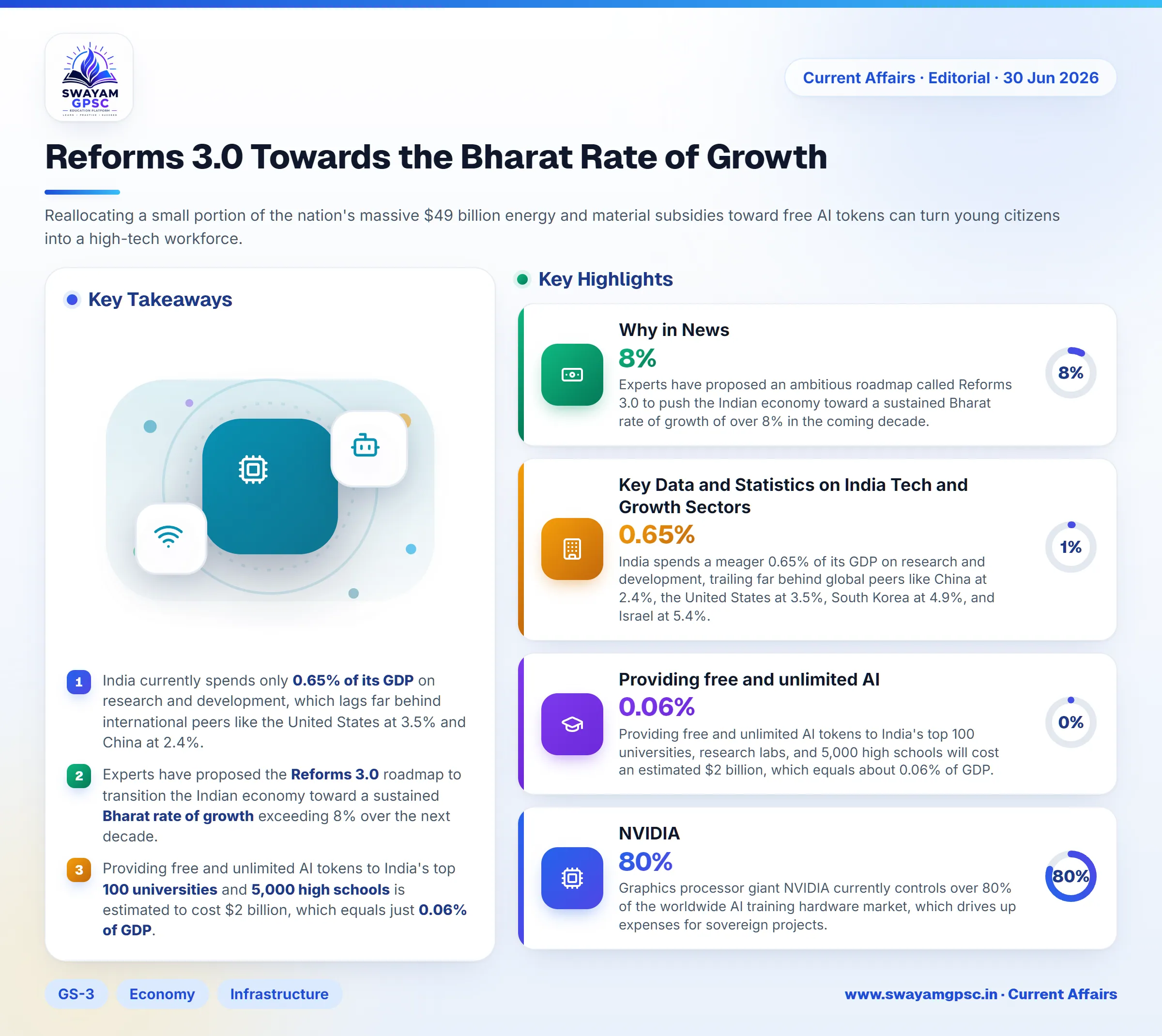
Reforms 3.0 Towards the Bharat Rate of Growth
#GS-3 #Economy #Infrastructure #Science & Technology #Artificial Intelligence #ICT #Growth #Governance & Social Justice #Good Governance
Key takeaways
- India currently spends only 0.65% of its GDP on research and development, which lags far behind international peers like the United States at 3.5% and China at 2.4%.
- Experts have proposed the Reforms 3.0 roadmap to transition the Indian economy toward a sustained Bharat rate of growth exceeding 8% over the next decade.
- Providing free and unlimited AI tokens to India's top 100 universities and 5,000 high schools is estimated to cost $2 billion, which equals just 0.06% of GDP.
- Graphics processor giant NVIDIA currently commands over 80% of the global AI training hardware market, pushing up development costs for sovereign projects.
- India's digital public infrastructure successfully handles 250 billion annual transactions worth $3.4 trillion, managing half of the planet's real-time payment volumes.
Why in News
- Experts have proposed an ambitious roadmap called Reforms 3.0 to push the Indian economy toward a sustained Bharat rate of growth of over 8% in the coming decade.
About Reforms 3.0
- Reforms 3.0 shifts policy thinking so that Artificial Intelligence is viewed as core national infrastructure rather than simple commercial software.
- Similar to the historic 1991 economic liberalization, this framework aims to bypass old computing limits by making foundational large language models open-source and offering free processing tokens to top research centers.
Key Data and Statistics on India Tech and Growth Sectors
- India spends a meager 0.65% of its GDP on research and development, trailing far behind global peers like China at 2.4%, the United States at 3.5%, South Korea at 4.9%, and Israel at 5.4%.
- Providing free and unlimited AI tokens to India's top 100 universities, research labs, and 5,000 high schools will cost an estimated $2 billion, which equals about 0.06% of GDP.
- This proposed $2 billion cognitive budget equals just one-fourteenth of India's annual $49 billion food subsidy umbrella and one-tenth of its fertilizer subsidy.
- Graphics processor giant NVIDIA currently controls over 80% of the worldwide AI training hardware market, which drives up expenses for sovereign projects.
Opportunities for India Growth 3.0 Paradigm
- Using AI as a cognitive multiplier can systematically push long-term economic expansion past historical averages and reach the targeted Bharat rate of growth.
- Reallocating a small portion of the nation's massive $49 billion energy and material subsidies toward free AI tokens can turn young citizens into a high-tech workforce.
- Leveraging India's massive 1.4-billion-user market as negotiating power allows the state to secure huge cloud capacity from global hyperscalers in exchange for land and power access.
- Using entirely open-source models like Llama or DeepSeek on domestic servers ensures absolute AI data sovereignty and removes the danger of sudden foreign API shutdowns.
- Creating paid enterprise tiers for corporate clients can generate enough revenue to fund completely free access for schools and medical centers.
Key Initiatives Taken So Far
- The historic rollout of the biometric identity framework has securely enrolled 1.38 billion citizens, creating the world's largest digital public utility.
- Local digital infrastructure now seamlessly processes 250 billion annual transactions valued at $3.4 trillion, managing half of all real-time payment volumes globally.
- Policy backing for high-speed network expansion since 2016 successfully drove national mobile data prices down from $3 per GB to just $0.10 per GB, setting the structural foundation for free AI tokens.
- The successful deployment of home-grown computing architectures like Sarvam proves that frontier AI systems can be trained and fine-tuned locally using regional Indic languages.
Challenges
- Relying entirely on monopolistic computing hardware vendors makes a nationwide 1.4-billion-user platform financially difficult due to expensive GPU pricing.
- Finalizing public-private partnerships with massive global hyperscalers requires navigating complex geopolitical pressures and strict data residency rules.
- Hosting national-level large language models requires immense engineering strength to maintain 99.99% system uptimes and sub-200ms latencies across Tier-2 and Tier-3 cities.
- Expanding public sector AI tools exposes systems to serious digital threats like prompt injections and algorithmic hallucinations.
- Convincing state departments to pause baseline subsidy growth across material sectors like fertilizers to fund long-term digital tools demands strong political will.
Way Forward
- Break single-vendor dependence by setting up an optimized computing architecture split as 40% on cost-effective AWS Trainium or AMD chips, 30% on Google TPUs for academic research, and 30% on NVIDIA for legacy training.
- Enact a formal 24-month policy framework to build a multi-vendor sovereign compute matrix in partnership with major technology providers.
- Instantly launch an API sandbox for 500 tech startups and deliver unlimited free tokens to the top 20 IITs and the IISc to anchor early research.
- Create public and fine-tuned foundational models optimized across all 22 official languages to bring AI capabilities to local courts, clinics, and farms.
- Treat compute clusters as critical national assets rather than simple cloud containers, mirroring the long-term funding models used for space and nuclear programs.
Conclusion
- By combining its massive 1.4-billion-user market leverage with an optimized computing grid and free research tokens, the nation can break foreign monopolies and lower technology costs.
- Treating compute power as a basic public utility will remain vital to turn the cognitive revolution into a lasting pillar of economic sovereignty as the state finalizes its National AI Token Policy.