Reforming India's Tribunal System and Judicial Independence
#GS-2 #Indian Polity & Constitution #Judiciary #Constitution #Governance & Social Justice #Good Governance #Regulatory Bodies #Tribunals #Tribunals Reforms Bill 2026 #National Tribunals Commission
Key takeaways
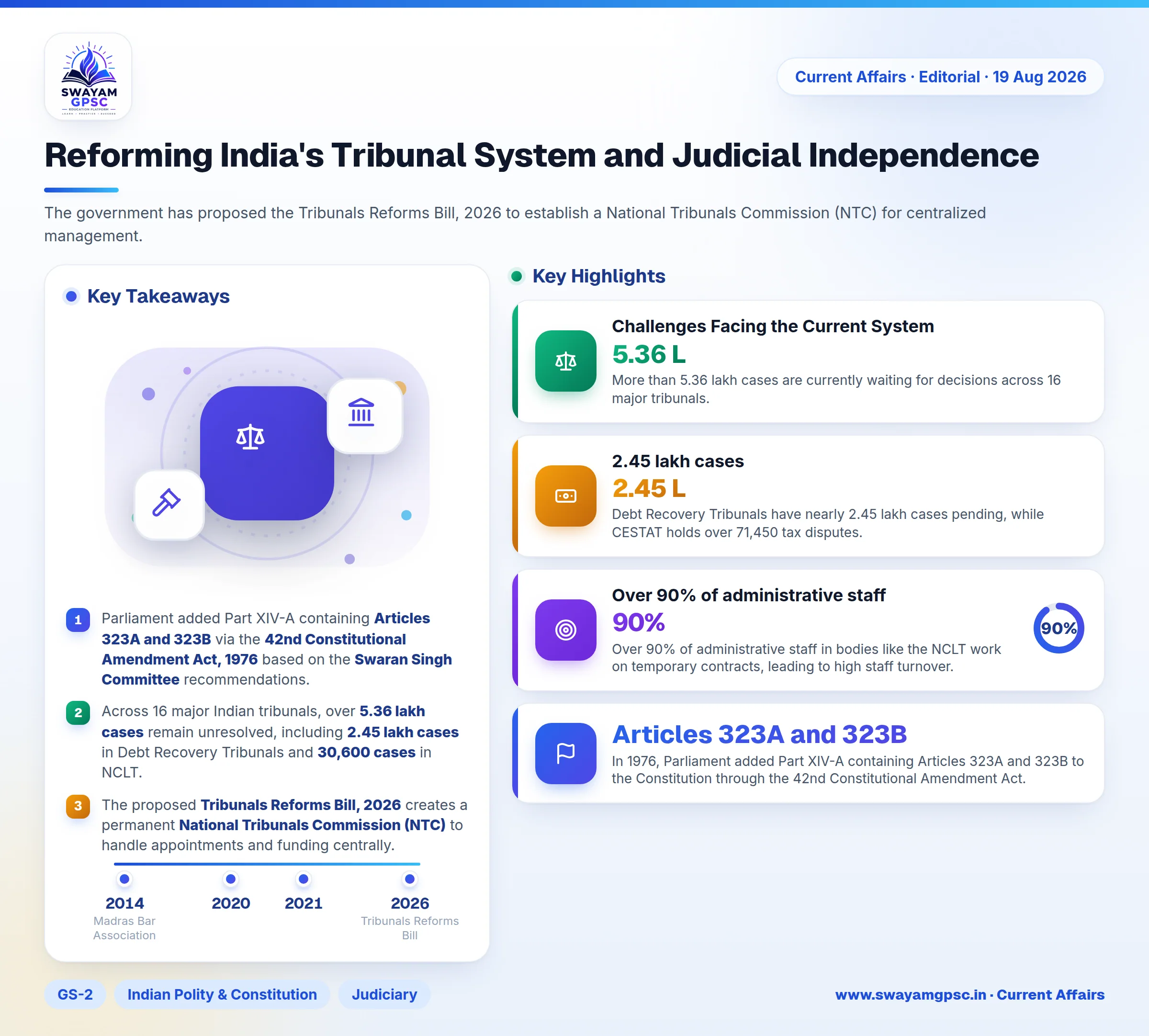
- Parliament added Part XIV-A containing Articles 323A and 323B via the 42nd Constitutional Amendment Act, 1976 based on the Swaran Singh Committee recommendations.
- Across 16 major Indian tribunals, over 5.36 lakh cases remain unresolved, including 2.45 lakh cases in Debt Recovery Tribunals and 30,600 cases in NCLT.
- The proposed Tribunals Reforms Bill, 2026 creates a permanent National Tribunals Commission (NTC) to handle appointments and funding centrally.
- Supreme Court precedents like L. Chandra Kumar (1997) mandate judicial review by High Courts and executive non-interference under Article 50.
Why in News
- In 1976, Parliament added Part XIV-A containing Articles 323A and 323B to the Constitution through the 42nd Constitutional Amendment Act.
- This addition followed recommendations from the Swaran Singh Committee to create special courts for speedy justice.
- The main objective was to reduce case pressure on regular civil courts and High Courts by handling technical matters separately.
- Over time, tribunals suffered from major problems such as high case backlog, unfilled posts, government control, and poor facilities.
- The government has proposed the Tribunals Reforms Bill, 2026 to establish a National Tribunals Commission (NTC) for centralized management.
Core Objective of Tribunal Reforms
- Reforming the tribunal system focuses on creating an independent body called the National Tribunals Commission (NTC).
- This new setup aims to fill vacant posts quickly and lower the number of pending cases across courts.
- It protects tribunal independence from government influence while keeping domain experts in place for specialized decisions.
Landmark Judicial Precedents Governing Tribunals
- In the L. Chandra Kumar v. Union of India (1997) case, the Supreme Court ruled that judicial review under Articles 226, 227, and 32 forms part of the Basic Structure.
- The court held that litigants can challenge tribunal orders before a Division Bench of the High Court.
- This judgment recommended setting up a single national body to manage all tribunals in the country.
- In the Union of India v. R. Gandhi (2010) ruling, the Supreme Court stated that technical members must possess expertise equal to judicial members.
- The court emphasized that the executive branch cannot single-handedly control service conditions because it is often a party in tribunal disputes.
- In the Madras Bar Association series of cases (2014, 2020, and 2021), the court cancelled rules like short 4-year terms and age limits of 50 years.
- These rulings repeated the mandatory need for an independent National Tribunals Commission to protect separation of powers under Article 50.
Challenges Facing the Current System
- More than 5.36 lakh cases are currently waiting for decisions across 16 major tribunals.
- Debt Recovery Tribunals have nearly 2.45 lakh cases pending, while CESTAT holds over 71,450 tax disputes.
- The National Company Law Tribunal (NCLT) has over 30,600 pending cases, where clearance takes between 48 and 700 days.
- Important bodies such as the National Green Tribunal (NGT) and TDSAT work without their full sanctioned strength.
- Delay in appointments happens because different parent ministries handle recruitment separately without coordination.
- Tribunals currently rely on their parent ministries for office space, staff, and annual funding.
- Since the Union government is the main party in tax and service disputes, this dependency harms neutral decisions.
- Over 90% of administrative staff in bodies like the NCLT work on temporary contracts, leading to high staff turnover.
Key Pillars of the Proposed Reform Framework
- The framework establishes a permanent National Tribunals Commission (NTC) to oversee appointments, budgets, and administration.
- Members get fixed 5-year terms with retirement ages of 70 years for Chairpersons and 67 years for Members.
- Selection panels will be led by a former Supreme Court Judge or High Court Chief Justice, along with two former High Court Judges and two technical experts.
- Selection committees will recommend only one candidate per post along with a waiting list to stop government favoritism.
Arguments in Favor of Reform
- Removing administrative control from line ministries eliminates conflict of interest during government disputes.
- A permanent administrative secretariat tracks vacancies continuously and starts recruitment 6 months before a post opens up.
- Digital tools like the National Tribunals Data Grid (NTDG) make case tracking easier and increase public visibility.
Key Concerns and Criticism
- Creating a new central commission might add bureaucratic layers without speeding up actual dispute resolution.
- A rigid unified system may ignore specific operational needs, like field visits for environmental cases versus document checks in tax matters.
- Forming a new administrative commission will not resolve bench shortages unless the government provides direct funding.
Multi-Dimensional Governance Implications
- Slow decisions in NCLT and DRT lock up business capital and hurt the financial health of commercial banks.
- A fully functional National Green Tribunal (NGT) helps enforce environmental principles like the Precautionary Principle and Polluter Pays Principle.
- Giving judges primary control over tribunal selection protects separation of powers under Article 50.
Way Forward
- The NTC should focus only on administrative coordination and avoid interfering in judicial processes.
- The government must fund all tribunal operations directly from the Consolidated Fund of India to ensure monetary autonomy.
- Creating a specialized Indian Tribunals Administrative Service will replace temporary workers with trained staff.
- Tribunals should publish quarterly clearance stats and average case timelines on a public online dashboard.
- Making pre-court mediation mandatory for routine government service cases will lower unnecessary filings.
Conclusion
- Successful reform depends on keeping tribunals independent of government control and filling all vacant positions promptly.
- A central commission will benefit citizens only if it speeds up legal decisions and makes justice affordable.