Reforming India's Police System
#GS-2 #Governance & Social Justice #Civil Services #Good Governance #Executive #Judiciary #GS-3 #Current Events #National #Police Reforms #Law Enforcement
Key takeaways
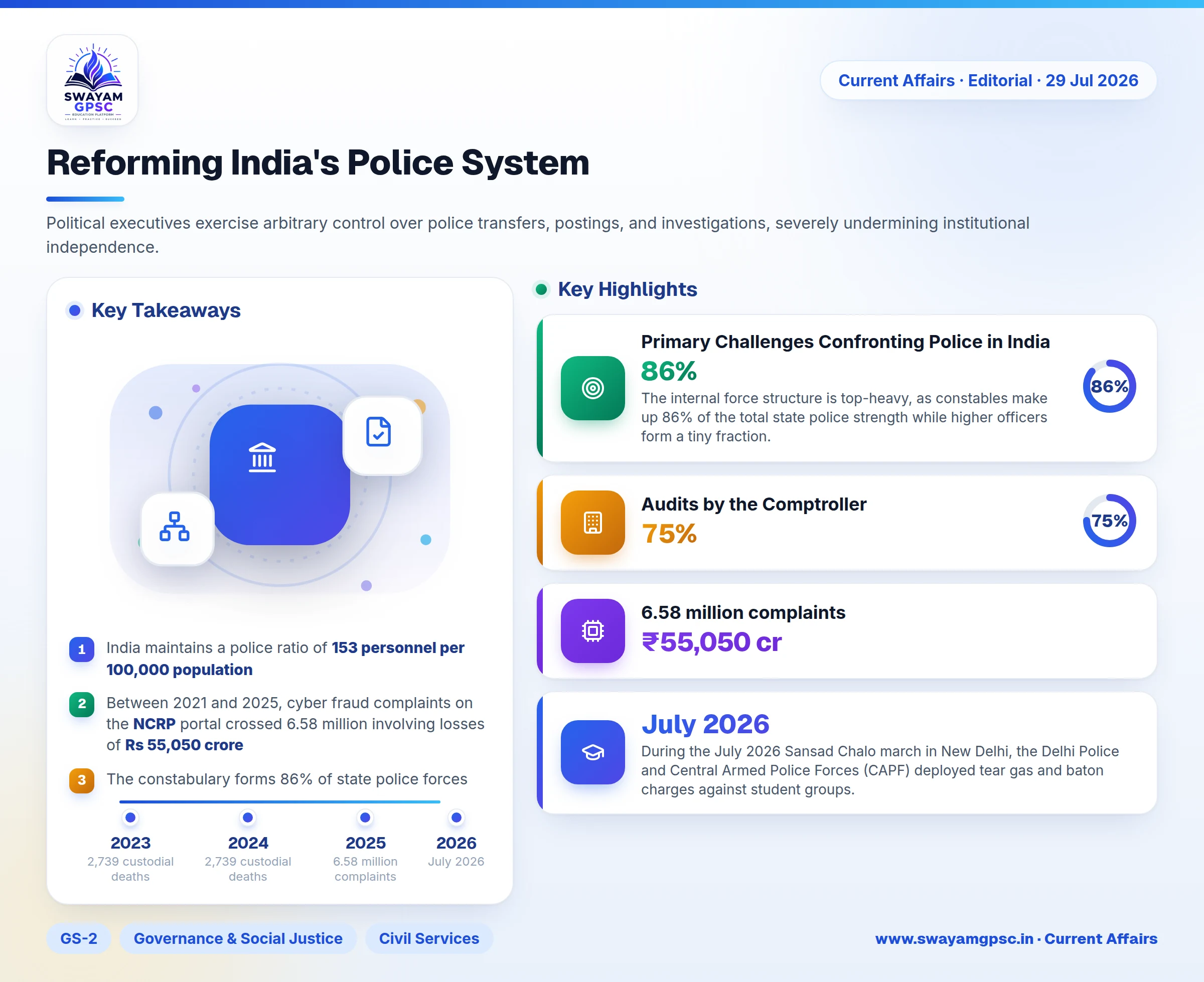
- India maintains a police ratio of 153 personnel per 100,000 population, which falls significantly short of the sanctioned level of 196 and the UN benchmark of 222.
- Between 2021 and 2025, cyber fraud complaints on the NCRP portal crossed 6.58 million involving losses of Rs 55,050 crore, but only 1.19 million resulted in formal FIRs.
- The constabulary forms 86% of state police forces, yet these frontline officers face severe promotion stagnation and shoulder heavy operational workloads.
- The National Human Rights Commission reported 2,739 custodial deaths in 2024, underscoring the urgent need for institutional accountability and human rights protections.
- The Supreme Court in Prakash Singh v. Union of India (2006) laid down six mandatory directives, including a 2-year fixed tenure for DGPs and the separation of investigation from law and order.
Why in News
- Excessive force used by law enforcement during recent peaceful student demonstrations at Jantar Mantar highlighted severe systemic breakdowns in standard crowd control procedures.
- This incident underlines the urgent need for a Supreme Court judicial inquiry to fix institutional accountability and prosecute abusive personnel.
Primary Challenges Confronting Police in India
- Law enforcement agencies frequently rely on violent containment methods and aggressive riot control tactics instead of using psychological de-escalation.
- During the July 2026 Sansad Chalo march in New Delhi, the Delhi Police and Central Armed Police Forces (CAPF) deployed tear gas and baton charges against student groups.
- Video recordings showed indiscriminate physical assaults and harassment of female protesters designed to intimidate rather than disperse the crowd.
- Political executives exercise arbitrary control over police transfers, postings, and investigations, severely undermining institutional independence.
- State governments frequently bypass the Supreme Court directives in Prakash Singh v. Union of India (2006) by passing executive ordinances to retain control over police officers.
- India maintains a police ratio of 153 personnel per 100,000 population, which falls well below the sanctioned national level of 196 and the recommended UN benchmark of 222.
- These severe staffing shortages lead to poor investigation quality, huge case backlogs, delayed response times, and eroded public trust.
- The internal force structure is top-heavy, as constables make up 86% of the total state police strength while higher officers form a tiny fraction.
- Ground-level constables shoulder most beat patrolling duties but usually receive only one promotion in their career, leading to low morale and outdated methods.
- Local police stations mix routine law and order management with criminal investigations, diverting detectives to festival duties and VIP security details.
- Reports from the National Crime Records Bureau (NCRB) and the Law Commission show low conviction rates caused by poor forensic handling at crime scenes.
- Audits by the Comptroller and Auditor General (CAG) highlight critical shortages of modern communication tools, non-lethal gear, and transport vehicles, with vehicle deficits reaching up to 75% in some units.
- Frequent reliance on third-degree torture during custodial interrogations continues to taint the human rights record of police forces across the country.
- The National Human Rights Commission reported 2,739 custodial deaths in 2024, 2,400 in 2023, and 1,995 in 2022, affecting mostly vulnerable groups.
- Local cybercrime units lack trained technical experts and cross-border investigation mechanisms needed to track modern digital crimes effectively.
- Data from the Indian Cyber Crime Coordination Centre (I4C) shows that out of 6.58 million complaints on the National Cyber Crime Reporting Portal (NCRP) involving Rs 55,050 crore in fraud between 2021 and 2025, only about 1.19 million led to formal FIRs.
Key Committees, Commissions, and Judgements Related to Police Reforms
- The National Police Commission (1977-1981) chaired by Dharma Vira recommended replacing the colonial Police Act of 1861, creating State Security Commissions, fixing DGP tenures, and separating investigation from law enforcement.
- The Ribeiro Committee (1998) recommended setting up independent Police Establishment Boards and Police Complaints Authorities at district and state levels.
- The Padmanabhaiah Committee (2000) examined structural modernization, constable recruitment standards, career promotion pathways, and increased women representation.
- The Malimath Committee (2002-2003) advocated establishing a National Security Commission, upgrading forensic laboratories, and separating police investigation duties.
- The Second Administrative Reforms Commission (2007) recommended insulating police operations from political interference, forming specialized cyber cadres, and promoting community policing.
- The Model Police Act Committee (2005-2006) drafted the Model Police Act, 2006 to introduce operational autonomy and strict human rights compliance.
- In Prakash Singh v. Union of India (2006), the Supreme Court issued six binding directives, including a 2-year fixed tenure for DGPs, functional separation of investigation, and setting up State Security Commissions.
- In D.K. Basu v. State of West Bengal (1997), the Supreme Court mandated specific custodial safeguards, including timely family notification and compulsory medical examinations.
- In Paramvir Singh Saini v. Baljit Singh (2020), the Supreme Court ordered mandatory installation of night-vision CCTV cameras with audio recording facilities inside all police stations and lockups.
Structural Reforms Required to Enhance Police Effectiveness
- Law enforcement agencies should establish social media monitoring centers to anticipate crowd gatherings and prevent violent clashes through proactive communication.
- Authorities must set clear medical protocols and maintain transparent dialogue during high-profile activist hunger strikes to avoid triggering widespread public outrage.
- Governments must fully implement the Prakash Singh (2006) directives by creating independent State Security Commissions to protect police leadership from arbitrary political transfers.
- Police departments must integrate CCTNS and ICJS data with artificial intelligence tools to enable predictive policing and scientific force deployment.
- States should set up a dedicated State Investigation Fund to provide forensic and travel budgets directly to specialized investigative units without bureaucratic delays.
- Urban police stations should set up dedicated restorative justice cells with trained mediators to resolve minor civil and non-heinous community disputes outside courtrooms.
- India needs an autonomous National Police Staff College for joint leadership training across civil services, alongside lateral entry for policy and psychology experts.
- Police forces should implement mandatory rotation policies across administrative, intelligence, and community desks to build skills and boost morale among constables.
- Each state should establish an independent statutory Police Ombudsman to protect internal whistleblowers reporting illegal orders or political interference.
Conclusion
- Overcoming structural deficits and political interference will transform the Indian police force into a citizen-centric institution that protects human rights and upholds the rule of law.