Reforming India's Plastic Waste Management and Extended Producer Responsibility Framework
#GS-3 #Environment #Pollution #Sustainable Development #Current Events #National #Plastic Waste Management #Extended Producer Responsibility
Key takeaways
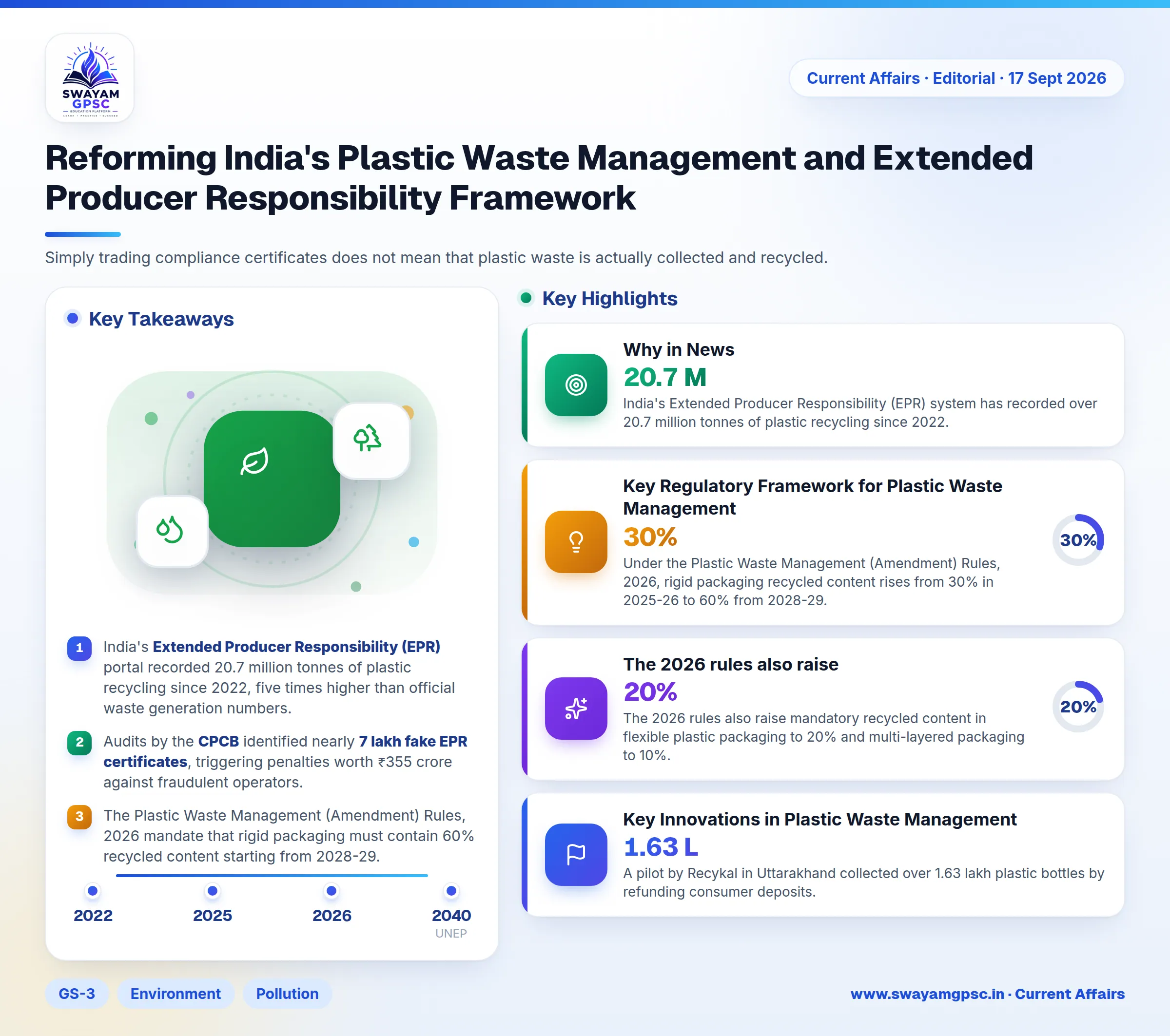
- India's Extended Producer Responsibility (EPR) portal recorded 20.7 million tonnes of plastic recycling since 2022, five times higher than official waste generation numbers.
- Audits by the CPCB identified nearly 7 lakh fake EPR certificates, triggering penalties worth ₹355 crore against fraudulent operators.
- The Plastic Waste Management (Amendment) Rules, 2026 mandate that rigid packaging must contain 60% recycled content starting from 2028-29.
- A CAG audit revealed that Punjab urban local bodies treated only 35% of daily waste in 2021-22, while recovering a mere 0.52% of projected user fees.
- According to UNEP, expanding reuse systems and deposit refund models can lower global plastic pollution by 30% by 2040.
Why in News
- India's Extended Producer Responsibility (EPR) system has recorded over 20.7 million tonnes of plastic recycling since 2022.
- This reported recycling volume is five times greater than the nation's official plastic waste generation numbers.
- Despite these massive figures on paper, plastic waste continues to leak heavily into natural ecosystems across the country.
- This contradiction reveals severe weaknesses in regulatory enforcement, data verification, and digital record transparency.
- Simply trading compliance certificates does not mean that plastic waste is actually collected and recycled.
- India urgently needs to move away from paper compliance toward product design reforms, source reduction, and field-level monitoring.
Key Regulatory Framework for Plastic Waste Management
- The Plastic Waste Management Rules, 2016 govern plastic waste across production, consumption, collection, recycling, and final disposal.
- These rules expanded regulatory oversight to rural jurisdictions, making Gram Panchayats key bodies for local enforcement.
- Waste generators must segregate plastic at source, avoid littering, and hand recyclables directly to authorized collection agencies.
- Recent amendments to the rules shift regulatory focus from simple waste collection toward circular design standards.
- Under the Plastic Waste Management (Amendment) Rules, 2026, rigid packaging recycled content rises from 30% in 2025-26 to 60% from 2028-29.
- The 2026 rules also raise mandatory recycled content in flexible plastic packaging to 20% and multi-layered packaging to 10%.
- Exemptions apply when food, pharmaceutical, or chemical regulators like the FSSAI or the Central Insecticides Board restrict recycled plastics.
- The Guidelines on Extended Producer Responsibility for Plastic Packaging, 2022 establish mandatory targets for producers, importers, and brand owners.
- These guidelines categorize plastic into rigid, flexible, multi-layered, and compostable packaging with distinct recycling quotas.
- Producers must register on the CPCB digital portal and purchase verified recycling credits from registered recyclers.
- The Food Safety and Standards (Packaging) Regulations, 2018 prevent chemical contamination and microplastic risks in food-contact materials.
- A 2025 amendment by FSSAI permits processed recycled PET (rPET) in food packaging under strict safety standards.
- The Hazardous and Other Wastes Rules, 2016 implement India's international obligations under the Basel Convention.
- India banned the import of solid plastic waste in 2019 to stop foreign waste dumping on domestic soil.
- Customs authorities hold the legal authority to turn away and re-export illegal international waste shipments.
- The Environment (Protection) Act, 1986 gives the Union Government broad powers to regulate plastic pollution and penalize violators.
- Authorities impose environmental penalties using the Polluter Pays Principle, affirmed in the landmark Vellore Citizens' Welfare Forum (1996) judgment.
- The National Green Tribunal Act, 2010 offers a judicial forum for citizens to demand environmental cleanup and penalize non-compliance.
Key Innovations in Plastic Waste Management
- Advanced chemical recycling like pyrolysis breaks down contaminated, low-grade, and multilayered plastics into valuable hydrocarbon oils.
- For example, Navi Mumbai firm APChemi refines plastic pyrolysis oil into chemical feedstock through its PUREMAX technology.
- Robotics and computer vision are replacing risky manual waste sorting with automated sorting systems.
- Ahmedabad startup Ishitva Robotic Systems builds AI-powered robotic arms that sort plastics quickly by polymer type and color.
- Mobile platforms and deposit-return networks use QR codes and direct digital payments to reward bottle returns.
- A pilot by Recykal in Uttarakhand collected over 1.63 lakh plastic bottles by refunding consumer deposits.
- The digital intelligence platform run by Banyan Nation tracks recycled plastics from waste pickers to commercial buyers.
- Advanced mechanical recyclers use hot washing and decontamination to produce high-grade food contact resins from discarded bottles.
- Banyan Nation has produced more than 3 billion bottles using certified recycled plastic, avoiding low-value downcycling.
- Engineers are turning mixed end-of-life plastic waste into geocells and aggregate substitutes for highway construction.
- In 2025, a road project on the DND-Faridabad-KMP Expressway incorporated 30 tonnes of end-of-life plastic into sub-base geocells.
- This road building approach absorbs difficult multi-layered plastics while cutting down the need for natural gravel.
- Startups are manufacturing biodegradable packaging from farm residues like bagasse, paddy straw, and seaweed.
- The India Plastic Challenge-Hackathon funded alternative materials made from paddy straw to tackle packaging waste and stubble burning.
- More than 150 manufacturers presented sustainable bio-based alternatives at the central government's National Expo.
- River interception technologies stop plastic debris before it breaks apart into tiny microplastics or reaches open waters.
- In 2026, The Ocean Cleanup launched an automated river interception project to trap floating waste across Mumbai.
- These cleanup systems deploy floating booms, solar-powered interceptors, and automated conveyor belts linked to local recycling centers.
- Cities are integrating informal waste workers into formal municipal services through organized worker cooperatives.
- In Pune, the SWaCH cooperative unites 3,000 waste pickers to serve 6 lakh households and recover 50,000 tonnes of waste yearly.
- This cooperative model guarantees worker identity cards, reliable doorstep collection, and direct income from collected recyclable items.
Challenges
- Plastic consumption is growing much faster than local processing capacities, while inaccurate waste numbers hide the real crisis.
- The CPCB reported national plastic waste generation at 4.13 million tonnes during 2022-23.
- Independent studies estimate annual plastic waste generation between 4-9 million tonnes, revealing missing rural and informal data.
- These wide data gaps prevent municipal bodies from correctly sizing their recycling facilities and processing machinery.
- Poor segregation at homes contaminates clean plastic with food and wet waste, sending useful recyclables straight to dump yards.
- In Ernakulam district, 89% of the 8,941 tonnes of non-biodegradable waste collected in 2025 was discarded as unrecyclable reject waste.
- Multi-layered packaging combines thin plastic films, adhesives, and aluminium foils, making physical material separation nearly impossible.
- Waste pickers routinely ignore multi-layered sachets because of their low resale value, leaving them scattered across open landscapes.
- Sending multi-layered plastics to cement kilns is simple thermal disposal rather than genuine material recycling.
- Weak digital verification allows corrupt companies to buy fake compliance certificates rather than physically recycling scrap.
- Government investigations identified nearly 7 lakh fake EPR certificates, resulting in penalties totaling around ₹355 crore.
- The current regulatory system focuses heavily on registered firms while ignoring millions of unregistered informal manufacturers.
- Urban local bodies lack sufficient revenue, trained waste engineers, and processing machinery to handle daily plastic waste.
- A CAG audit in Punjab revealed that cities treated only 35% of daily waste in 2021-22, while recovering just 0.52% of projected user fees.
- Informal waste pickers manually sort dangerous materials without gloves, respiratory masks, medical cover, or fair financial earnings.
- When cities introduce mechanized collection, private contractors frequently push traditional waste pickers away from high-value recyclables.
- Piles of abandoned plastic are burned on streets and open dumps, releasing dangerous dioxins, furans, and particulate matter.
- Burning plastic in cement kilns converts fossil carbon directly into greenhouse-gas emissions, discouraging true material circularity.
- Tiny microplastics wash into waterways, enter farm soils through sewage sludge, and accumulate inside human food chains.
- An ICMR study in Bhopal detected 10-15 microplastic particles per litre in treated municipal wastewater.
- These microscopic particles carry dangerous heavy metals and chemical additives, posing severe long-term threats to public health.
Way Forward
- India should establish binding reduction quotas for virgin plastic use and expand standardized refillable packaging networks.
- A dedicated levy on virgin plastic would help make recycled materials more cost-competitive for commercial packaging makers.
- The UNEP reports that scaling up reusable container systems can cut overall plastic pollution by 30% by 2040.
- Regulators should adopt eco-modulated EPR fees, charging higher penalties on non-recyclable items and discounting easy-to-recycle materials.
- South Korea grants up to a 50% fee reduction for highly recyclable products, showing how smart fee structures influence design.
- Every plastic product should carry a digital recyclability passport that discloses all additives, pigments, and polymer layers.
- A practical scalability test would stop greenwashing by barring claims for materials that lack commercial recycling facilities.
- The central EPR portal should cross-check recycling claims against real-time GST invoices, e-way bills, and weighbridge records.
- Authorities should blacklist fraudulent recycling firms and hold company directors personally responsible for bogus certificates.
- States should build regional recycling hubs connecting small towns and rural panchayats through coordinated transport systems.
- EPR trust funds should pay municipal bodies a fixed per-tonne fee to cover the real cost of collecting low-value plastics.
- Municipalities must integrate informal waste pickers into the formal system using identity cards, stable service fees, and social protections.
- The World Bank highlights that integrating informal waste collectors is essential for building sustainable producer responsibility models.
- The government should roll out a national microplastics action program to sample drinking water, farm soils, and coastal waters.
- Authorities should introduce mandatory microfibre filters for industrial washing machines and set durability limits on car tyres.
- India should align its domestic waste management rules with the legally binding targets of the emerging Global Plastics Treaty.
Frequently Asked Questions
- Under the PWM Rules, producers must collect all plastic packaging they generate and fulfill recycling quotas using verified EPR certificates.
- The certificate market faces criticism because unchecked portals allowed companies to trade paper credits without physical recycling.
- Plastic Waste Processors process physical waste and generate certified digital EPR credits based on capacity guidelines set by CPCB.
- Multi-layered plastics contain blended aluminium and polymer layers that make chemical separation expensive, causing high environmental littering.
- The Plastic Waste Management (Amendment) Rules, 2026 mandate progressive recycled plastic targets, shifting policy focus toward design circularity.
Conclusion
- India's EPR system must quickly shift from paper certificate transactions into a verifiable circular economy.
- Regulators must eliminate fake credits by demanding strict material traceability, source reduction, and eco-friendly product designs.
- Policy success must ultimately be judged by real declines in virgin plastic use and environmental leakage rather than traded certificates.