Reforming India's Food Safety Ecosystem for Public Health and Trade
#GS-2 #Governance & Social Justice #Regulatory Bodies #Health #GS-3 #Economy #Food Security #Agriculture #Science & Technology #Biotechnology #Environment #Sustainable Development #Current Events #National #FSSAI #Food Processing
Why in News
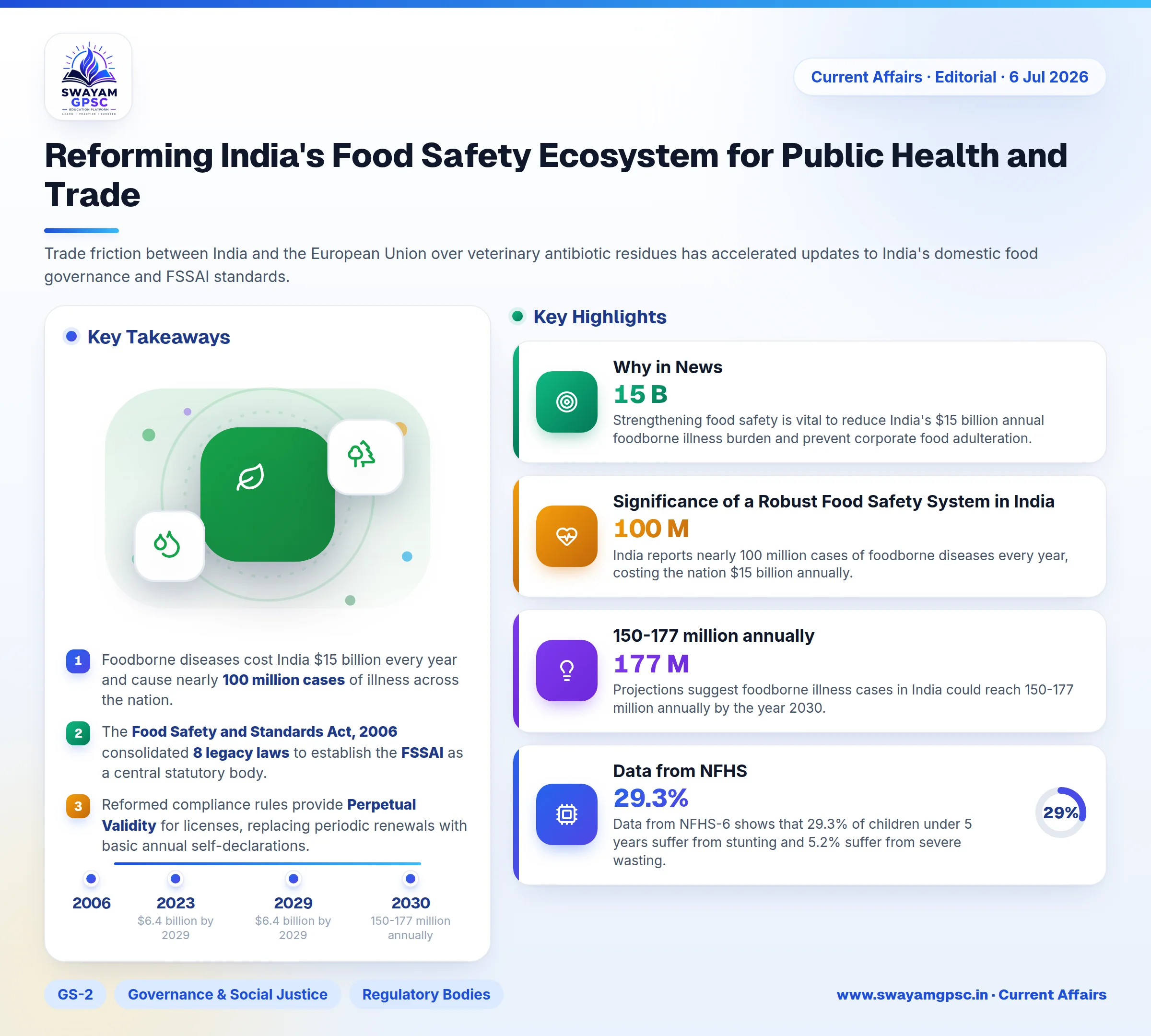
- Trade friction between India and the **European Union** over **veterinary antibiotic residues** has accelerated updates to India's domestic food governance and **FSSAI** standards.
- Strengthening food safety is vital to reduce India's **$15 billion** annual foodborne illness burden and prevent corporate food adulteration.
- Building a resilient system requires adopting modern technology like **AI-driven predictive modeling**, satellite risk mapping, and computer-vision compliance.
Significance of a Robust Food Safety System in India
- Unsafe food places a heavy financial burden on India that rivals the impact of malaria, HIV/AIDS, and tuberculosis combined.
- India reports nearly **100 million cases** of foodborne diseases every year, costing the nation **$15 billion** annually.
- Projections suggest foodborne illness cases in India could reach **150-177 million annually** by the year **2030**.
- According to the **World Health Organisation (WHO)**, India **ranks 15th** globally in Years of Life Lost due to contaminated food.
- Contaminated food causes severe digestive infections that stop young children from absorbing necessary nutrients properly.
- Data from **NFHS-6** shows that **29.3%** of children under 5 years suffer from stunting and **5.2%** suffer from severe wasting.
- Dangerous bacteria like **Salmonella** and **E. coli** cause long-term gut problems that make national nutrition programs like **POSHAN Abhiyaan** less effective.
- Strict legal oversight protects honest business owners while stopping companies from deliberately selling adulterated food products.
- Enforcement actions revealed serious adulteration involving chemical contaminants like **ethylene glycol in milk** along with fake paneer and synthetic milk networks.
- Meeting international **Sanitary and Phytosanitary (SPS)** standards under the **WTO** protects India's agricultural exports and maintains global trade trust.
- Indian exports of spices, seafood, and rice often face border rejections from agencies like the European Food Safety Authority and the US FDA.
- Frequent causes for export rejections include **ethylene oxide residues** in spices, aflatoxins in peanuts, and heavy metals like lead in rice.
- Unregulated exposure to **pesticide residues** in crops leads to long-term health risks including hormonal imbalances and cancer.
- Using non-therapeutic **antibiotics as growth promoters** in livestock builds drug resistance and weakens critical human medicines against **Antimicrobial Resistance (AMR)**.
- India's packaging market has crossed **$86 billion** in value, making it the **3rd largest** packaging market in the world.
- The packaged food sector in India is expected to grow from **$2.8 billion** in 2023 to **$6.4 billion by 2029**.
- Millions of workers rely on street food, but vendors often lack clean municipal water, proper waste management, and hygiene training.
- Unsubstantiated claims like **100% Organic** or **Diabetic-Friendly** confuse buyers on e-commerce sites, requiring **FSSAI** to mandate clear license displays.
- New regulations require health supplement makers to record batch details, limit active ingredients, and perform **stability and shelf-life studies**.
Legal and Institutional Measures Governing Food Safety in India
- The **Food Safety and Standards Act, 2006 (FSS Act)** acts as the central law for food safety in India.
- This law combined **8 legacy laws**, including the Prevention of Food Adulteration Act, 1954, into one single legislative framework.
- The Act changed India's approach from reactive adulteration checks to a preventive, science-based safety system across the supply chain.
- The **Food Safety and Standards Authority of India (FSSAI)** was set up as a **statutory body** under the **FSS Act, 2006**.
- The FSSAI board consists of a **Chairperson and 22 members**, where at least one-third of the positions are reserved for women.
- Scientific panels within FSSAI determine **Maximum Residue Limits (MRLs)** for pesticides and chemicals in alignment with **Codex Alimentarius** benchmarks.
- State governments appoint a **Commissioner of Food Safety** to oversee nationwide implementation of food safety regulations at the state level.
- District level **Designated Officers (DOs)** issue business licenses and approve legal prosecutions against non-compliant businesses.
- Frontline **Food Safety Officers (FSOs)** inspect manufacturing sites, collect official food samples, and issue corrective notices to operators.
- The government simplified licensing by introducing **Perpetual Validity**, which replaces frequent renewals with simple annual self-declarations.
- Businesses with an annual turnover up to **Rs 1.5 Crore** receive instant FSSAI registration without prior physical inspections.
- State authorities handle licenses for food businesses generating an annual turnover between **Rs 1.5 Crore and Rs 50 Crore**.
- The Central FSSAI authority directly manages licenses for large enterprises earning over **Rs 50 Crore** annually.
- Regulators use the **Food Safety Compliance System (FoSCoS)** portal to digitize documentation, track supply chains, and improve transparency.
- Routine testing happens through state labs, **NABL-accredited** private facilities, and specialized National Reference Laboratories.
- Mobile units called **Food Safety on Wheels (FSWs)** travel to remote areas to run fast, on-the-spot testing for adulterants.
- The **Eat Right India** campaign encourages citizens to cut down on excessive salt, sugar, and saturated fat consumption.
- Under **FoSTaC**, every certified food business must employ one certified Food Safety Supervisor for every 25 handlers.
- FSSAI certifies clean food hubs across public market zones, corporate offices, and religious places through programs like **BHOG**.
Way Forward
- Regulatory agencies should use machine learning to predict food adulteration hotspots by analyzing price spikes, weather patterns, and crop yields.
- If tomato production drops suddenly in a region, automated systems can trigger immediate audits of local ketchup factories.
- Deploying **Portable DNA Barcoding** devices at market entry points will allow field officers to identify fake food products within minutes.
- Using ISRO satellite data for **Geospatial Pre-Harvest Mapping** can identify high-risk **Aflatoxin Hotspots** in crops weeks before harvesting.
- Installing computer-vision AI inside cloud kitchens enables automatic tracking of hygiene violations like missing hairnets or improper food handling.
- Replacing plastic packaging with **Active Bio-Preservative Films** made from neem or turmeric extracts can eliminate harmful bacteria naturally.
- Linking FSSAI hygiene audit scores with business credit profiles through financial aggregators offers lower interest rates to compliant food businesses.
Conclusion
- Building a modern food safety system is essential for protecting national public health and securing India's trade economy.
- Combining strong statutory standards with decentralized AI technology helps eliminate foodborne risks across the entire supply chain.