Reforming Fire Safety in Indian Cities
#GS-1 #Urbanization #GS-2 #Government Policies & Interventions #GS-3 #Disaster Management #Infrastructure #Good Governance
Key takeaways
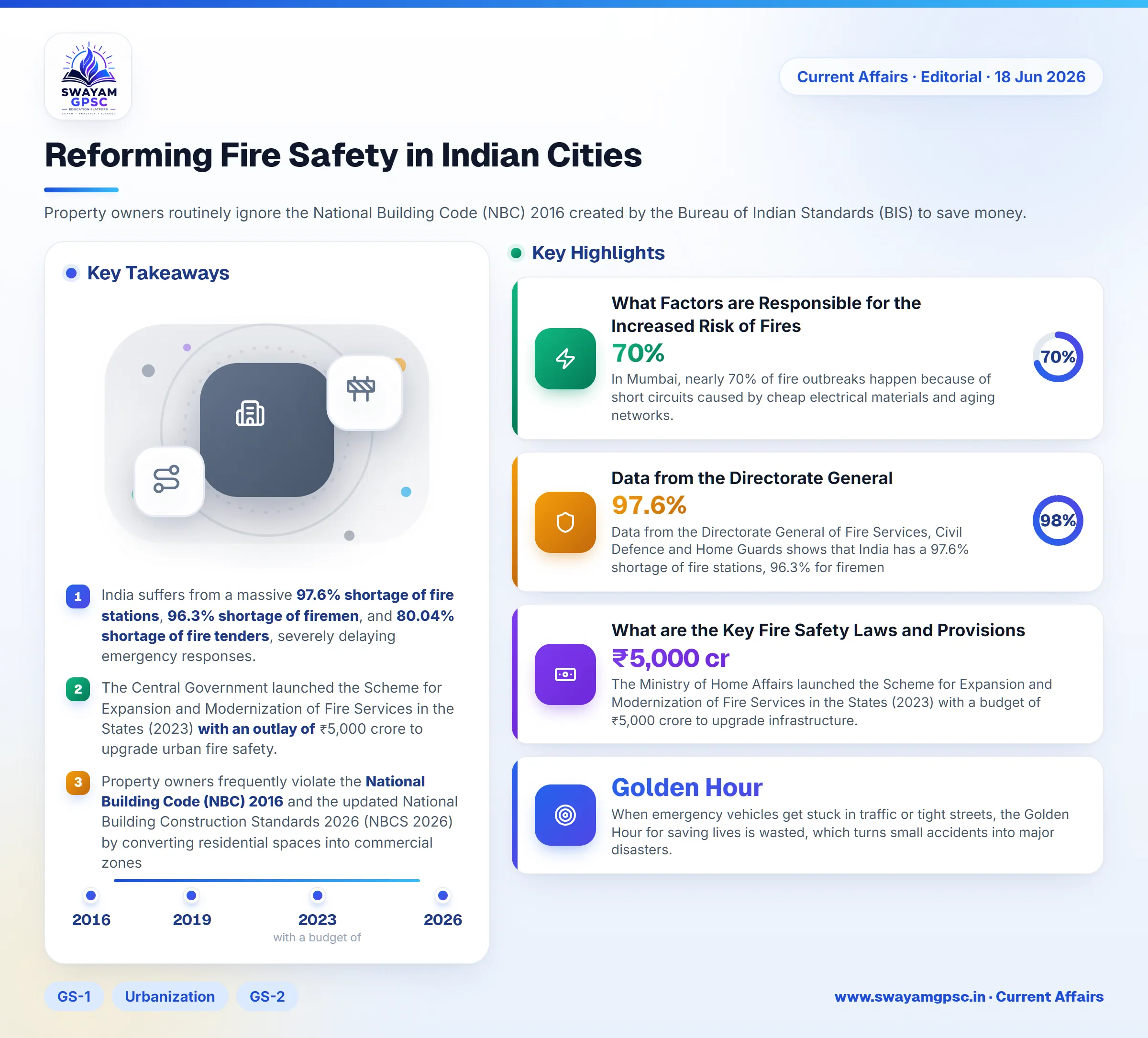
- India suffers from a massive 97.6% shortage of fire stations, 96.3% shortage of firemen, and 80.04% shortage of fire tenders, severely delaying emergency responses.
- The Central Government launched the Scheme for Expansion and Modernization of Fire Services in the States (2023) with an outlay of ₹5,000 crore to upgrade urban fire safety.
- Property owners frequently violate the National Building Code (NBC) 2016 and the updated National Building Construction Standards 2026 (NBCS 2026) by converting residential spaces into commercial zones without safety upgrades.
- In Mumbai, nearly 70% of all fire outbreaks are caused by electrical short circuits due to aging networks and substandard wiring materials.
Why in News
- A recent editorial published in the Business Standard on June 17, 2026, discusses Delhi's recurring fire tragedies and urban failures.
- The article points out that widespread illegal building practices, bribery among officials, and public indifference have turned preventable fires into normal occurrences.
- It calls for urgent civic responsibility and stronger administrative accountability to protect citizens from deadly urban fires.
What Factors are Responsible for the Increased Risk of Fires in Urban Areas?
- Property owners routinely ignore the National Building Code (NBC) 2016 created by the Bureau of Indian Standards (BIS) to save money.
- For example, people frequently turn residential homes into commercial spaces like warehouses or restaurants without adding proper safety features.
- Unplanned city growth creates confusing urban traps with narrow lanes that block modern fire trucks from reaching emergency spots.
- When emergency vehicles get stuck in traffic or tight streets, the Golden Hour for saving lives is wasted, which turns small accidents into major disasters.
- Fire services are handled by individual states and listed under the XII Schedule of the Constitution via Article 243(W), leading to a split and weak regulatory system.
- Corrupt officials often issue No Objection Certificates (NOCs) to builders even when buildings lack basic fire safety tools like alarms and sprinklers.
- Inspections are often ignored, allowing dangerous places like coaching classes and gaming centers to stay open despite huge safety gaps.
- In a tragic incident in Hauz Rani located in South Delhi, 21 people died at a bed-and-breakfast hotel running 26 rooms on a permit for 6 without any fire clearance.
- Many homes and offices plug heavy machines like 1.5-tonne air conditioners into old electrical wiring designed only for basic lighting.
- In Mumbai, nearly 70% of fire outbreaks happen because of short circuits caused by cheap electrical materials and aging networks.
- Most older residential and commercial buildings do not have Arc-Fault Circuit Interrupters (AFCI) that cut power before a spark creates a fire.
- India suffers from a severe shortage of specialized fire-forensic tools and smart early detection systems.
- Data from the Directorate General of Fire Services, Civil Defence and Home Guards shows that India has a 97.6% shortage of fire stations, 96.3% for firemen, and 80.04% for fire tenders and rescue vehicles.
- Many businesses break safety rules by turning common spaces like stairwells and parking basements into storage areas for flammable goods.
- In September 2011, the West Bengal fire services department warned AMRI Hospital, Kolkata for using its basement to store LPG cylinders, mattresses, and wooden boxes instead of cars.
- Despite a three-month deadline to fix this, the hospital ignored the warning, and a severe fire broke out there in December 2011.
- Modern high-rise glass buildings use central heating and ventilation systems that lack smoke-exhaust mechanisms, turning air ducts into highways for toxic smoke.
- Since smoke inhalation causes most deaths in high-rise fires, the lack of automated smoke-management systems makes building-wide evacuations nearly impossible.
What are the Key Fire Safety Laws and Provisions for Buildings in India?
- The Bureau of Indian Standards (BIS) published the National Building Construction Standards 2026 (NBCS 2026) to guide the design and maintenance of buildings across the country, replacing the older National Building Code of India (NBC) 2016.
- The new standard shifts from a strict mandatory code to an advisory guidance framework, giving local governments more power over administrative and height requirements.
- While the older NBC 2016 required safety compliance for residential buildings taller than 15 meters, the NBCS 2026 raised this limit to structures 24 meters or taller.
- Because fire control is a state subject, individual states pass their own rules like the Maharashtra Fire Prevention and Life Safety Measures Act of 2006 and the Tamil Nadu Fire Service Act of 1985.
- These state laws require commercial buildings and high-rises to get a Fire No Objection Certificate (NOC) or Fire Safety Certificate (FSC) from local authorities.
- The Central Government created the Model Bill to Provide for the Maintenance of Fire and Emergency Service for the State in 2019 to help states modernize their local fire laws.
- This model bill encourages states to use advanced tools like GPS and better fire trucks while adding stricter penalties for rule-breakers.
- Several states, including Andhra Pradesh, have updated their old laws to match this modern central framework.
- Buildings must follow strict Indian Standards such as IS 2189 for automated fire alarms, IS 15683 for portable extinguishers, and IS 16947 for fire-resistant glass.
- For factories and manufacturing plants, the Factories Act, 1948 acts as the main law holding owners responsible for emergency exits and worker safety drills.
- The Ministry of Home Affairs launched the Scheme for Expansion and Modernization of Fire Services in the States (2023) with a budget of ₹5,000 crore to upgrade infrastructure.
- This funding helps buy modern fire tenders and hydraulic platforms for high-rises while digitizing communication networks and building fire forensics.
What Measures can be Adopted to Improve Fire Resilience in Urban Areas?
- Cities should set up small Micro-Fire Stations in crowded areas instead of depending only on distant, heavy fire trucks.
- Using fire scooters or mini-tenders equipped with compressed air foam systems helps firefighters navigate narrow streets and tackle fires within the first 3 to 5 minutes.
- Urban local bodies should build Digital Twin models for high-risk zones by connecting real-time sensor data with building blueprints.
- During an emergency, control rooms can use digital twins to check internal layouts and guide first responders using augmented reality headsets.
- High-rise buildings should link all smoke sensors wirelessly to a central building management system to automate safety responses during a fire.
- Automated systems should recall elevators to the ground floor, activate stairwell fans to keep out smoke, and cut power to affected floors instantly.
- City planners should adopt blue-green infrastructure by building underground water reservoirs and planting fire-resistant green belts along roads.
- Using blockchain technology for safety audits can keep an unchangeable public record of all fire inspection reports and maintenance logs.
- This transparent system stops corrupt officials and builders from back-dating certificates or falsifying safety records.
- Municipalities can use crowdsourced mobile apps to let ordinary citizens report blocked lanes or illegal wiring, creating a live heatmap of urban fire risks.
- Governments should partner with insurance companies to link property insurance costs directly to a building's fire safety score.
- Buildings that install advanced IoT sensors and fire suppression systems should receive tax rebates and lower insurance premiums to make safety financially rewarding.
Way Forward
- India's urban fire crisis happens because of poor governance, corruption, and unplanned growth rather than simple bad luck.
- The country must move past temporary punishments after a disaster and focus instead on systemic prevention.
- Integrating smart technology, decentralizing firefighting tools, and enforcing strict accountability through digital records are essential steps.
- Without replacing public apathy with a genuine culture of safety, rapid urban growth will remain deeply dangerous for everyone.