Reforming Corporate Sector for Global Competitiveness
#GS-3 #Economy #Capital Market #Growth & Development #Infrastructure #Agriculture #Employment #Science & Technology
Key takeaways
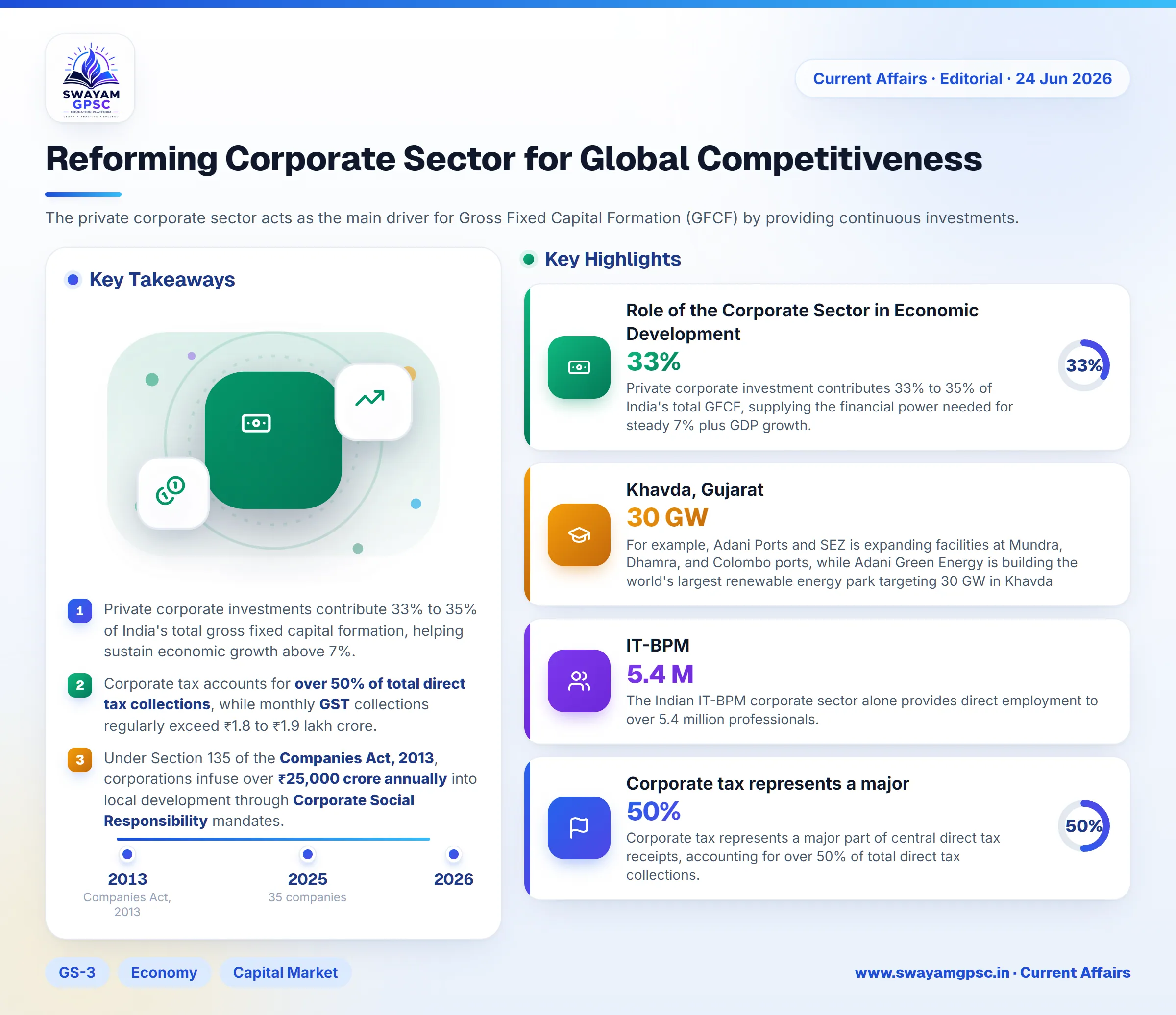
- Private corporate investments contribute 33% to 35% of India's total gross fixed capital formation, helping sustain economic growth above 7%.
- Corporate tax accounts for over 50% of total direct tax collections, while monthly GST collections regularly exceed ₹1.8 to ₹1.9 lakh crore.
- Under Section 135 of the Companies Act, 2013, corporations infuse over ₹25,000 crore annually into local development through Corporate Social Responsibility mandates.
- India's Incremental Capital Output Ratio stands at 4.3, reflecting higher capital requirements per unit of output compared to past high-growth Asian economies.
- The MSME sector faces a massive credit gap of ₹30 lakh crore, with small enterprises receiving only 4% to 5% of total bank credit.
Why in News
- A recent editorial published in the Indian Express on 24 June 2026 highlights the need to transform India's business landscape.
- Moving toward a high-income status requires shifting domestic companies into high-margin global scale-ups.
- This transformation demands fixing profit inequalities and reducing regulatory friction through technology partnerships and shared value networks.
Role of the Corporate Sector in Economic Development
- The private corporate sector acts as the main driver for Gross Fixed Capital Formation (GFCF) by providing continuous investments.
- Private corporate investment contributes 33% to 35% of India's total GFCF, supplying the financial power needed for steady 7% plus GDP growth.
- Major Indian business houses are expanding greenfield and brownfield projects, such as the Adani Group's extensive infrastructure footprint.
- For example, Adani Ports and SEZ is expanding facilities at Mundra, Dhamra, and Colombo ports, while Adani Green Energy is building the world's largest renewable energy park targeting 30 GW in Khavda, Gujarat.
- The corporate sector drives formal employment by shifting excess labor from low-productivity agriculture to organized secondary and tertiary fields.
- The Indian IT-BPM corporate sector alone provides direct employment to over 5.4 million professionals.
- Corporate manufacturing also drives formal job creation through regular payroll additions under the Employees' Provident Fund Organisation (EPFO).
- The corporate sector acts as a vital revenue source for public welfare and infrastructure by strengthening tax collections.
- Corporate tax represents a major part of central direct tax receipts, accounting for over 50% of total direct tax collections.
- Leading entities like Reliance Industries, HDFC Bank, and State Bank of India consistently rank among the highest corporate taxpayers.
- Integrated supply chains help monthly GST collections regularly surpass ₹1.8 to ₹1.9 lakh crore.
- Corporate growth scales domestic manufacturing to global standards, bringing in foreign exchange and easing current account imbalances.
- India's merchandise and services exports now cross $750 billion annually.
- Pharmaceutical leaders like Sun Pharma and Dr. Reddy's Laboratories establish India as a global pharmacy hub.
- Manufacturing firms like Foxconn India and Tata Electronics lead global smartphone supply chains under the Production Linked Incentive (PLI) scheme.
- The private corporate sector accounts for roughly 36% of India's Gross Expenditure on R&D (GERD) in high-tech areas like biopharmaceuticals and automotive engineering.
- Automotive firms like Mahindra & Mahindra and Tata Motors invest heavily in indigenous electric vehicle architectures.
- Space startups like Skyroot Aerospace work through IN-SPACe platforms to build local satellite launch systems.
- Corporates channel idle retail savings into long-term capital assets through public equity issues, corporate bonds, and banking channels.
- Initial public offerings from firms like Zomato convert retail savings into corporate working capital.
- Industrial corridors and Special Economic Zones help spread economic development beyond traditional metropolitan centers.
- Targeted corporate factory setups have transformed locations like Sri City in Andhra Pradesh and Sanand in Gujarat into multi-billion-dollar export hubs.
- Under the Companies Act, 2013, Section 135 mandates that qualifying companies spend 2% of their average net profits on Corporate Social Responsibility.
- This legal requirement infuses over ₹25,000 crore annually directly into local social, educational, and environmental projects.
Challenges Faced by the Corporate Sector in India
- Despite healthy bank balance sheets, private investment recovery remains hesitant, with the private share of fixed investment stuck around 33% to 35%.
- Aggregate manufacturing capacity utilization hovers around 74.3%, staying just below the standard 78% to 80% threshold required for major expansions.
- This creates a confidence gap where companies choose cash accumulation over physical asset creation.
- Outside of IT and pharmaceuticals, Indian firms scale mainly within the home market rather than owning global products or patents.
- While India had 35 companies with a turnover exceeding Rs 1 trillion in FY 2025, only Reliance Industries Limited crossed the $10 billion profit threshold.
- India's corporate profit pool concentrates heavily in cyclical sectors, with financials and commodities accounting for 41% and 19% of aggregate profit after tax, respectively.
- India maintains a negligible presence in frontier technology stacks like semiconductors, leaving global profits with foreign giants.
- Indian corporate operations deal with a rising Incremental Capital Output Ratio (ICOR) estimated around 4.3, compared to 3.2 in South Korea and 2.7 in Taiwan during their high-growth decades.
- A higher ICOR means companies must deploy more capital to generate a single unit of economic output due to structural inefficiencies.
- Corporates face heavy price volatility in input commodities, imported base metals, and global freight costs.
- While large blue-chip firms enjoy robust credit, Micro, Small, and Medium Enterprises (MSMEs) face severe credit rationing and high capital costs.
- Small enterprises account for just 4% to 5% of total bank credit in India, down from about 6% a decade ago.
- A report by SIDBI shows that the MSME sector faces a massive credit gap of ₹30 lakh crore.
- Climate adaptation and deep-tech startups remain structurally underfunded due to risk aversion in formal banking channels.
- Multi-state corporations struggle with complex compliance burdens and overlapping regulatory filings at municipal and environmental levels.
- Sudden changes in Quality Control Orders and export-import duties create policy uncertainty that discourages long-term foreign direct investment.
- Geopolitical conflicts and the rise of friend-shoring present major export hurdles for Indian businesses.
- China has weaponized supply chains by restricting technicians at Apple-Foxconn facilities and curbing exports of germanium and gallium needed for electronics.
- Corporate hiring surveys point to low formal employability rates, with the India Skills Report 2025 showing only 54.81% of graduates are employable at industry standards.
- Companies are forced to spend internal resources on remedial training while engaging in destructive talent wars for specialized skills.
Way Forward
- Expand Regulatory Sandboxes beyond fintech into hard-to-abate sectors like deep-tech and advanced biotechnology to test innovations in a safe environment.
- Implement an advanced technology sandbox directive that allows aerospace and green energy corporations to run pilots free from legacy compliance burdens.
- Move from a simple philanthropic model to Shared Value Ecosystems by recognizing social infrastructure investments as qualifying CSR credits.
- Incentivize private corporate consortia to co-develop sovereign open-source deep-tech platforms like domestic artificial intelligence models.
- Offer direct Sovereign Tech Tax Credits to domestic conglomerates pooling research capital for local industrial workflows.
- Shift from isolated factories toward self-contained Industrial Communes where housing, green utilities, and clean manufacturing coexist.
- Grant fast-track zoning and special urban status to corporate clusters along major industrial corridors to cut logistical friction.
- Build out the Export Promotion Mission to integrate MSMEs into global value chains using a risk-based customs warehousing model.
- Enhance the credit rating profile of infrastructure corporate bonds to attract patient institutional capital from global pension funds.
- Utilize institutions like the National Bank for Financing Infrastructure and Development and its credit enhancement facility to raise project bond ratings.