Recalibrating India's Strategic Engagement with Central Asia
#GS-2 #Current Events #International #Central Asia #Chabahar Port #SCO #GS-3 #Infrastructure #Economy
Key takeaways
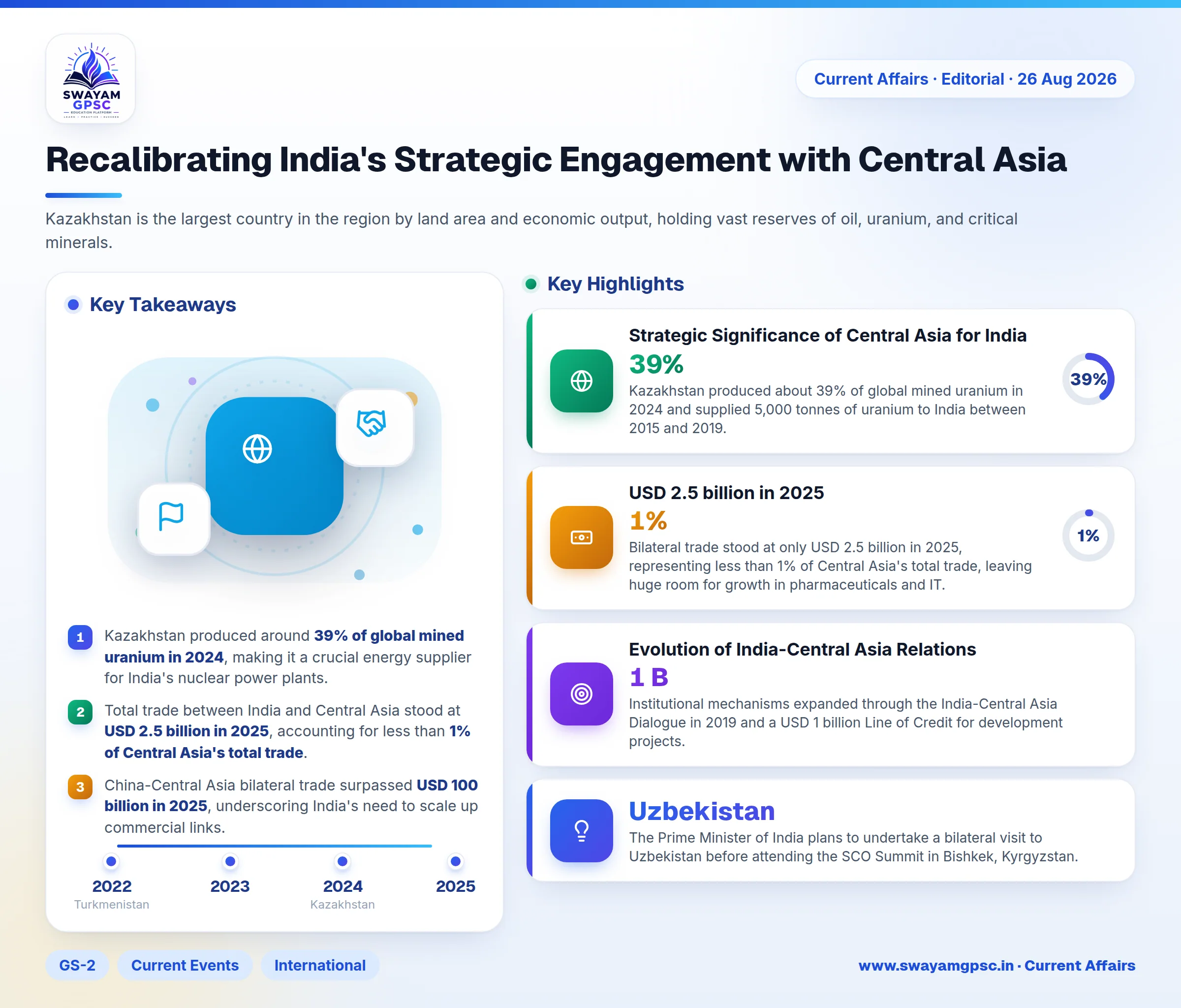
- Kazakhstan produced around 39% of global mined uranium in 2024, making it a crucial energy supplier for India's nuclear power plants.
- Total trade between India and Central Asia stood at USD 2.5 billion in 2025, accounting for less than 1% of Central Asia's total trade.
- China-Central Asia bilateral trade surpassed USD 100 billion in 2025, underscoring India's need to scale up commercial links.
- India has extended a USD 1 billion Line of Credit to support infrastructure and development projects across Central Asian nations.
Why in News
- The Prime Minister of India plans to undertake a bilateral visit to Uzbekistan before attending the SCO Summit in Bishkek, Kyrgyzstan.
- Central Asia is undergoing rapid geopolitical changes as countries seek to diversify their relations away from traditional major powers.
- The strategic importance of trans-Caspian transport corridors and deposits of critical minerals is growing rapidly.
- India must shift its regional strategy toward realistic economic projects, reliable connectivity, and long-term commercial partnerships.
Overview of Central Asian Republics
- Kazakhstan is the largest country in the region by land area and economic output, holding vast reserves of oil, uranium, and critical minerals.
- Kyrgyzstan offers huge hydropower potential and serves as the source region for tributaries of the Syr Darya river.
- Tajikistan shares crucial borders with Afghanistan and China, making it essential for regional hydropower and security.
- Turkmenistan possesses the fourth-largest proven natural gas reserves in the world.
- Uzbekistan is the most populated country in Central Asia, borders all four other republics, and is one of only two doubly landlocked countries globally alongside Liechtenstein.
Major Transformations Reshaping Central Asian Geopolitics
- The five Central Asian nations have held regular Consultative Meetings of their heads of state since 2018 to act as a unified regional bloc.
- The Treaty of Friendship, Good-Neighbourliness and Cooperation signed in 2022 gained complete regional backing after Turkmenistan joined it.
- Member states resolved longstanding border disputes across the sensitive Fergana Valley involving Kyrgyzstan, Tajikistan, and Uzbekistan.
- The expansion into a C5+Azerbaijan (C6) framework links Central Asia directly to the Caspian Sea, South Caucasus, Türkiye, Black Sea, and European markets.
- This expanded framework strengthens the Middle Corridor, which connects China to Europe through Kazakhstan, the Caspian Sea, Azerbaijan, Georgia, and Türkiye.
- Regional states follow a multi-vector foreign policy by building simultaneous ties with Russia, China, the US, the European Union, Türkiye, Japan, Gulf states, and India.
- During 2025, leaders from Central Asia held summit-level talks with top representatives from China, Russia, the EU, the US, and Japan.
- While Russia maintains security influence through the CSTO and the Eurasian Economic Union, the Ukraine conflict has weakened Moscow's regional dominance.
- Western sanctions and supply chain breaks forced Central Asian states to diversify their diplomatic and commercial ties while maintaining functional relations with Moscow.
- China has become the dominant source of infrastructure funding, trade, pipelines, digital networks, and critical mineral projects.
- Initiatives under the Belt and Road Initiative, including the China-Kyrgyzstan-Uzbekistan railway and gas pipelines, are changing Eurasian trade routes.
- Türkiye has expanded the Organization of Turkic States into a strong platform for trade, defence, and connectivity, while Gulf countries like the UAE, Saudi Arabia, and Qatar invest heavily in local energy and infrastructure.
- Kazakhstan joined the Abraham Accords in November 2025 during the C5+1 meeting in Washington, reflecting deeper ties with the US and Israel.
- Washington actively supports Central Asia in critical minerals, energy, artificial intelligence, and transport to reduce dependence on Beijing and Moscow.
- Security concerns regarding Afghanistan have shifted, as the expected spread of extremism after the Taliban's 2021 return did not happen on a large scale.
- Central Asian states now engage pragmatically with Kabul on border security, trade, and shared resources like the Qosh Tepa Canal on the Amu Darya river.
Strategic Significance of Central Asia for India
- Central Asia sits at the crossroads of Russia, China, Afghanistan, Iran, and the Caspian Sea, serving as a continental bridge to Europe.
- The region holds vast deposits of oil, natural gas, uranium, copper, gold, and rare earth elements crucial for India's clean energy and defence industries.
- Kazakhstan produced about 39% of global mined uranium in 2024 and supplied 5,000 tonnes of uranium to India between 2015 and 2019.
- Turkmenistan ranks among the top five holders of natural gas reserves globally, offering valuable energy opportunities for India.
- Securing stability in Central Asia helps India counter terror networks across the Afghanistan-Pakistan-Central Asia arc, as highlighted in the 2022 India-Central Asia NSA meeting.
- Developing alternative transport links like Chabahar Port in Iran helps India bypass Pakistan and access Eurasian markets directly.
- The International North-South Transport Corridor (INSTC) and the Ashgabat Agreement create multi-modal transport links connecting India to the Persian Gulf and Europe.
- Expanding Indian presence in Central Asia balances China's growing dominance under the Belt and Road Initiative and the CPEC.
- Regular engagement through the SCO, the India-Central Asia Summit, and ministerial dialogues keeps India involved in major Eurasian security and economic decisions.
- Bilateral trade stood at only USD 2.5 billion in 2025, representing less than 1% of Central Asia's total trade, leaving huge room for growth in pharmaceuticals and IT.
- Joint military exercises like KAZIND with Kazakhstan, KHANJAR with Kyrgyzstan, and DUSTLIK with Uzbekistan build operational trust near strategic borders.
- Central Asian nations support UN Security Council reforms and back India's bid for a permanent seat in a reformed council.
Evolution of India-Central Asia Relations
- Historical links began along the ancient Silk Route, enriched by Buddhism, Sufism, and ties during the Kushan Empire.
- During the Soviet era, India maintained cultural and educational links through Moscow and opened a Consulate in Tashkent in 1987.
- Following the independence of the five republics in 1991, Indian Prime Minister P.V. Narasimha Rao visited four Central Asian countries between 1993 and 1995.
- Strategic ties grew with the INSTC Agreement in 2000 and the signing of a Strategic Partnership with Kazakhstan in 2009.
- India launched the Connect Central Asia Policy in 2012 to enhance political, energy, IT, healthcare, and educational cooperation.
- Prime Minister Narendra Modi visited all five Central Asian nations in 2015, leading to full SCO membership in 2017 and joining the Ashgabat Agreement in 2018.
- Institutional mechanisms expanded through the India-Central Asia Dialogue in 2019 and a USD 1 billion Line of Credit for development projects.
- The first India-Central Asia Summit in 2022 established specialized Joint Working Groups on Chabahar and Afghanistan in 2023.
Challenges
- India lacks a direct land border with Central Asia because Pakistan denies overland transit access across its territory.
- Key connectivity projects like the INSTC, Chabahar Port, and the TAPI pipeline face delays due to sanctions on Iran and financial roadblocks.
- China holds a structural advantage through shared land borders and massive investments that India cannot match project-for-project.
- Russia retains deep influence in language, military systems, and labor migration, requiring India to expand its presence without upsetting Moscow.
- Bilateral trade remained low at USD 2.5 billion in 2025, compared to over USD 100 billion in China-Central Asia trade, due to high freight costs and poor banking links.
- Instability and terrorism risks in Afghanistan continue to complicate regional connectivity and trade routes.
- Political differences with Türkiye and Azerbaijan over issues like Kashmir complicate India's access to westward trans-Caspian routes.
- Slow implementation of institutional mechanisms, such as delayed meetings of the India-Central Asia Parliamentary Forum, weakens strategic progress.
Way Forward
- India should focus on sectors with clear comparative advantages, such as pharmaceuticals, digital public infrastructure, IT, agro-processing, and critical minerals.
- New Delhi must make Chabahar Port fully operational as a commercial hub by setting up scheduled shipping lines, cargo facilities, and rupee payment mechanisms.
- Establishing a dedicated Central Asia Trade Facilitation Fund will assist Indian MSMEs with warehousing, market entry, and product certification.
- India can export its proven digital public infrastructure, including digital payment systems, e-governance tools, and digital health platforms.
- India should adopt a targeted country-specific strategy, prioritizing uranium and minerals with Kazakhstan, pharmaceuticals with Uzbekistan, natural gas with Turkmenistan, security with Tajikistan, and medical education with Kyrgyzstan.
- Flexible diplomatic engagement with Türkiye and Azerbaijan on trade and transport can expand India's choices without compromising its ties with Armenia.
Conclusion
- Central Asia is moving away from big power rivalry toward regional cohesion and multi-vector diplomacy.
- India must overcome geographical barriers through persistent economic engagement, digital partnerships, and reliable connectivity through Chabahar.