Recalibrating the India-Bangladesh Partnership
#GS-2 #Indian Polity & Constitution #International #Governance & Social Justice #Economy #Infrastructure #Agriculture #Environment #Climate Change #Sustainable Development #India and its Neighbourhood #Look East to Act East #Bilateral Groupings & Agreements #Groupings & Agreements Involving India and/or Affecting India's Interests #Effect of Policies & Politics of Countries on India's Interests
Key takeaways
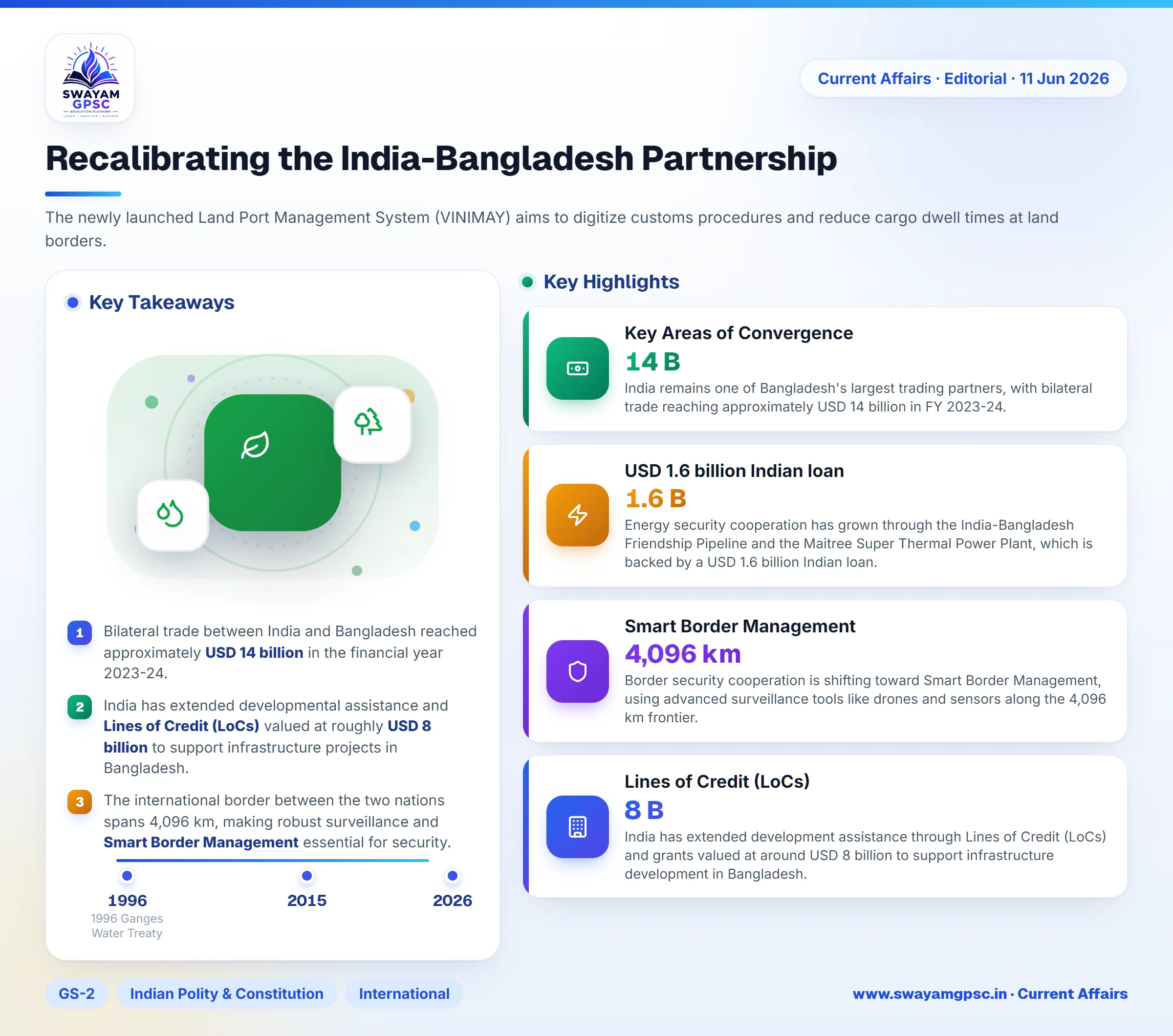
- Bilateral trade between India and Bangladesh reached approximately USD 14 billion in the financial year 2023-24.
- India has extended developmental assistance and Lines of Credit (LoCs) valued at roughly USD 8 billion to support infrastructure projects in Bangladesh.
- The international border between the two nations spans 4,096 km, making robust surveillance and Smart Border Management essential for security.
- The 1996 Ganges Water Treaty is scheduled to expire in December 2026, prompting urgent calls for renegotiation and climate-resilient water sharing.
Why in News
- The diplomatic relationship between India and Bangladesh is facing a period of paralysis more than 100 days after the formation of the Tarique Rahman administration led by the Bangladesh Nationalist Party (BNP).
- Unresolved disputes like asylum for Sheikh Hasina, border management friction, and water-sharing agreements are stalling bilateral progress.
- Experts emphasize that both nations must transition toward public-centric diplomacy to overcome the current trust deficit.
Key Areas of Convergence
- India remains one of Bangladesh's largest trading partners, with bilateral trade reaching approximately USD 14 billion in FY 2023-24.
- Both governments are actively working toward signing the Comprehensive Economic Partnership Agreement (CEPA) to formalize market access and reduce trade barriers as Bangladesh prepares to move out of its Least Developed Country (LDC) status.
- Major infrastructure projects like the Akhaura-Agartala Cross-Border Rail Link and the Khulna-Mongla Port Rail Line have been successfully completed with Indian financial assistance.
- Energy security cooperation has grown through the India-Bangladesh Friendship Pipeline and the Maitree Super Thermal Power Plant, which is backed by a USD 1.6 billion Indian loan.
- The newly launched Land Port Management System (VINIMAY) aims to digitize customs procedures and reduce cargo dwell times at land borders.
- Border security cooperation is shifting toward Smart Border Management, using advanced surveillance tools like drones and sensors along the 4,096 km frontier.
- India has extended development assistance through Lines of Credit (LoCs) and grants valued at around USD 8 billion to support infrastructure development in Bangladesh.
- Both nations collaborate on disaster management through joint flood forecasting and real-time data sharing for transboundary rivers like the Teesta and Ganges.
- Multilateral platforms like BIMSTEC and the proposed BBIN (Bangladesh-Bhutan-India-Nepal) Motor Vehicles Agreement provide a framework for deeper sub-regional integration.
Challenges
- The presence of former Prime Minister Sheikh Hasina in India is a major diplomatic hurdle, as Dhaka demands her extradition to face trial for alleged crimes against humanity.
- Disputes over border management and alleged illegal push-ins across the 4,096 km frontier have triggered strong diplomatic protests from Bangladesh.
- The 1996 Ganges Water Treaty is set to expire in December 2026, while negotiations over the long-standing Teesta River dispute remain deadlocked.
- Anti-India sentiment has grown among the youth in Bangladesh, often amplified by online campaigns like #IndiaOut due to perceived past bias toward the Bangladesh Awami League regime.
- Trade friction persists despite high overall volumes, with businesses citing bottlenecks at land crossings such as Petrapole-Benapole.
- Bangladesh has adopted a multi-alignment foreign policy strategy, deepening its economic ties with China, which raises strategic concerns for New Delhi in the Bay of Bengal region.
- Lingering administrative challenges in land record management following the 2015 Land Boundary Agreement (LBA) continue to cause localized friction.
Way Forward
- Both countries should establish a permanent Joint Economic & Logistics Council to resolve trade bottlenecks and customs delays in real time.
- Expanding energy cooperation through a shared Bay of Bengal Energy Hub will create deep strategic interdependence between the two economies.
- Accelerating the full digitization of cross-border trade through platforms like VINIMAY will lower operational costs for small businesses.
- Creating localized Border Special Economic Zones (BSEZs) can foster a shared stakeholder economy for communities living along the international border.
- Increasing funding for academic exchanges, student programs, and journalism fellowships will help build a resilient public-centric foundation for bilateral ties.
- Proactively negotiating a renewed Ganges Water Treaty and establishing a joint Himalayan-Delta research center will help depoliticize water management.
- Leveraging the BIMSTEC Maritime Transport Cooperation Agreement can act as a regional safety valve to keep economic cooperation stable during political friction.