RBI Urges States to Adopt Prudent Borrowing for Fiscal Sustainability
#GS-3 #Economy #Government Budgeting #Fiscal Policy #Monetary Policy #Infrastructure #Indian Polity & Constitution #Federalism #Governance & Social Justice
Key takeaways
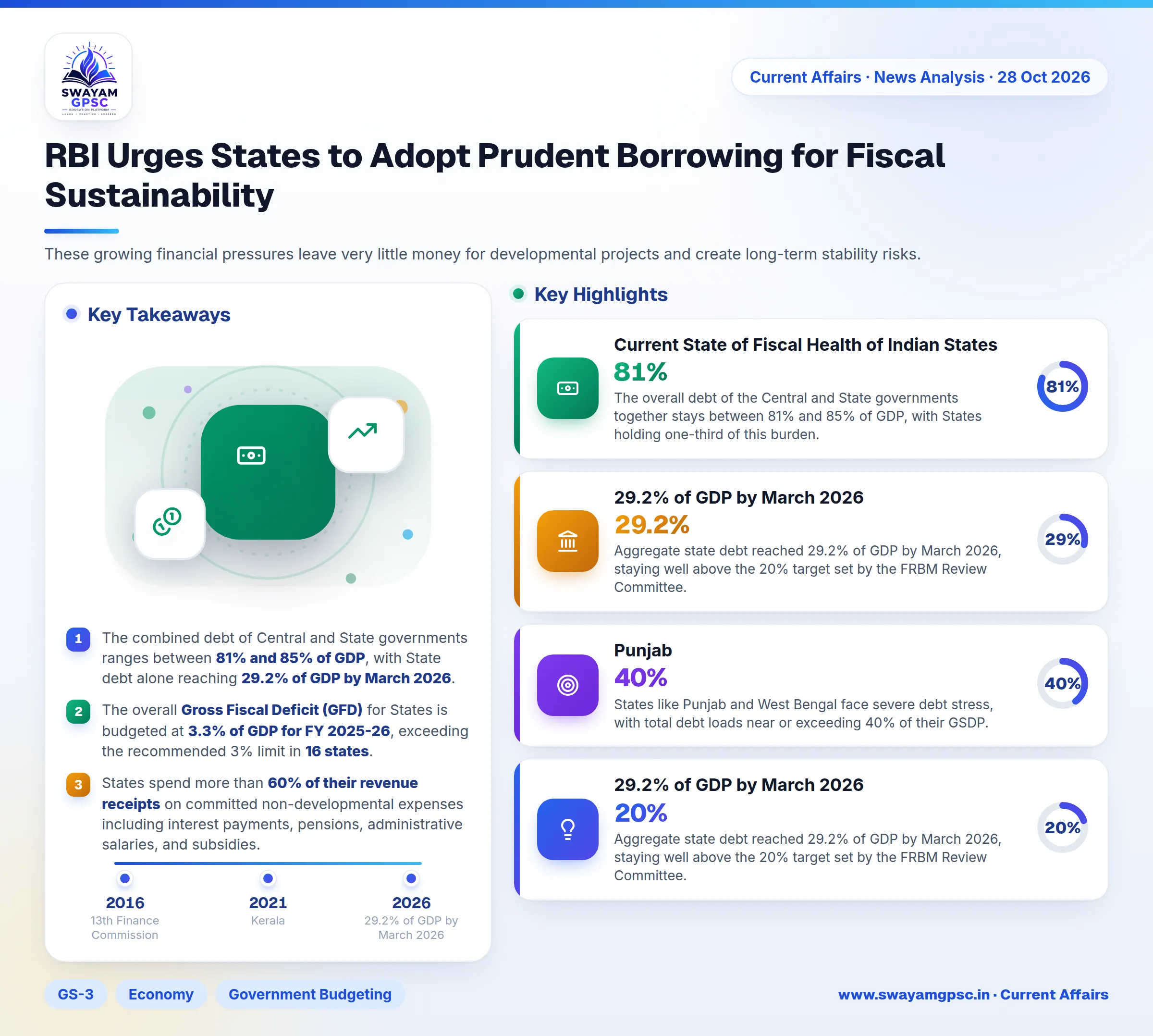
- The combined debt of Central and State governments ranges between 81% and 85% of GDP, with State debt alone reaching 29.2% of GDP by March 2026.
- The overall Gross Fiscal Deficit (GFD) for States is budgeted at 3.3% of GDP for FY 2025-26, exceeding the recommended 3% limit in 16 states.
- States spend more than 60% of their revenue receipts on committed non-developmental expenses including interest payments, pensions, administrative salaries, and subsidies.
- Capital spending delivers a high fiscal multiplier of 2.45, making borrowing for long-term infrastructure far more productive than borrowing for daily consumption spending.
- The Union Government now counts off-budget loans taken by state-owned corporations against the standard borrowing caps set under Article 293(3) of the Constitution.
Why in News
- The Reserve Bank of India (RBI) Governor spoke at the 36th Conference of State Finance Secretaries.
- He advised State governments to follow smart debt management plans and improve their daily cash handling to keep their long-term finances stable.
Summary of State Fiscal Health
- State governments across India face rising debt-to-GSDP ratios, higher fiscal deficits, extra off-budget borrowings, and heavy mandatory spending obligations.
- These growing financial pressures leave very little money for developmental projects and create long-term stability risks.
- To protect economic growth, States must follow strict debt limits, manage daily cash flows better, and follow rules set by the Fiscal Responsibility and Budget Management (FRBM) framework.
- States should also focus on building infrastructure assets, improve transparency in public accounts, and strengthen financial oversight for future generations.
Understanding Prudent Borrowing
- Prudent borrowing is a financial control strategy where a government limits taking new loans strictly based on its capacity to pay them back.
- This concept relies on the Golden Rule of Public Finance, which says borrowed money should go toward long-term Capital Expenditure (Capex) rather than daily administrative expenses.
- Investing in assets like hospitals, schools, and transportation networks helps build future tax revenues for the state.
- Smart financial management matches borrowing dates directly with daily cash shortfalls to prevent holding idle money that builds up interest costs.
Significance of Prudent Borrowing
- Limiting public debt prevents crowding out private businesses from getting affordable loans in domestic banking markets.
- High government debt creates massive yearly interest expenses that drain government money away from essential public programs.
- Lowering overall debt reduces interest obligations, freeing up budget money for education, public health, and clean energy initiatives.
- High debt relative to state output keeps credit ratings near lower investment grades, raising borrowing costs for private companies.
- Uncontrolled budget deficits can drive up overall demand without matching supply, leading to long-term structural inflation.
- Borrowing responsibly ensures that current operational costs are not passed on to future generations through heavier tax burdens.
Current State of Fiscal Health of Indian States
- The overall debt of the Central and State governments together stays between 81% and 85% of GDP, with States holding one-third of this burden.
- Aggregate state debt reached 29.2% of GDP by March 2026, staying well above the 20% target set by the FRBM Review Committee.
- States like Punjab and West Bengal face severe debt stress, with total debt loads near or exceeding 40% of their GSDP.
- In contrast, Gujarat, Maharashtra, and Odisha managed their debt wisely, keeping their debt ratios below the recommended 20% ceiling.
- States like Kerala and Tamil Nadu showed fiscal improvement by cutting total liabilities by nearly 4 to 5 percentage points since 2021.
- The combined Gross Fiscal Deficit (GFD) across all states widened to 3.3% of GDP for FY 2025-26.
- A total of 16 states planned for budget deficits higher than the standard 3% limit because central grants fell short.
- Rising bond yields in October 2026 raised overall borrowing costs for states trying to fund their budget shortfalls.
- States spend over 60% of their total revenues on committed costs like salaries, pensions, subsidies, and debt interest, leaving little for new projects.
- State governments carry out two-thirds of total public spending in India and collect one-third of all public revenue.
- States heavily rely on the Centre's 50-year interest-free loans under the SASCI scheme to keep their infrastructure spending active.
Key Issues in Current Borrowing Practices of States
- States bypass standard budget borrowing rules by taking loans through state corporations or special purpose entities without full legislative oversight.
- Taking loans makes economic sense when spent on Capex because it generates higher income through a fiscal multiplier of around 2.45.
- Many states take loans to cover regular revenue spending like subsidies and debt waivers, which yield no financial returns.
- State financial backing for struggling power distribution companies (DISCOMs) creates hidden debt that can land back on state balance sheets.
- Unplanned borrowing dates by central and state authorities cause sudden spikes in bond market rates, disturbing credit flow.
Measures Needed for Sustaining Long-Term Fiscal Health
- States should adopt digital networks like the Unified Lending Interface (ULI) and use Programmable Central Bank Digital Currency (P-CBDC) for welfare payouts.
- Using programmable digital money ensures targeted delivery of benefits while stopping leakage of public funds.
- State governments must use the State Level Bankers' Committee (SLBC) platform to speed up regional bank lending and improve rural infrastructure.
- States need to follow their state-level budget discipline laws strictly by keeping budget deficits under 3% to 3.5% of GSDP.
- Setting up an independent Fiscal Council, as suggested by the 13th Finance Commission, 14th Finance Commission, and N.K. Singh Committee (2016), will improve debt monitoring.
- The Central Government took a positive step by counting off-budget loans against normal state borrowing ceilings under Article 293(3) of the Constitution.
- States should use guidelines from the RBI Compendium on Cash and Debt Management to match bond sales with real spending needs.
Conclusion
- Smart borrowing does not mean stopping all loans, but rather using debt to build productive economic assets instead of funding daily consumption.
- Maintaining disciplined financial management and protecting future generations will form the foundation of India's economic growth during Amrit Kaal.