RBI Monetary Policy Committee Decision and Economic Outlook
#GS-3 #Economy #Growth #Inflation #Banking #Monetary Policy #Reserve Bank of India
Key takeaways
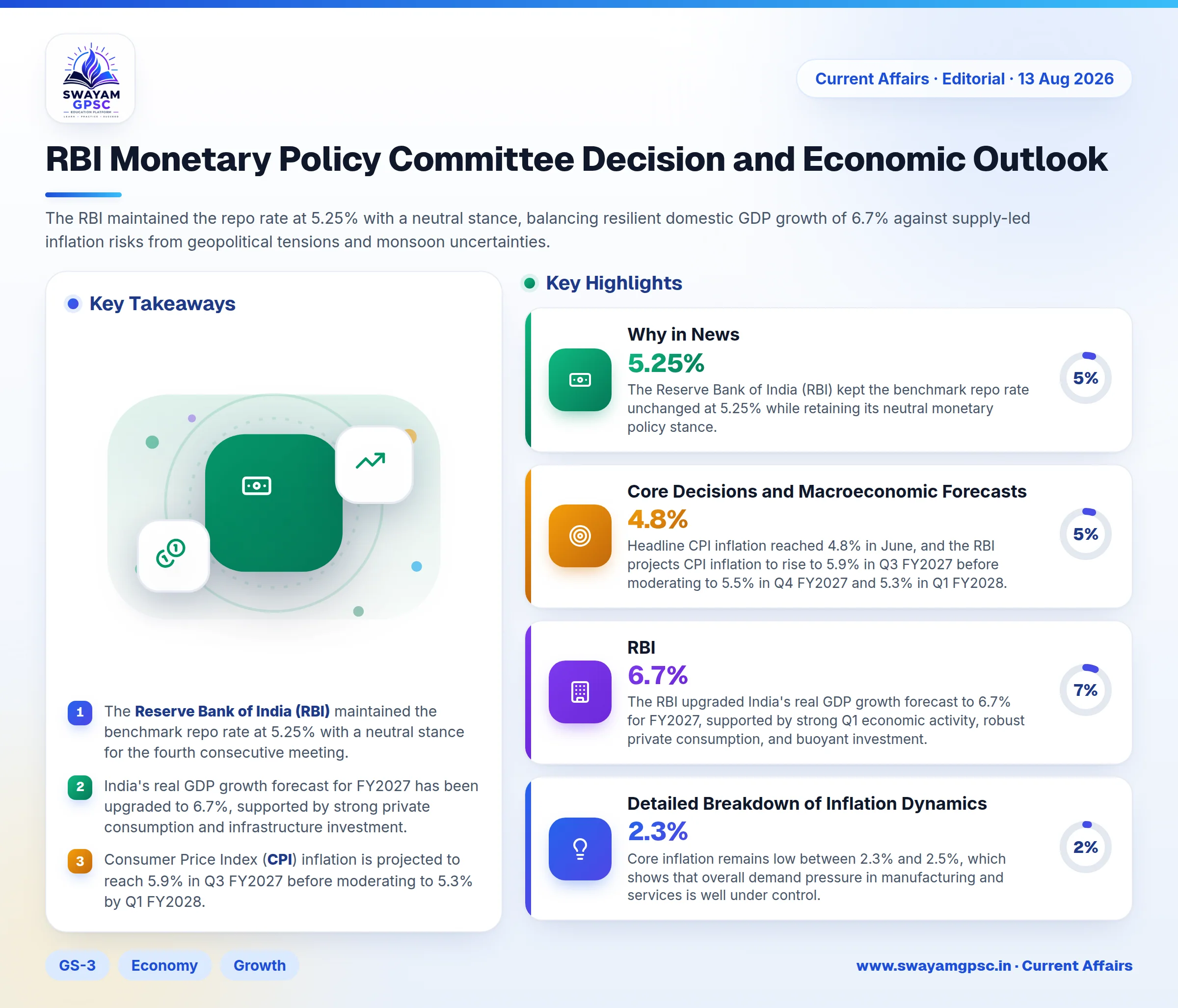
- The Reserve Bank of India (RBI) maintained the benchmark repo rate at 5.25% with a neutral stance for the fourth consecutive meeting.
- India's real GDP growth forecast for FY2027 has been upgraded to 6.7%, supported by strong private consumption and infrastructure investment.
- Consumer Price Index (CPI) inflation is projected to reach 5.9% in Q3 FY2027 before moderating to 5.3% by Q1 FY2028.
- India's merchandise exports expanded by 15.5% year-on-year in June, demonstrating resilient global competitiveness.
Why in News
- The Reserve Bank of India (RBI) kept the benchmark repo rate unchanged at 5.25% while retaining its neutral monetary policy stance.
- This decision marks the fourth consecutive meeting where the RBI has maintained a status quo, balancing elevated short-term inflation risks against strong domestic economic growth.
About RBI Monetary Policy Committee Decision
- The RBI maintained the repo rate at 5.25% with a neutral stance, balancing resilient domestic GDP growth of 6.7% against supply-led inflation risks from geopolitical tensions and monsoon uncertainties.
Core Decisions and Macroeconomic Forecasts
- The repo rate stands at 5.25%, and a neutral stance allows the central bank to adjust policy rates in either direction based on coming economic data.
- Headline CPI inflation reached 4.8% in June, and the RBI projects CPI inflation to rise to 5.9% in Q3 FY2027 before moderating to 5.5% in Q4 FY2027 and 5.3% in Q1 FY2028.
- The RBI upgraded India's real GDP growth forecast to 6.7% for FY2027, supported by strong Q1 economic activity, robust private consumption, and buoyant investment.
- The Monetary Policy Committee (MPC) adopted a data-dependent wait-and-watch approach because risks to growth and inflation remain evenly balanced.
Detailed Breakdown of Inflation Dynamics
- High food prices and sudden fluctuations in global crude oil prices are the main causes behind the recent 4.8% headline inflation rate.
- Core inflation remains low between 2.3% and 2.5%, which shows that overall demand pressure in manufacturing and services is well under control.
- Prolonged high fuel and transport costs could gradually push up the prices of core goods and services in coming quarters.
- Uneven monsoon rainfall threatens agricultural production in both kharif and rabi seasons, placing upward pressure on food prices.
Analysis of Domestic Growth Momentum
- Urban and rural demand grew healthily in Q1, supporting manufacturing capacity and maintaining steady demand for services.
- Gross Fixed Capital Formation (GFCF) stays strong, boosted by government spending on infrastructure and healthier private sector balance sheets.
- India's merchandise exports increased by 15.5% year-on-year in June, showing solid global competitiveness despite slow world trade growth.
- Low Non-Performing Asset (NPA) levels and strong banking liquidity ensure smooth credit flow into productive economic sectors.
Major Risks to Economic Stability
- Conflicts and instability in West Asia cause sudden spikes in crude oil prices and shipping freights, leading to imported inflation.
- Poor monsoon distribution damages crop yields, reducing farm incomes and disturbing food price stability.
- Ongoing trade route disruptions and protectionist policies create risks for export growth and raise industrial input costs.
- Volatility in global financial markets and differing interest rate policies among major central banks cause exchange rate fluctuations and uncertain capital flows.
Growth vs Inflation Trade-off
- Raising interest rates now might slow down economic growth without solving supply-side inflation caused by food and crude oil costs.
- Leaving inflation above the target of 4.0% for too long could raise long-term price expectations among households and businesses.
- The MPC status quo balances supporting domestic economic recovery while anchoring inflation expectations against external global shocks.
Way Forward
- Improve cold storage facilities, warehouse capacity, and transport networks to lower crop loss after harvest and keep food prices stable.
- Adopt climate-smart farming methods, expand drip irrigation, and use drought-resistant seeds to reduce crop reliance on monsoon rains.
- Increase strategic oil reserves and diversify energy sources to protect domestic fuel prices against geopolitical price spikes.
- Use short-term targeted fiscal measures, like reducing import duties or releasing government food stocks, to manage food prices without stretching the budget.
Conclusion
- The RBI neutral policy stance successfully balances domestic economic growth with supply-driven inflation risks.
- A flexible, data-driven approach maintains financial stability while shielding economic recovery from monsoon uncertainties and global market volatility.