RBI Field Trials for Polymer Banknotes in Small Denominations
#GS-3 #Economy #Banking #Current Events #National #RBI #Polymer Banknotes
Key takeaways
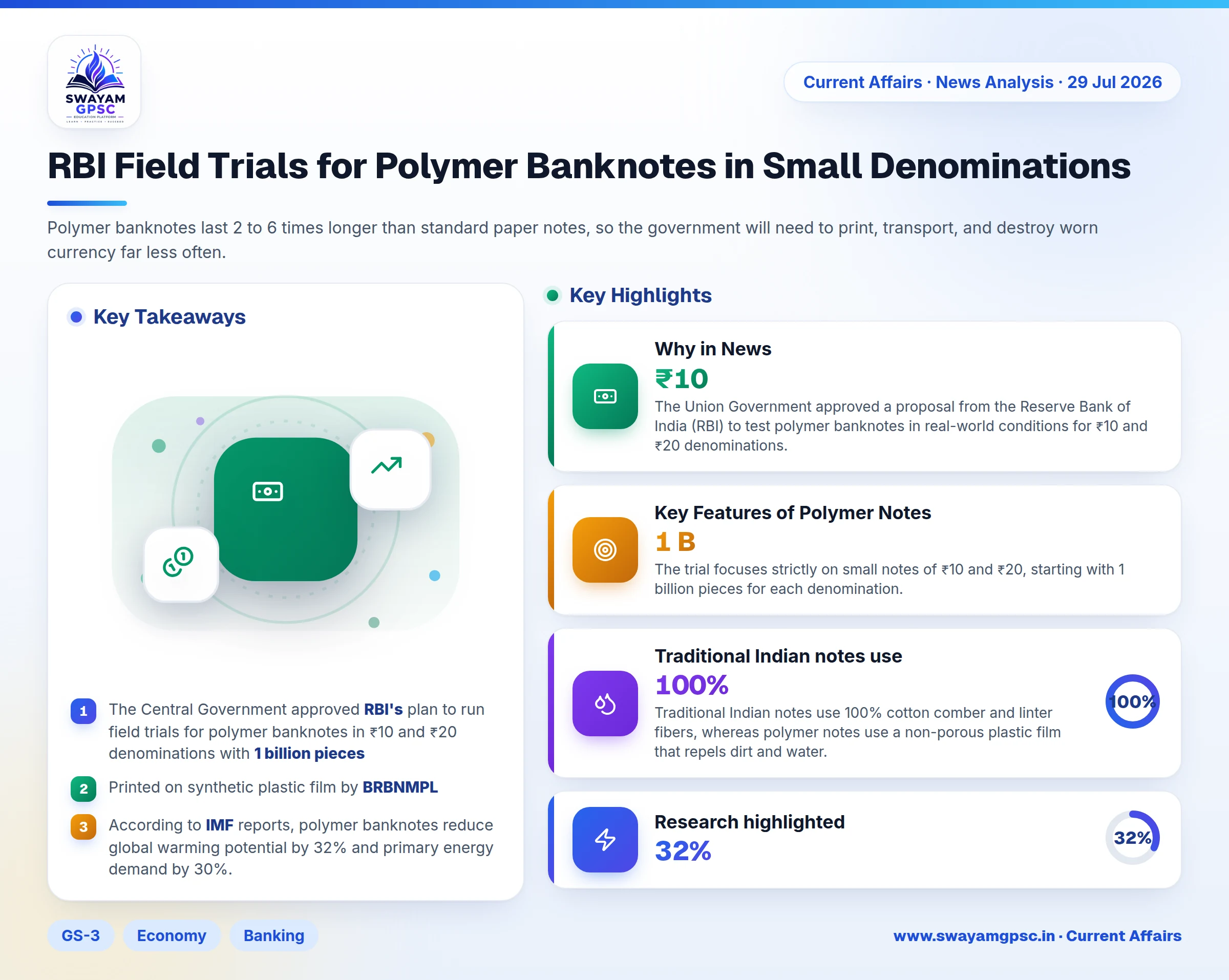
- The Central Government approved RBI's plan to run field trials for polymer banknotes in ₹10 and ₹20 denominations with 1 billion pieces per note type.
- Printed on synthetic plastic film by BRBNMPL, polymer banknotes last 2 to 6 times longer than cotton-paper currency and resist dirt and moisture.
- According to IMF reports, polymer banknotes reduce global warming potential by 32% and primary energy demand by 30%.
- Under Section 22 of the RBI Act, 1934, the RBI holds the exclusive right to issue currency notes, whereas ₹1 notes are issued directly by the Ministry of Finance.
- First introduced by Australia in 1988, polymer currency is currently used by nearly 60 countries worldwide.
Why in News
- The Union Government approved a proposal from the Reserve Bank of India (RBI) to test polymer banknotes in real-world conditions for ₹10 and ₹20 denominations.
Overview and Objectives
- The Reserve Bank of India (RBI) and its subsidiary, Bharatiya Reserve Bank Note Mudran Private Limited (BRBNMPL), are running this pilot program to test plastic polymer notes alongside traditional paper notes.
- The RBI serves as the official regulatory authority for this project, while BRBNMPL acts as the dedicated manufacturing body.
- This project aims to increase the life of low-value banknotes that tear easily, which will lower long-term printing costs and reduce environmental waste.
Key Features of Polymer Notes
- The trial focuses strictly on small notes of ₹10 and ₹20, starting with 1 billion pieces for each denomination.
- Traditional Indian notes use 100% cotton comber and linter fibers, whereas polymer notes use a non-porous plastic film that repels dirt and water.
- Polymer banknotes last 2 to 6 times longer than standard paper notes, so the government will need to print, transport, and destroy worn currency far less often.
- These plastic notes will circulate alongside regular paper currency, and the government has confirmed that it will not scrap existing paper notes.
- Research highlighted by the International Monetary Fund (IMF) shows that polymer notes lower global warming impact by 32% and energy use by 30%, and workers can melt old notes into plastic granules.
Legal Framework
- Under Section 22 of the RBI Act, 1934, the RBI holds the sole legal power to print and issue currency notes across India.
- The Ministry of Finance issues ₹1 notes directly, but the RBI Issue Department manages all ₹10 and ₹20 banknotes.
Global Adoption
- Australia launched polymer banknotes in 1988, and around 60 countries currently use plastic currency.
- Countries like Australia, Canada, New Zealand, Romania, and the United Kingdom have converted all their main banknote denominations to polymer.