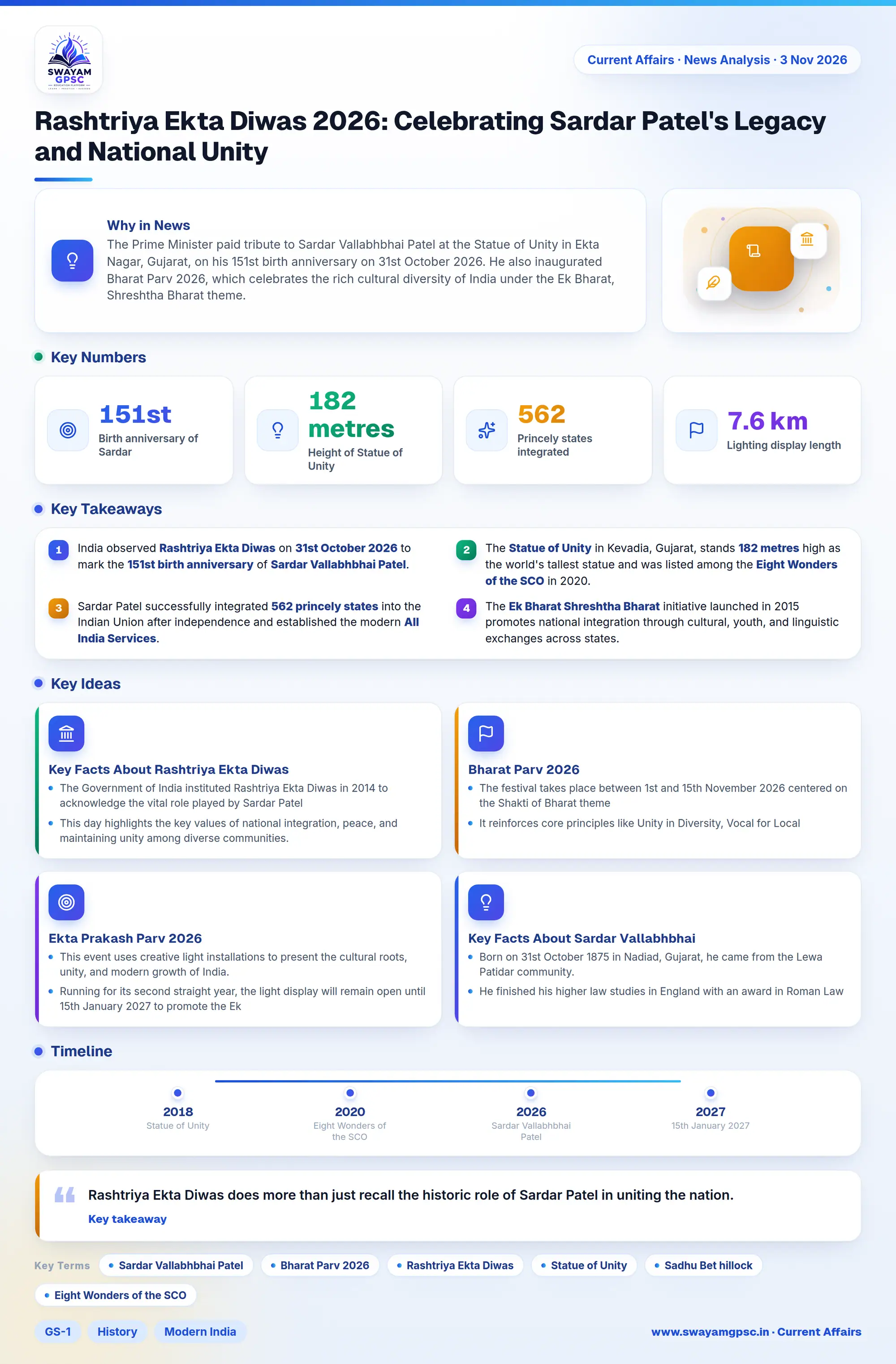
Rashtriya Ekta Diwas 2026: Celebrating Sardar Patel's Legacy and National Unity
#GS-1 #History #Modern India #Post-independence Consolidation of India #Important Personalities #GS-2 #Governance & Social Justice #Government Policies & Interventions #Current Events #National #Rashtriya Ekta Diwas #Sardar Vallabhbhai Patel #Statue of Unity #Ek Bharat Shreshtha Bharat
Key takeaways
- India observed Rashtriya Ekta Diwas on 31st October 2026 to mark the 151st birth anniversary of Sardar Vallabhbhai Patel.
- The Statue of Unity in Kevadia, Gujarat, stands 182 metres high as the world's tallest statue and was listed among the Eight Wonders of the SCO in 2020.
- Sardar Patel successfully integrated 562 princely states into the Indian Union after independence and established the modern All India Services.
- The Ek Bharat Shreshtha Bharat initiative launched in 2015 promotes national integration through cultural, youth, and linguistic exchanges across states.
Why in News
- The Prime Minister paid tribute to Sardar Vallabhbhai Patel at the Statue of Unity in Ekta Nagar, Gujarat, on his 151st birth anniversary on 31st October 2026.
- He also inaugurated Bharat Parv 2026, which celebrates the rich cultural diversity of India under the Ek Bharat, Shreshtha Bharat theme.
Key Facts About Rashtriya Ekta Diwas (National Unity Day)
- The Government of India instituted Rashtriya Ekta Diwas in 2014 to acknowledge the vital role played by Sardar Patel in uniting the country.
- This day highlights the key values of national integration, peace, and maintaining unity among diverse communities.
- It inspires citizens across the country to renew their pledge toward preserving national integrity and collective strength.
- The celebration serves as a vital platform to push forward the Ek Bharat Shreshtha Bharat (EBSB) initiative, which PM Modi introduced in 2015.
- The Statue of Unity was opened to the public on 31st October 2018 at Kevadia in Gujarat, standing as the tallest statue across the globe at 182 metres in honor of Sardar Vallabhbhai Patel.
- It sits on the Sadhu Bet hillock facing the Narmada River and the Sardar Sarovar Dam, representing national pride and togetherness.
- The Shanghai Cooperation Organisation (SCO) listed this site among its Eight Wonders of the SCO in 2020.
Bharat Parv 2026
- The festival takes place between 1st and 15th November 2026 centered on the Shakti of Bharat theme, bringing cultural traditions from every State and Union Territory together.
- It reinforces core principles like Unity in Diversity, Vocal for Local, and Culture to Commerce to support local craftspersons and native products.
Ekta Prakash Parv 2026
- This event uses creative light installations to present the cultural roots, unity, and modern growth of India.
- Running for its second straight year, the light display will remain open until 15th January 2027 to promote the Ek Bharat, Shreshtha Bharat mission.
- The themed light setups extend over 7.6 km, using indoor spaces for North, East, West, and South India alongside outdoor displays of regional traditions.
- Following the Vikas Bhi, Virasat Bhi approach, the displays celebrate women's progress, tech achievements, space missions, and the bravery of defense personnel.
Key Facts About Sardar Vallabhbhai Patel
- Born on 31st October 1875 in Nadiad, Gujarat, he came from the Lewa Patidar community.
- He finished his higher law studies in England with an award in Roman Law, coming back to practise as a barrister in 1913.
- People gave him the title Iron Man of India because of his strong resolve, treating him as a lasting symbol of strength and national unity.
- Inspired by Mahatma Gandhi, he stepped into the freedom struggle to support the national cause.
- During the Kheda Satyagraha in 1918, he led farmers affected by failed crops to demand relief from land revenue payments.
- He led the Bardoli Satyagraha in 1928 against unfair tax hikes, where people honored his leadership with the title Sardar.
- He took part in major Gandhian protests, gathered public backing for the Salt Satyagraha in 1930, and went to prison several times.
- As President of the 46th Indian National Congress Session at Karachi in 1931, he supported the Gandhi-Irwin Pact and helped pass key resolutions on Fundamental Rights and the National Economic Programme.
- British authorities arrested and jailed him during the intense phase of the Quit India Movement in 1942.
- After independence, he unified 562 princely states into the Indian Union, preserving the territorial integrity of the country.
- The Indian Independence Act, 1947 ended British control over princely rulers, creating a situation where states could join India, Pakistan, or stay independent.
- He shaped the structure of the modern All India Services, giving the nation a strong administrative foundation.
- People call him the patron saint of India's civil servants because he built a solid foundation for the administrative setup.
- The nation marks National Civil Services Day on 21st April to remember his 1947 address where he called administrative officers the steel frame of India.
- He served as the Chairman of the Advisory Committee on Fundamental Rights, Minorities, and Tribal and Excluded Areas in the Constituent Assembly.
Ek Bharat Shreshtha Bharat (EBSB) Initiative
- The Government started the EBSB scheme on 31st October 2015 to build on Patel's vision through cultural, language, and social programs among states.
- The program aims to deepen emotional connections between citizens living in different parts of India.
- It creates opportunities for people to learn about diverse languages and regional cultures.
- It builds national unity by establishing formal learning partnerships between paired states.
- It showcases the wide variety of traditions, art forms, and heritage across the country.
- It helps states share useful administrative and cultural practices with one another.
- The system pairs different States and Union Territories together so citizens can interact through cultural, educational, and linguistic programs.
- The Ministry of Education launched the Bhasha Sangam App under this program to teach everyday phrases in 22 Indian languages.
- Programs like Yuva Sangam and local EBSB Clubs arrange youth exchange visits to build mutual trust.
- Events like Kashi Tamil Sangamam celebrate ancient spiritual ties between Kashi and Tamil Nadu through arts and traditions.
- Regional food meets and cultural displays encourage internal travel while helping people value different traditions.
- Digital tools like the My Bharat Portal and online quiz contests bring national heritage awareness to citizens online.
- This effort turns the idea behind Rashtriya Ekta Diwas into an ongoing movement rather than just an annual event.
- With participation from millions of citizens, it supports schemes like Dekho Apna Desh and local sports, strengthening national identity.
Conclusion
- Rashtriya Ekta Diwas does more than just recall the historic role of Sardar Patel in uniting the nation.
- Programs like Ek Bharat Shreshtha Bharat and Bharat Parv turn regional differences into a shared bond, helping citizens build a unified and inclusive India.