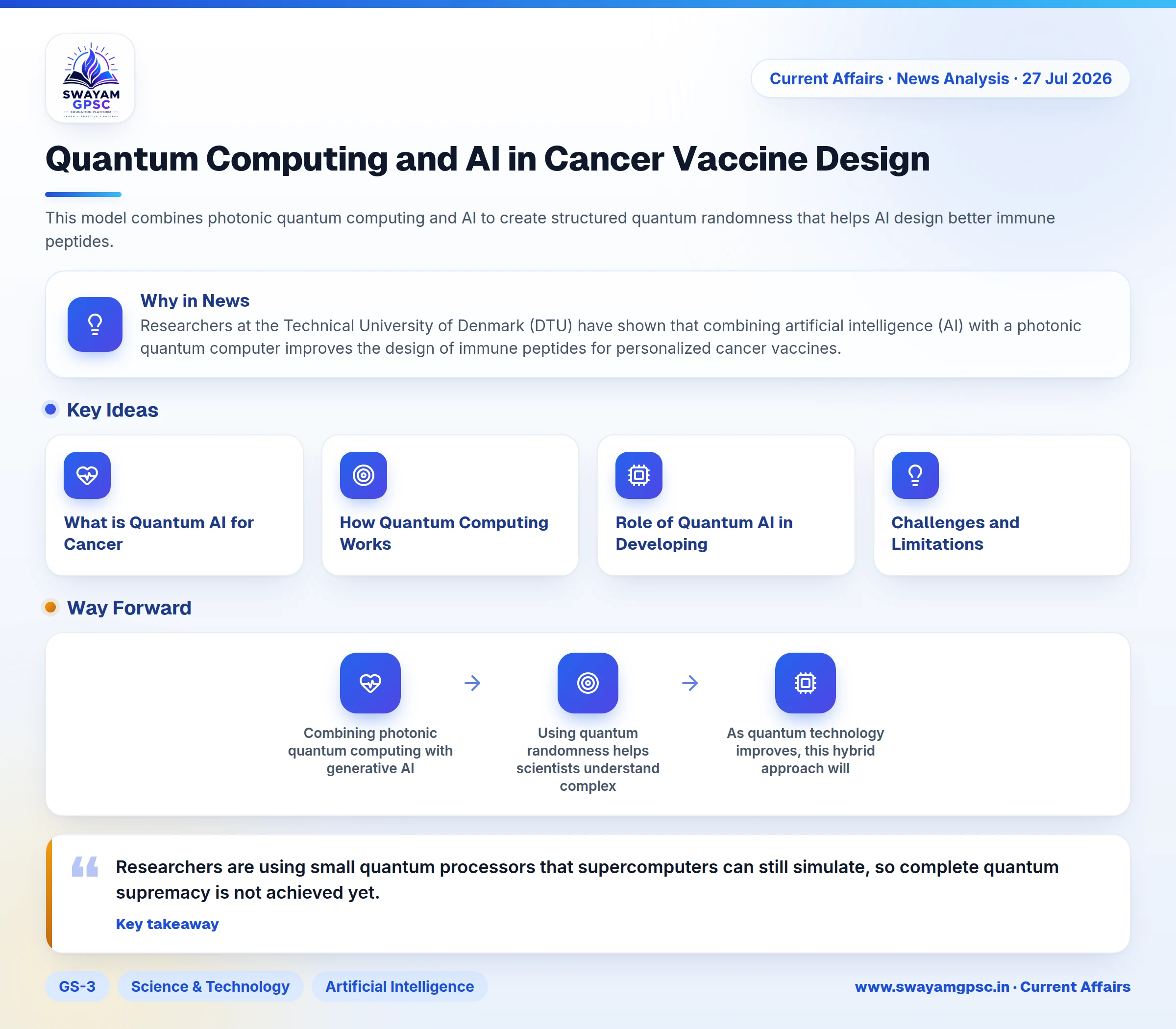
Quantum Computing and AI in Cancer Vaccine Design
#GS-3 #Science & Technology #Artificial Intelligence #Biotechnology #International
Why in News
- Researchers at the **Technical University of Denmark (DTU)** have shown that combining **artificial intelligence (AI)** with a **photonic quantum computer** improves the design of immune peptides for personalized cancer vaccines.
What is Quantum AI for Cancer Vaccines?
- This model combines **photonic quantum computing** and **AI** to create structured quantum randomness that helps AI design better immune peptides.
- The main target of this technology is to discover peptides for rare **Human Leukocyte Antigen (HLA)** types used in targeted cancer treatments.
How Quantum Computing Works
- Normal computers use binary bits of **0** or **1**, but quantum computers use **qubits** that exist as both **0** and **1** at the same time.
- Photonic quantum processors use tiny light particles called **photons** as qubits to process and transmit complex data.
- When photons interact with each other inside the processor, they create interconnected mathematical patterns rather than basic random numbers.
- This wave interaction provides better starting points that allow AI models to explore much wider, complex biological data patterns.
Role of Quantum AI in Developing Cancer Vaccines
- Amino acids combine in hundreds of billions of ways to form peptides, and **quantum AI** quickly filters these combinations down to the best options.
- Regular AI models struggle with rare immune profiles, but **quantum distributions** greatly improve accuracy for rare **HLA** genetic types.
- The system designs peptides that fit securely inside the **HLA** molecule groove, allowing immune cells to easily detect target cancerous cells.
- By quickly analyzing unique tumor mutations in a patient, this platform speeds up the production of personalized **neoantigen vaccines**.
Challenges and Limitations
- Researchers are using small quantum processors that supercomputers can still simulate, so complete **quantum supremacy** is not achieved yet.
- Binding a peptide in a laboratory test does not guarantee that it will trigger a strong **T-cell** immune response inside a human body.
- Using this technology widely requires scaling up to larger, error-free **quantum processors** and more advanced **generative AI** models.
- Improved standard computing algorithms might achieve similar results, so researchers need to conduct more comparative tests.
Significance of the Research
- This approach helps design therapies for rare **HLA** genetic types that traditional data-driven AI models usually neglect.
- The **DTU** research team successfully created and tested top candidate peptides in real lab tests with strong binding stability.
- This research creates a useful model combining traditional machine learning with **NISQ** quantum devices to solve complex biological problems.
- Beyond cancer treatments, this hybrid model can help design vaccines for new viruses, autoimmune diseases, and complex proteins.
Way Forward
- Combining **photonic quantum computing** with **generative AI** represents a major step forward in personalized healthcare.
- Using quantum randomness helps scientists understand complex biomolecular structures and serve patients with rare genetic backgrounds.
- As quantum technology improves, this hybrid approach will speed up personalized cancer vaccine development from lab discovery to hospital practice.