Pyroprocessing and Strengthening India's Nuclear Energy Ecosystem
#GS-3 #Economy #Infrastructure #Energy #Science & Technology #Nuclear Technology #Achievements of Indians in Science & Technology #Mineral & Energy Resources #GS-1 #Rapid Fire CA #Quick Facts For Prelims
Key takeaways
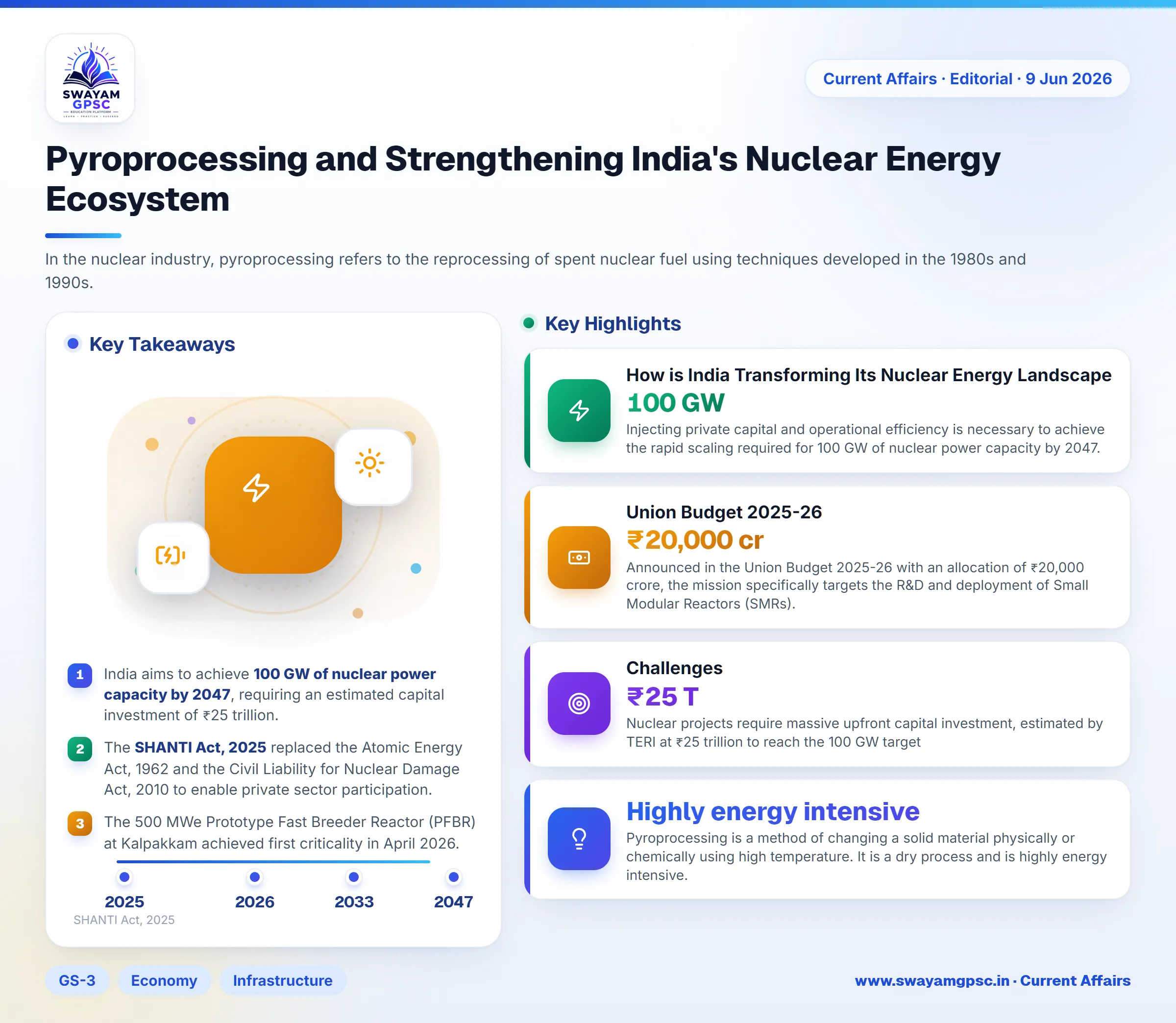
- India aims to achieve 100 GW of nuclear power capacity by 2047, requiring an estimated capital investment of ₹25 trillion.
- The SHANTI Act, 2025 replaced the Atomic Energy Act, 1962 and the Civil Liability for Nuclear Damage Act, 2010 to enable private sector participation.
- The 500 MWe Prototype Fast Breeder Reactor (PFBR) at Kalpakkam achieved first criticality in April 2026.
- The Union Budget allocated ₹20,000 crore to target research, development, and deployment of Small Modular Reactors.
Pyroprocessing
- Pyroprocessing is a method of changing a solid material physically or chemically using high temperature. It is a dry process and is highly energy intensive.
- In cement-making, finely ground limestone, clay and iron are fed into a rotary kiln, where limestone loses carbon dioxide as the temperature rises to around 900°C.
- At about 1,450°C, the mixture partly melts to form marble-sized clinker nodules, which are later ground to produce cement.
- In metallurgy, pyroprocessing is used to extract metals from ores through multiple stages, including roasting, where sulphide ores are heated in air to convert them into metal oxides.
- Other stages include smelting, which melts ore to separate metal from waste impurities called slag, and calcining, where limestone is heated to produce lime.
- In the nuclear industry, pyroprocessing refers to the reprocessing of spent nuclear fuel using techniques developed in the 1980s and 1990s.
- The used fuel is broken into pieces and placed in a high-temperature salt bath, usually made of lithium and potassium chlorides at 500°C or more, after which an electric current separates elements based on their electrochemical properties.
- The separated elements of interest are recovered in different streams, and this process has been studied in Japan, South Korea and the U.S. as part of advanced fast reactor programmes.
Why in News
- Amid rising geopolitical risks in the Gulf and a persistent reliance on coal, India is renewing its focus on nuclear energy as a stable, domestic baseload source.
- India is leveraging indigenous technological milestones and policy reforms to diversify its energy mix and reduce import vulnerability.
- India's shift toward a nuclear-led energy strategy, driven by the SHANTI Act, 2025, Small Modular Reactors (SMRs) and Stage II PFBR criticality, represents a critical move to ensure energy Aatmanirbharta.
How is India Transforming Its Nuclear Energy Landscape
- The SHANTI Act (Sustainable Harnessing and Advancement of Nuclear Energy for Transforming India), 2025, replaced the outdated Atomic Energy Act, 1962 and the Civil Liability for Nuclear Damage Act, 2010.
- It provides clear rules for licensing, safety, and liability that previously stalled collaboration with foreign technology providers for projects like Jaitapur and Kovvada.
- It effectively removed the statutory supplier liability for nuclear accidents.
- The Act grants statutory backing to the Atomic Energy Regulatory Board (AERB) and makes it accountable to Parliament, strengthening regulatory independence, transparency, and safety oversight.
- Injecting private capital and operational efficiency is necessary to achieve the rapid scaling required for 100 GW of nuclear power capacity by 2047.
- Considering this, under the SHANTI Act, 2025 the government now allows private companies to apply for licenses to build, own, and operate nuclear plants, as well as to engage in fuel fabrication.
- While sensitive fuel-cycle activities (e.g., enrichment, waste reprocessing) remain state-controlled, the government is currently developing assured power purchase agreements (PPAs) to mitigate investment risk for private players entering the sector.
- A dedicated, mission-mode approach ensures concentrated focus on emerging nuclear technologies that are more scalable than traditional, large-scale plants.
- Announced in the Union Budget 2025-26 with an allocation of ₹20,000 crore, the mission specifically targets the R&D and deployment of Small Modular Reactors (SMRs).
- The government aims to operationalize at least 5 indigenously designed SMRs (such as the BSMR-200) by 2033 to provide flexible, reliable baseload power.
- Advancing to the 2nd stage of the nuclear cycle is vital for long-term energy security, as it allows India to utilize its vast domestic thorium reserves.
- In April, 2026, the 500 MWe Prototype Fast Breeder Reactor (PFBR) at Kalpakkam achieved first criticality.
- This milestone enables the conversion of depleted uranium into plutonium, providing the necessary fissile material to eventually power the 3rd stage of India's nuclear program, which is designed to utilize thorium.
- Moving away from bespoke, one-off projects to standardized, fleet-mode construction is the most effective way to reduce project gestation periods and costs.
- The Department of Atomic Energy (DAE) has standardized the 700 MWe Pressurized Heavy Water Reactor (PHWR) design. This allows for simultaneous construction across multiple sites, creating economies of scale in manufacturing and supply chain management.
- Recent successes include the rapid commercialization of units at Kakrapar Atomic Power Station (KAPS, Gujarat) and Rajasthan Atomic Power Station (Rawatbhata) using this model.
- Decarbonizing heavy industry requires localized, consistent energy sources that do not rely on the vagaries of weather or long-distance grid transmission.
- The government is promoting BSRs as captive power plants for energy-intensive sectors like steel and aluminum.
- BSMR-200 and SMR-55 can be deployed as a captive plant for energy intensive industries such as aluminum, steel, etc., repurposing of retiring fossil fuel-based power plants and for providing energy for remote as well as off-grid locations.
- By deploying these modular units directly near industrial clusters, the government aims to provide carbon-free process heat and electricity, thereby tackling industrial emissions that are currently hard to abate using only solar or wind.
- Reducing dependence on imported high-tech components is critical to achieving both economic efficiency and strategic autonomy.
- The Department of Atomic Energy (DAE) and Indian industry have successfully developed indigenous materials, such as ApuRVA (Advanced Purified Reactor Vessel Alloy), for use in reactor pressure vessels.
- Furthermore, a new discovery of uranium deposits at the Jaduguda Mines in 2024 has extended the operational life of that facility by 50 years, ensuring more reliable fuel supply chains.
- The formation of Anushakti Vidyut Nigam Limited (ASHVINI), a Joint Venture (JV) between the Nuclear Power Corporation of India Limited (NPCIL) and NTPC Limited, signifies a structural shift from centralized state management to a collaborative, multi-agency implementation model.
- By pooling NPCIL’s technical expertise in reactor design with NTPC’s vast project management and financial capital, the government has created an engine for rapid capacity addition.
- The Mahi Banswara Rajasthan Atomic Power Project (MBRAPP) acts as the flagship beneficiary of this JV, aiming to commission four 700 MWe indigenous PHWRs.
- The adoption of **
- % Partitioning and Transmutation
Challenges
- Nuclear projects require massive upfront capital investment, estimated by TERI at ₹25 trillion to reach the 100 GW target, and suffer from long construction timelines compared to solar or wind projects.
- According to the **NITI Aayog
Way Forward
- Instead of building standalone power plants, integrate nuclear reactors directly into Energy-Intensive Industrial Clusters (e.g., steel, aluminum, or fertilizer hubs). It shifts the value proposition from simply selling
Prelims in Focus
- Pyroprocessing is a dry and energy-intensive method used to alter materials using high temperatures, applied widely in cement, metallurgy, and nuclear fuel reprocessing.
- The SHANTI Act, 2025 replaces legacy nuclear laws to enable private sector participation and modernize governance.
- The Prototype Fast Breeder Reactor (PFBR) at Kalpakkam achieved first criticality in April 2026, marking a step toward India's thorium utilization goals.