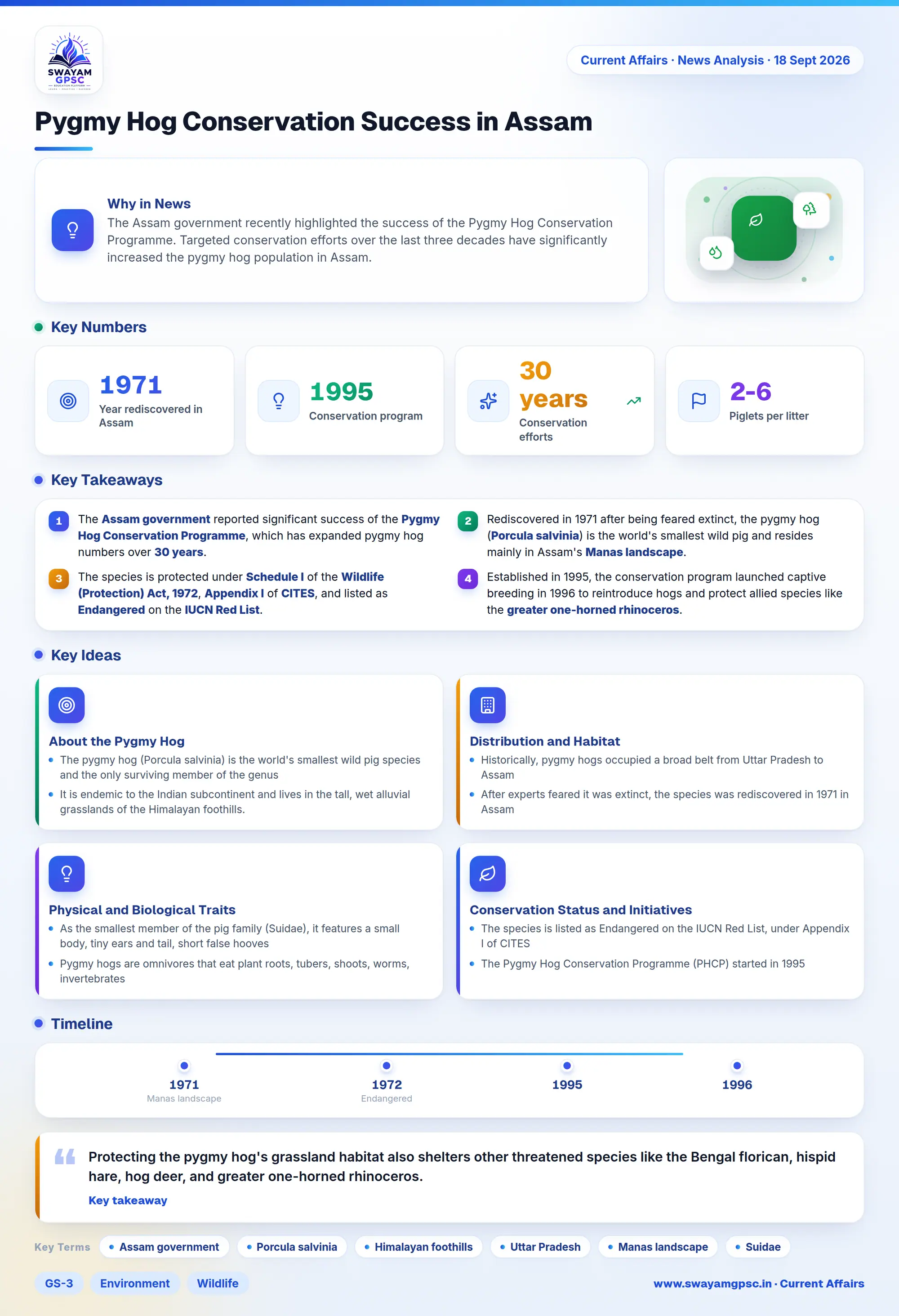
Pygmy Hog Conservation Success in Assam
#GS-3 #Environment #Wildlife #Biodiversity #National #Conservation
Key takeaways
- The Assam government reported significant success of the Pygmy Hog Conservation Programme, which has expanded pygmy hog numbers over 30 years.
- Rediscovered in 1971 after being feared extinct, the pygmy hog (Porcula salvinia) is the world's smallest wild pig and resides mainly in Assam's Manas landscape.
- The species is protected under Schedule I of the Wildlife (Protection) Act, 1972, Appendix I of CITES, and listed as Endangered on the IUCN Red List.
- Established in 1995, the conservation program launched captive breeding in 1996 to reintroduce hogs and protect allied species like the greater one-horned rhinoceros.
Why in News
- The Assam government recently highlighted the success of the Pygmy Hog Conservation Programme.
- Targeted conservation efforts over the last three decades have significantly increased the pygmy hog population in Assam.
About the Pygmy Hog
- The pygmy hog (Porcula salvinia) is the world's smallest wild pig species and the only surviving member of the genus Porcula.
- It is endemic to the Indian subcontinent and lives in the tall, wet alluvial grasslands of the Himalayan foothills.
Distribution and Habitat
- Historically, pygmy hogs occupied a broad belt from Uttar Pradesh to Assam, including Nepal's Terai and Bengal's Duars.
- After experts feared it was extinct, the species was rediscovered in 1971 in Assam, where remaining wild populations live mainly in the Manas landscape.
- Pygmy hogs inhabit undisturbed riverine tall grasslands filled with dense grasses, herbs, shrubs, and young trees.
- Human settlement and farm expansion heavily threaten these alluvial grasslands, making the pygmy hog a key indicator species for ecosystem health.
Physical and Biological Traits
- As the smallest member of the pig family (Suidae), it features a small body, tiny ears and tail, short false hooves, a streamlined shape, and no facial warts.
- Pygmy hogs are omnivores that eat plant roots, tubers, shoots, worms, invertebrates, and occasionally small reptiles or bird eggs.
- Adult males live alone, whereas females and young hogs stay in small family groups of 4 to 6 individuals.
- Breeding occurs seasonally around April and May with the arrival of the monsoon in Assam, yielding litters of 2 to 6 piglets.
Conservation Status and Initiatives
- The species is listed as Endangered on the IUCN Red List, under Appendix I of CITES, and under Schedule I of India's Wildlife (Protection) Act, 1972.
- The Pygmy Hog Conservation Programme (PHCP) started in 1995, launching major captive breeding efforts in 1996 alongside disease prevention and reintroduction schemes.
- Protecting the pygmy hog's grassland habitat also shelters other threatened species like the Bengal florican, hispid hare, hog deer, and greater one-horned rhinoceros.