Public Examinations Reforms and Nandan Nilekani Task Force
#GS-2 #Governance & Social Justice #Education #Good Governance #Indian Polity & Constitution #GS-3 #Science & Technology #Cyber Security #National #Public Examinations Reform #National Testing Agency #Transparency & Accountability
Why in News
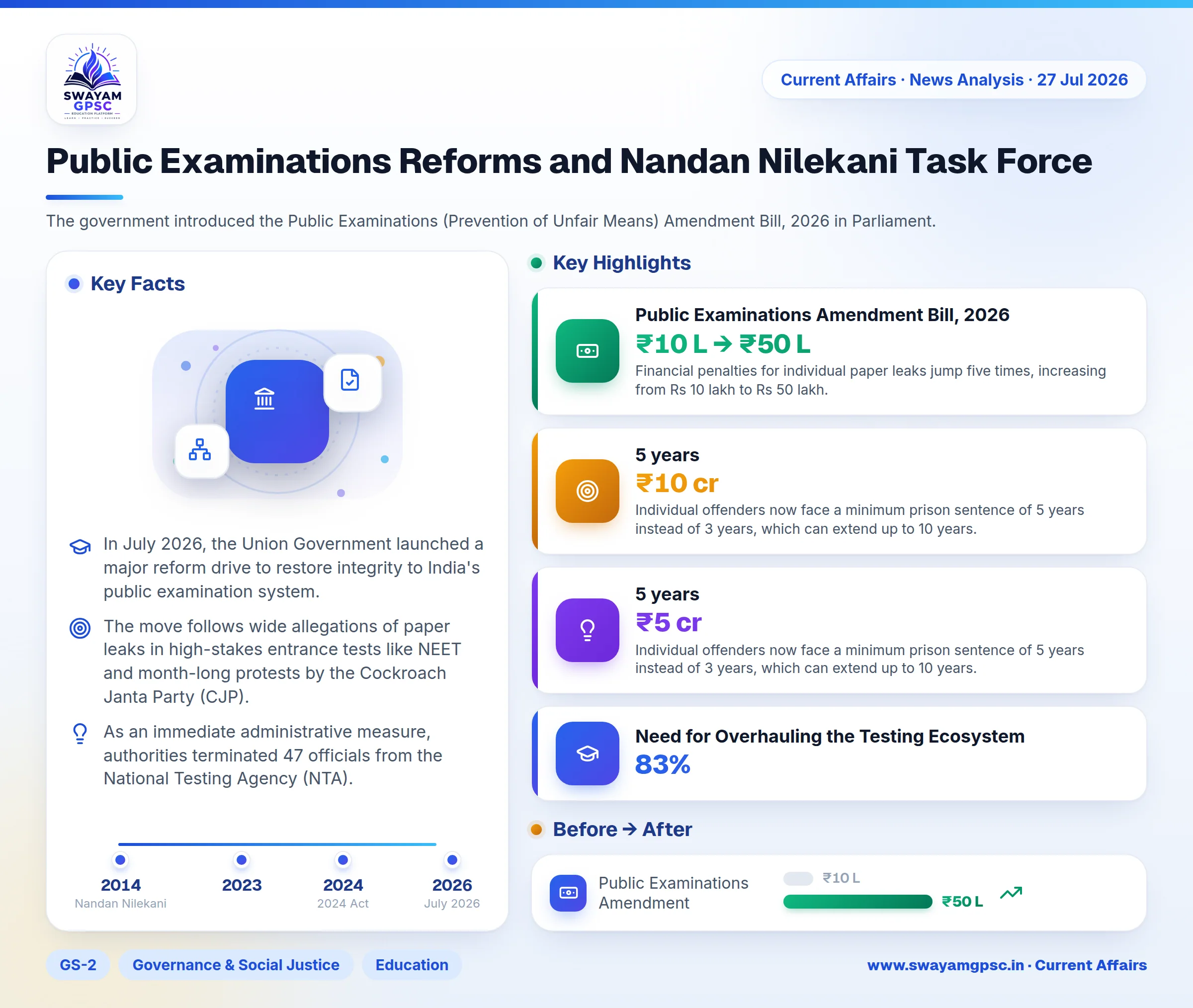
- In **July 2026**, the **Union Government** launched a major reform drive to restore integrity to India's public examination system.
- The move follows wide allegations of paper leaks in high-stakes entrance tests like **NEET** and month-long protests by the **Cockroach Janta Party (CJP)**.
- As an immediate administrative measure, authorities terminated **47** officials from the **National Testing Agency (NTA)**.
- The government introduced the **Public Examinations (Prevention of Unfair Means) Amendment Bill, 2026** in Parliament.
- Prime Minister Narendra Modi announced a high-powered task force under former **UIDAI** chairman **Nandan Nilekani** to rebuild public trust in national entrance tests.
Public Examinations Amendment Bill, 2026
- The new bill increases punishment significantly for individuals caught leaking question papers or tampering with OMR sheets.
- Individual offenders now face a minimum prison sentence of **5 years** instead of **3 years**, which can extend up to **10 years**.
- For organized crime syndicates running exam fraud, the minimum jail term rises from **5 years** to **7 years**.
- Financial penalties for individual paper leaks jump five times, increasing from **Rs 10 lakh** to **Rs 50 lakh**.
- Organized crime networks face massive minimum fines of **Rs 10 crore**, up from **Rs 1 crore**.
- Private IT vendors and printing agencies complicit in cheating face maximum fines of **Rs 5 crore**, up from **Rs 1 crore**.
- The bill doubles the debarment period for guilty private service providers from **4 years** to **8 years**.
- Local police, central agencies, and **Special Task Forces (STFs)** must conclude all investigations within **60 days**.
- State and Union Territory governments must designate Session Courts as **Fast-Track Courts** to hear exam crime cases daily.
- All existing cases registered under the **2024 Act** will transfer automatically to these newly created Fast-Track Courts.
- Fast-Track Courts must conclude every trial within **3 months** after the police file their chargesheet.
- Parties must file legal appeals within **30 days**, and a two-judge High Court bench must decide the matter within **3 months**.
High-Powered Task Force
- The government established a high-level committee chaired by **Nandan Nilekani**, co-founder of Infosys and former chairman of **UIDAI** from **2009 to 2014**.
- The task force will suggest next-generation reforms to create leak-proof, technology-driven, secure, and transparent examination systems.
Dr. K. Radhakrishnan Committee Recommendations
- The **Ministry of Education** established a 7-member expert panel in **June 2024** under former **ISRO** Chairman **Dr. K. Radhakrishnan**.
- The panel addressed deep structural flaws after the **UGC-NET** paper leak and irregularities in **NEET-UG 2024**.
- The committee submitted its report titled **The Reformation of National Common Entrance Testing in India** featuring **101 recommendations**.
- Key suggestions included hiring permanent domain experts, setting up specialized operational divisions, and giving preference to **government examination centres**.
- The report proposed **DIGI-EXAM** featuring **Aadhaar-based biometric authentication**, encrypted question delivery, AI monitoring, and computer-based adaptive tests.
- By **2026**, authorities implemented most suggestions, including expanded CCTV networks, mobile jammers, and increased use of **government examination centres**.
Need for Overhauling the Testing Ecosystem
- Current testing relies heavily on central printing and physical transit, creating dangerous single points of failure where paper leaks occur easily.
- Testing bodies outsource digital test centers to private IT vendors that lack cybersecurity, allowing solver gangs to execute screen-sharing frauds and server hacks.
- Systemic cheating undermines constitutional meritocracy and violates **Article 14** and **Article 16** by giving unfair advantages to wealthy candidates.
- Continuous exam leaks and court delays waste young productive years, noting that youth make up **83%** of India's unemployed workforce per the **ILO India Employment Report 2024**.
- Unpredictable exam schedules force rural and middle-class families into severe debt to pay for the **Rs 50,000-crore** private coaching industry.
- According to **NCRB's Accidental Deaths and Suicides in India**, student suicides increased by **80%** over the last decade, with exam failures acting as a major trigger.
- Existing testing bodies lack a **Zero-Trust Digital Architecture**, leaving systems exposed to dark-web paper leak mafias.
Cryptographic and Deep-Tech Interventions
- Testing agencies should adopt a Just-in-Time delivery model by transmitting encrypted digital papers over the secure **National Knowledge Network (NKN)**.
- Exam halls can decrypt and print question papers locally **15 to 30 minutes** before the test using a dual-key security system.
- Exam systems should use **Item Response Theory (IRT)** algorithms to dynamically generate unique question sequences with identical overall difficulty for each candidate.
- Computer-based test centers must rely on **air-gapping** to disconnect exam computers from the global internet during test hours to prevent remote hacks.
- All digital testing platforms must adhere to the **Digital Personal Data Protection Act, 2023** to protect student biometric data.
Restructuring Administrative and Audit Architecture
- The government must replace the outsourced model by converting state-owned institutions like Kendriya Vidyalayas, IITs, NITs, and AICTE colleges into secure testing hubs.
- The **National Testing Agency (NTA)** needs restructuring into a fully autonomous body with permanent technical staff and direct accountability mechanisms.
- Private digital test centers must undergo mandatory audits by the **Standardisation Testing and Quality Certification (STQC) Directorate** under MeitY to ensure **ISO 27001** cybersecurity compliance.
- Parliament should establish an independent **National Examination Audit Commission (NEAC)** to conduct surprise center audits and protect whistleblowers.
Procedural and Logistical De-risking
- Authorities should split single-day mega entrance tests into multiple sessions throughout the year, similar to SAT or JEE Main, allowing students to keep their best score.
- Exam centers must map **Aadhaar-linked biometrics** like facial recognition and iris scans dynamically to student screen activity throughout the test.
Systemic Educational Shifts
- The government should strengthen **PARAKH** to create uniform school board standards, allowing universities to give weight to Class 12 marks alongside entrance exam scores.
- Authorities must enforce the **2024 Coaching Center Guidelines** strictly to stop misleading rank claims, cap high fees, and penalize centers tied to solver gangs.
Conclusion
- A transparent, secure, and technology-driven public examination system will rebuild student trust, uphold constitutional values, and ensure India's youth drive economic growth.
Prelims in Focus: Nandan Nilekani Task Force Details
- The government formed a multidisciplinary expert task force chaired by **Nandan Nilekani** to redesign public examination security.
- The panel brings together leading figures including **Dr. S. Somnath** (former ISRO Chairman), **Tapan Deka** (former IB Director), **Prof. V. Kamakoti** (Director, IIT Madras), **Anita Karwal** (former Education Secretary), and **Amrit Lal Meena** (Logistics Expert).
- This expert team combines knowledge across digital infrastructure, internal security, scientific testing, and logistics to transform NTA operations and eliminate paper leaks completely.