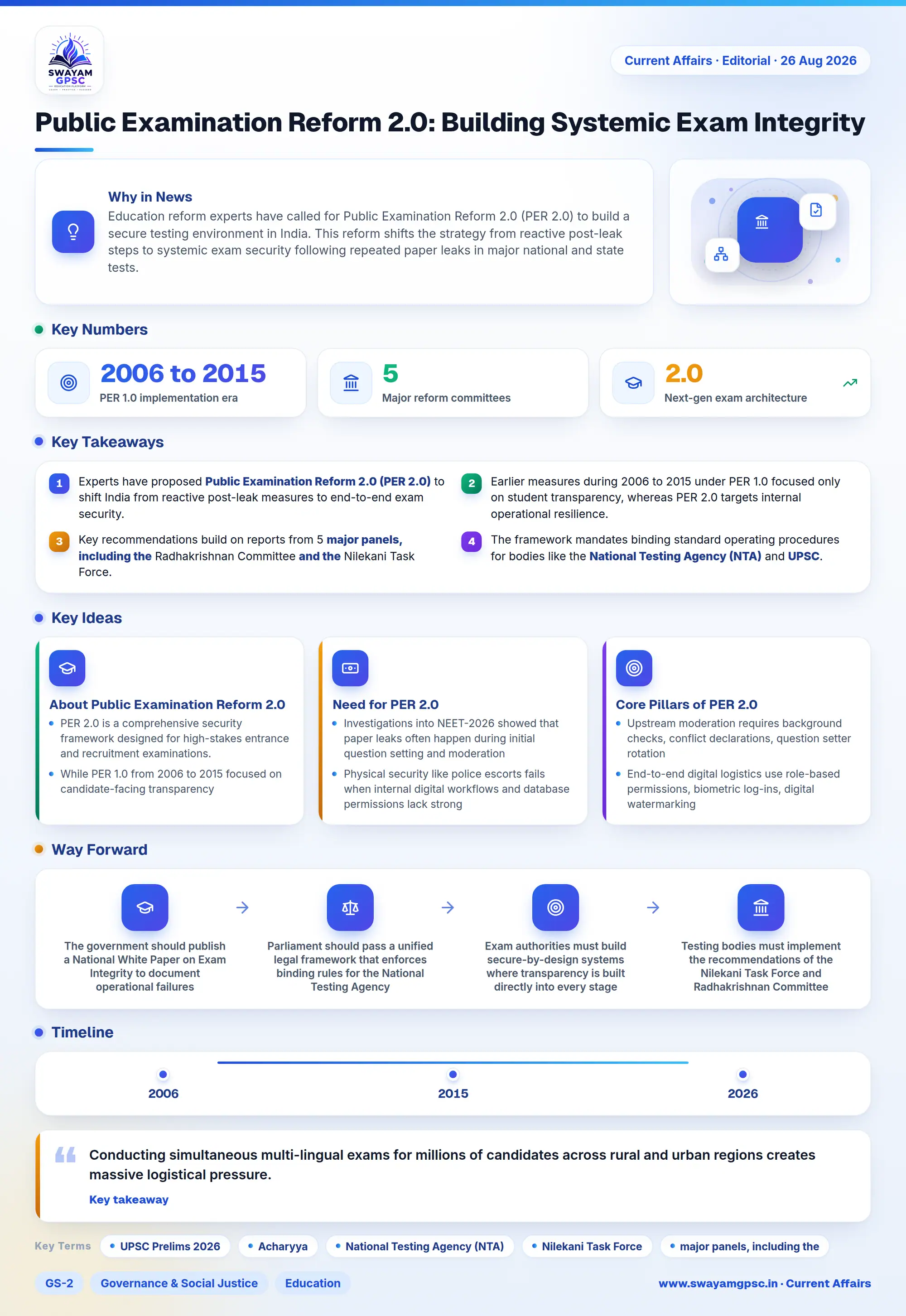
Public Examination Reform 2.0: Building Systemic Exam Integrity
#GS-2 #Governance & Social Justice #Education #Good Governance #Regulatory Bodies #National #Public Examination Reform
Key takeaways
- Experts have proposed Public Examination Reform 2.0 (PER 2.0) to shift India from reactive post-leak measures to end-to-end exam security.
- Earlier measures during 2006 to 2015 under PER 1.0 focused only on student transparency, whereas PER 2.0 targets internal operational resilience.
- Key recommendations build on reports from 5 major panels, including the Radhakrishnan Committee and the Nilekani Task Force.
- The framework mandates binding standard operating procedures for bodies like the National Testing Agency (NTA) and UPSC.
- Legal enforcement will rely on fast-track courts under the Public Examinations (Prevention of Unfair Means) Act.
Why in News
- Education reform experts have called for Public Examination Reform 2.0 (PER 2.0) to build a secure testing environment in India.
- This reform shifts the strategy from reactive post-leak steps to systemic exam security following repeated paper leaks in major national and state tests.
About Public Examination Reform 2.0
- PER 2.0 is a comprehensive security framework designed for high-stakes entrance and recruitment examinations.
- While PER 1.0 from 2006 to 2015 focused on candidate-facing transparency, PER 2.0 strengthens internal operational safety.
- The framework mandates independently auditable Standard Operating Procedures, end-to-end chain-of-custody tracking, and institutional accountability from paper setting to final results.
Need for PER 2.0
- Investigations into NEET-2026 showed that paper leaks often happen during initial question setting and moderation rather than during physical transport.
- Physical security like police escorts fails when internal digital workflows and database permissions lack strong verification checks.
- Question errors in UPSC Prelims 2026 and translation flaws in UGC-NET 2026 damage exam credibility when fast resolution tools are missing.
- Committees like Acharyya, Kakodkar, Ramasami, Radhakrishnan Committee, and Nilekani Task Force suggested reforms, but governments failed to implement auditable action reports.
- Systemic paper leaks, artificial score increases, and unusual mark clusters cause huge stress among millions of young aspirants.
Core Pillars of PER 2.0
- Upstream moderation requires background checks, conflict declarations, question setter rotation, and machine translation to limit human handling.
- End-to-end digital logistics use role-based permissions, biometric log-ins, digital watermarking, and tamper-proof tracking at every step.
- Test centers will be allocated randomly through algorithms, with strict audits of private centers and continuous CCTV monitoring.
- Testing bodies must conduct post-exam forensic data audits, independent cybersecurity reviews, secure whistleblower systems, and annual integrity reports.
Challenges
- Conducting simultaneous multi-lingual exams for millions of candidates across rural and urban regions creates massive logistical pressure.
- Over-reliance on third-party test centers, private software vendors, and temporary staff creates critical security vulnerabilities.
- Commercial coaching networks use large sums of money to breach question banks through corrupt testing officials and middlemen.
- Moving toward digital exams exposes systems to remote network hacking and AI-generated fake OMR sheets.
- Uneven testing capabilities and conflicting legal standards between central bodies and state public service commissions complicate uniform enforcement.
Way Forward
- The government should publish a National White Paper on Exam Integrity to document operational failures and successful testing methods.
- Parliament should pass a unified legal framework that enforces binding rules for the National Testing Agency (NTA), UPSC, and state commissions.
- Exam authorities must build secure-by-design systems where transparency is built directly into every stage of the examination cycle.
- Testing bodies must implement the recommendations of the Nilekani Task Force and Radhakrishnan Committee under a strict time-bound legal mandate.
- Government should set up fast-track courts and enforce strict penalties under the Public Examinations (Prevention of Unfair Means) Act for swift justice.