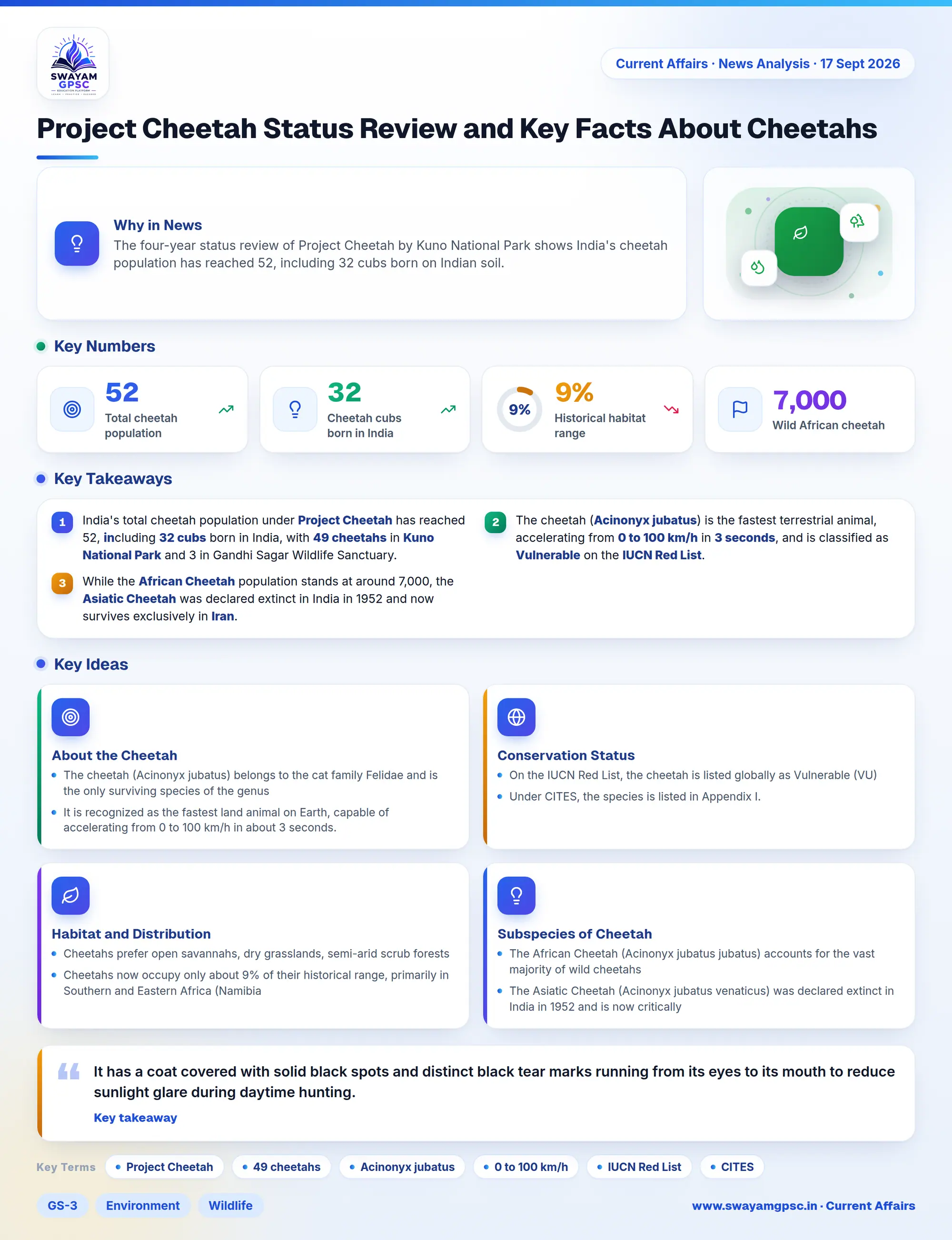
Project Cheetah Status Review and Key Facts About Cheetahs
#GS-3 #Environment #Wildlife #Biodiversity #Project Cheetah #IUCN Red List
Key takeaways
- India's total cheetah population under Project Cheetah has reached 52, including 32 cubs born in India, with 49 cheetahs in Kuno National Park and 3 in Gandhi Sagar Wildlife Sanctuary.
- The cheetah (Acinonyx jubatus) is the fastest terrestrial animal, accelerating from 0 to 100 km/h in 3 seconds, and is classified as Vulnerable on the IUCN Red List.
- While the African Cheetah population stands at around 7,000, the Asiatic Cheetah was declared extinct in India in 1952 and now survives exclusively in Iran.
Why in News
- The four-year status review of Project Cheetah by Kuno National Park shows India's cheetah population has reached 52, including 32 cubs born on Indian soil.
- The programme has entered its consolidation phase, with 49 cheetahs in Kuno National Park (17 free-ranging) and 3 cheetahs in Gandhi Sagar Wildlife Sanctuary.
About the Cheetah
- The cheetah (Acinonyx jubatus) belongs to the cat family Felidae and is the only surviving species of the genus Acinonyx.
- It is recognized as the fastest land animal on Earth, capable of accelerating from 0 to 100 km/h in about 3 seconds.
Conservation Status
- On the IUCN Red List, the cheetah is listed globally as Vulnerable (VU), while the Asiatic subspecies is Critically Endangered (CR).
- Under CITES, the species is listed in Appendix I.
Habitat and Distribution
- Cheetahs prefer open savannahs, dry grasslands, semi-arid scrub forests, and bushlands that provide clear visibility for high-speed chases.
- Cheetahs now occupy only about 9% of their historical range, primarily in Southern and Eastern Africa (Namibia, Botswana, and South Africa), with small populations in Iran and reintroduced groups in India.
Subspecies of Cheetah
- The African Cheetah (Acinonyx jubatus jubatus) accounts for the vast majority of wild cheetahs, with around 7,000 individuals across sub-Saharan Africa.
- The Asiatic Cheetah (Acinonyx jubatus venaticus) was declared extinct in India in 1952 and is now critically endangered, surviving only in Iran.
Key Physical and Behavioral Characteristics
- Its body is built for speed with a flexible spine, enlarged heart, wide nasal passages, and a long tail that acts like a rudder during sharp turns.
- Unlike other cats, its semi-retractable claws act like athletic track spikes and its hard paw pads offer grip on dry ground.
- It has a coat covered with solid black spots and distinct black tear marks running from its eyes to its mouth to reduce sunlight glare during daytime hunting.
- It hunts mainly during the day using sharp vision, chasing prey in short sprints under 30 to 60 seconds before delivering a throat bite.
- Female cheetahs live solitary lives, while male brothers often form lifelong groups called coalitions to defend hunting territory.