The Private Healthcare Boom and Cost Crisis in India
#GS-2 #Governance & Social Justice #Health #Current Events #National #GS-3 #Economy #Infrastructure #Private Healthcare Crisis
Key takeaways
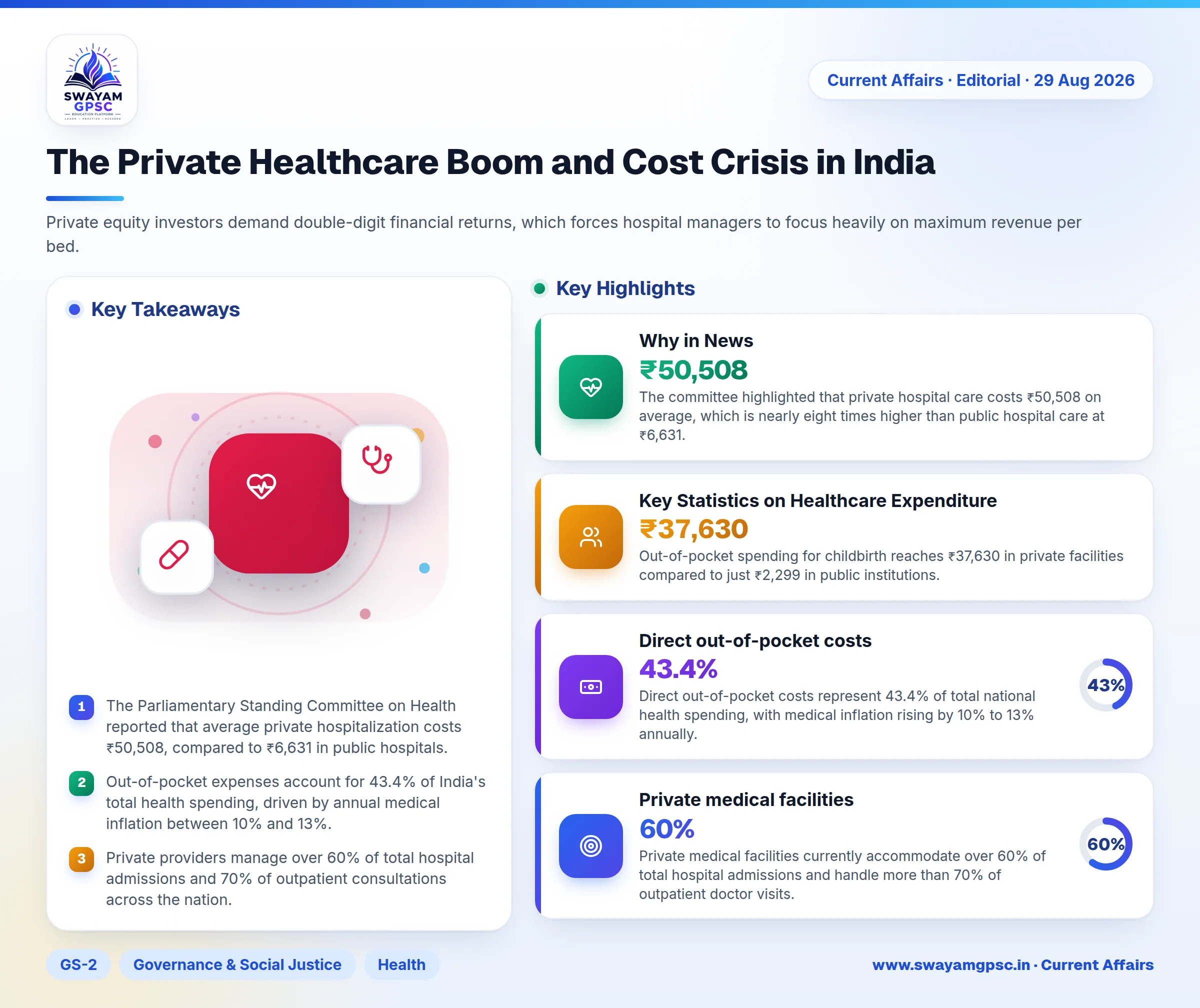
- The Parliamentary Standing Committee on Health reported that average private hospitalization costs ₹50,508, compared to ₹6,631 in public hospitals.
- Out-of-pocket expenses account for 43.4% of India's total health spending, driven by annual medical inflation between 10% and 13%.
- Private providers manage over 60% of total hospital admissions and 70% of outpatient consultations across the nation.
- Key committee proposals include benchmarking room rents against three-star hotel tariffs and boosting public healthcare spending to 2.5% of GDP.
Why in News
- The Parliamentary Standing Committee on Health and Family Welfare recently submitted its 176th Report focusing on healthcare affordability.
- The committee highlighted that private hospital care costs ₹50,508 on average, which is nearly eight times higher than public hospital care at ₹6,631.
Overview of Private Healthcare Expansion
- India is experiencing a rapid expansion of corporatized and equity-backed hospital chains designed to fill critical gaps in specialized medical care.
Key Statistics on Healthcare Expenditure
- Data from the National Sample Survey (NSO) 80th round confirms that private hospitalization costs remain almost eight times higher than public care.
- Out-of-pocket spending for childbirth reaches ₹37,630 in private facilities compared to just ₹2,299 in public institutions.
- Direct out-of-pocket costs represent 43.4% of total national health spending, with medical inflation rising by 10% to 13% annually.
- Private medical facilities currently accommodate over 60% of total hospital admissions and handle more than 70% of outpatient doctor visits.
Drivers of High Costs in Private Healthcare
- Private equity investors demand double-digit financial returns, which forces hospital managers to focus heavily on maximum revenue per bed.
- Patients lack specialized medical knowledge, allowing healthcare providers to prescribe unnecessary tests, extended ICU stays, or complex procedures.
- High land costs in prime city locations, costly imported diagnostic tools, and high specialist salaries drive up baseline hospital operational expenses.
- Hospitals routinely multiply consultation, nursing, and procedure charges in proportion to higher room rent tiers.
- Hospitals generate large profit margins by selling surgical supplies, diagnostic tools, and medicines at maximum retail prices.
Key Recommendations of the Parliamentary Standing Committee
- The panel recommended capping standard private hospital room tariffs using nearby three-star hotel rates as a reasonable benchmark.
- Tertiary hospitals must provide patients with legally binding, detailed pre-treatment estimates before starting complex medical procedures.
- The government should closely review foreign investments that buy existing domestic hospitals instead of creating new medical facilities in neglected districts.
- Authorities should establish single fixed-price packages that cover diagnostic tests, doctor consultations, surgeries, and post-discharge care together.
- Hospitals participating in Ayushman Bharat-PMJAY must set up Jan Aushadhi and AMRIT generic pharmacies to reduce out-of-pocket medicine costs.
Challenges Associated with Regulating Private Healthcare
- Capping room rents alone might encourage hospitals to raise prices on secondary items like laboratory diagnostics and nursing services.
- Strict price controls could discourage private investors from building new health facilities in smaller towns where public hospital beds are limited.
- Setting uniform prices across all hospitals ignores wide differences in equipment quality, nurse staffing levels, and specialist accreditations.
- Since health is a state subject under Entry 6 of List II, several state governments have delayed enforcing the Clinical Establishments Act of 2010.
- Patients continue relying on expensive private hospitals because nearby public health centers remain crowded and understaffed.
Way Ahead
- Healthcare systems should replace itemized medical bills with fixed bundled payments based on Diagnosis-Related Groups (DRG).
- Central and state governments must work together to enforce mandatory price displays and regular quality checks under the Clinical Establishments Act.
- Policy incentives should encourage new greenfield hospital projects in Tier-2 and Tier-3 towns rather than private buyouts of existing centers.
- Accelerating hospital integration with the National Health Claims Exchange (NHCX) will streamline insurance claims and prevent surprise charges.
- Increasing public healthcare expenditure toward 2.5% of GDP will build stronger district hospitals and Ayushman Arogya Mandirs.
Conclusion
- Isolated price limits offer temporary relief, but addressing high medical expenses requires structural reforms across both public and private sectors.
- By enforcing transparent price displays, introducing bundled treatment packages, and expanding public facilities, India can make healthcare affordable for all.