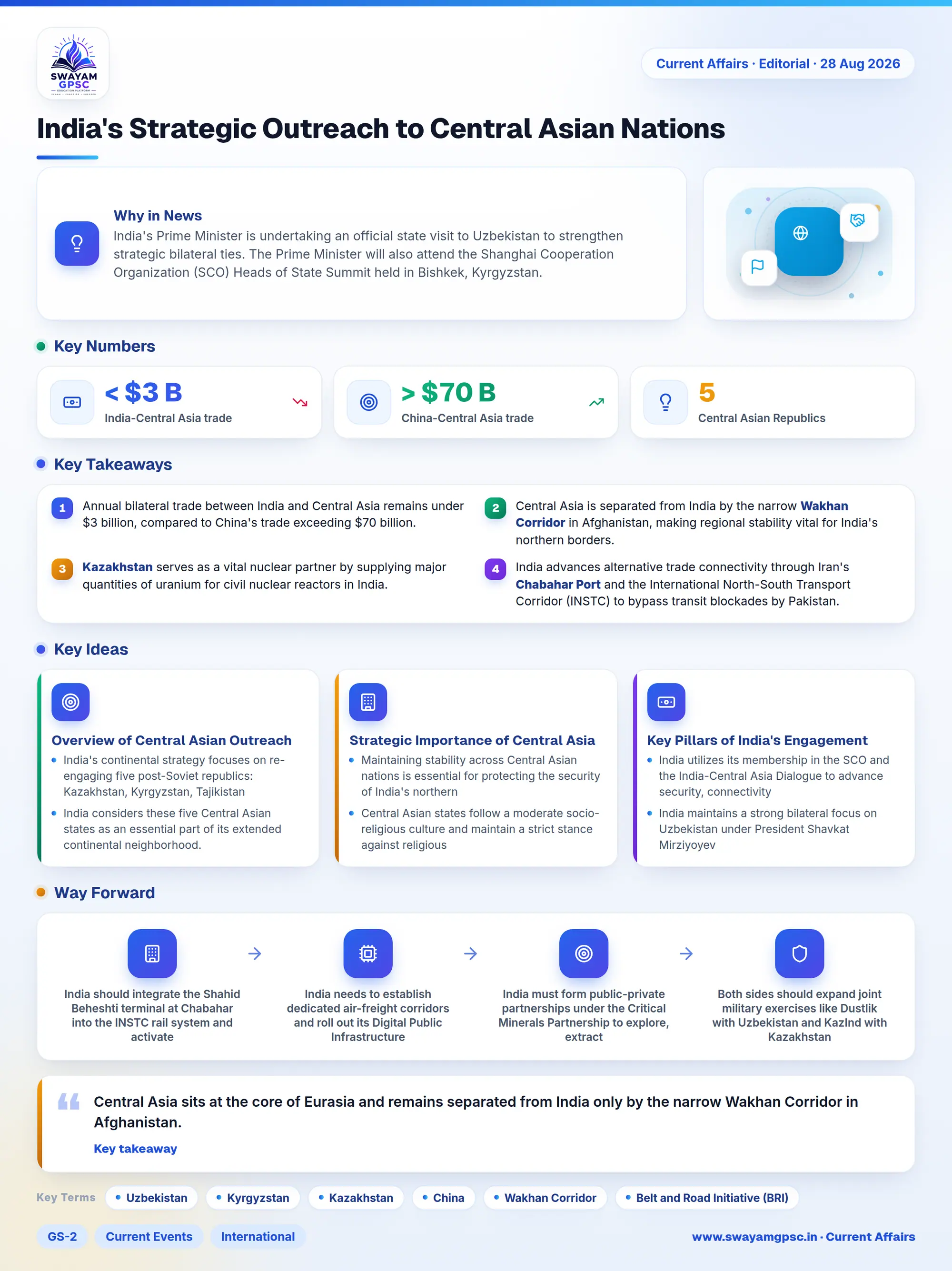
India's Strategic Outreach to Central Asian Nations
#GS-2 #Current Events #International #Governance & Social Justice #Central Asia #Shanghai Cooperation Organization #Chabahar Port #INSTC
Key takeaways
- Annual bilateral trade between India and Central Asia remains under $3 billion, compared to China's trade exceeding $70 billion.
- Central Asia is separated from India by the narrow Wakhan Corridor in Afghanistan, making regional stability vital for India's northern borders.
- Kazakhstan serves as a vital nuclear partner by supplying major quantities of uranium for civil nuclear reactors in India.
- India advances alternative trade connectivity through Iran's Chabahar Port and the International North-South Transport Corridor (INSTC) to bypass transit blockades by Pakistan.
Why in News
- India's Prime Minister is undertaking an official state visit to Uzbekistan to strengthen strategic bilateral ties.
- The Prime Minister will also attend the Shanghai Cooperation Organization (SCO) Heads of State Summit held in Bishkek, Kyrgyzstan.
Overview of Central Asian Outreach
- India's continental strategy focuses on re-engaging five post-Soviet republics: Kazakhstan, Kyrgyzstan, Tajikistan, Turkmenistan, and Uzbekistan.
- India considers these five Central Asian states as an essential part of its extended continental neighborhood.
- This outreach builds on ancient Silk Road civilizational ties to balance security interests, counter-terrorism priorities, energy access, and trade routes.
- The policy creates alternative connectivity options to prevent the region from turning into an exclusive sphere of influence for China or Pakistan.
Strategic Importance of Central Asia for India
- Central Asia sits at the core of Eurasia and remains separated from India only by the narrow Wakhan Corridor in Afghanistan.
- Maintaining stability across Central Asian nations is essential for protecting the security of India's northern frontiers.
- Central Asian states follow a moderate socio-religious culture and maintain a strict stance against religious extremism.
- This anti-radicalization stance aligns directly with India's efforts to counter terrorism originating from Afghan territory.
- The region contains vast hydrocarbon reserves and uranium, with Kazakhstan supplying major quantities of uranium for Indian civil nuclear reactors.
- Central Asia offers untapped deposits of critical and rare-earth minerals required for global clean energy transitions.
- As Russian influence shifts and China expands its Belt and Road Initiative (BRI), Central Asian states seek to diversify partnerships with democratic powers like India.
Key Pillars of India's Engagement
- India utilizes its membership in the SCO and the India-Central Asia Dialogue to advance security, connectivity, and economic growth under its SECURE vision.
- India maintains a strong bilateral focus on Uzbekistan under President Shavkat Mirziyoyev, expanding cooperation in joint counter-terrorism, pharmaceuticals, and digital infrastructure.
- India develops alternative multimodal transport links through Iran's Chabahar Port and the International North-South Transport Corridor (INSTC) to bypass transit restrictions by Pakistan.
- India leverages shared historical connections in language, Buddhism, Sufism, and architecture along with high demand for Indian higher education, medical tourism, and IT training.
Challenges in Regional Engagement
- Denial of direct land transit access through Pakistan prevents overland trade and increases logistics costs via maritime-land routes.
- China maintains a dominant economic footprint with annual regional trade exceeding $70 billion alongside extensive BRI infrastructure investments.
- Security risks stemming from instability, drug trafficking, and extremist groups in Afghanistan continue to impact border stability.
- Annual trade between India and Central Asia remains modest at under $3 billion due to high freight tariffs, banking hurdles, and limited air links.
- Complex border conflicts from the Soviet era, water-sharing disputes across the Amu Darya and Syr Darya rivers, and ethnic enclaves slow down regional integration.
Way Forward
- India should integrate the Shahid Beheshti terminal at Chabahar into the INSTC rail system and activate the Ashgabat Agreement for freight movement.
- India needs to establish dedicated air-freight corridors and roll out its Digital Public Infrastructure, such as UPI and telemedicine networks, across the region.
- India must form public-private partnerships under the Critical Minerals Partnership to explore, extract, and process lithium and rare earths in Kazakhstan and Uzbekistan.
- Both sides should expand joint military exercises like Dustlik with Uzbekistan and KazInd with Kazakhstan while sharing real-time intelligence via SCO's RATS.
- India should increase ITEC scholarships, set up university campuses in Tashkent and Almaty, and simplify tourist visa procedures to build stronger cultural links.
Conclusion
- The Prime Minister's visit confirms India's strategic resolve to rebuild its historical footprint across the Eurasian region.
- Navigating Eurasian geopolitical changes requires India to convert civilizational goodwill into functional trade routes, energy projects, and defense ties.
- Sustaining proactive diplomacy alongside digital and transport connectivity will ensure India remains a trusted partner for Central Asia.