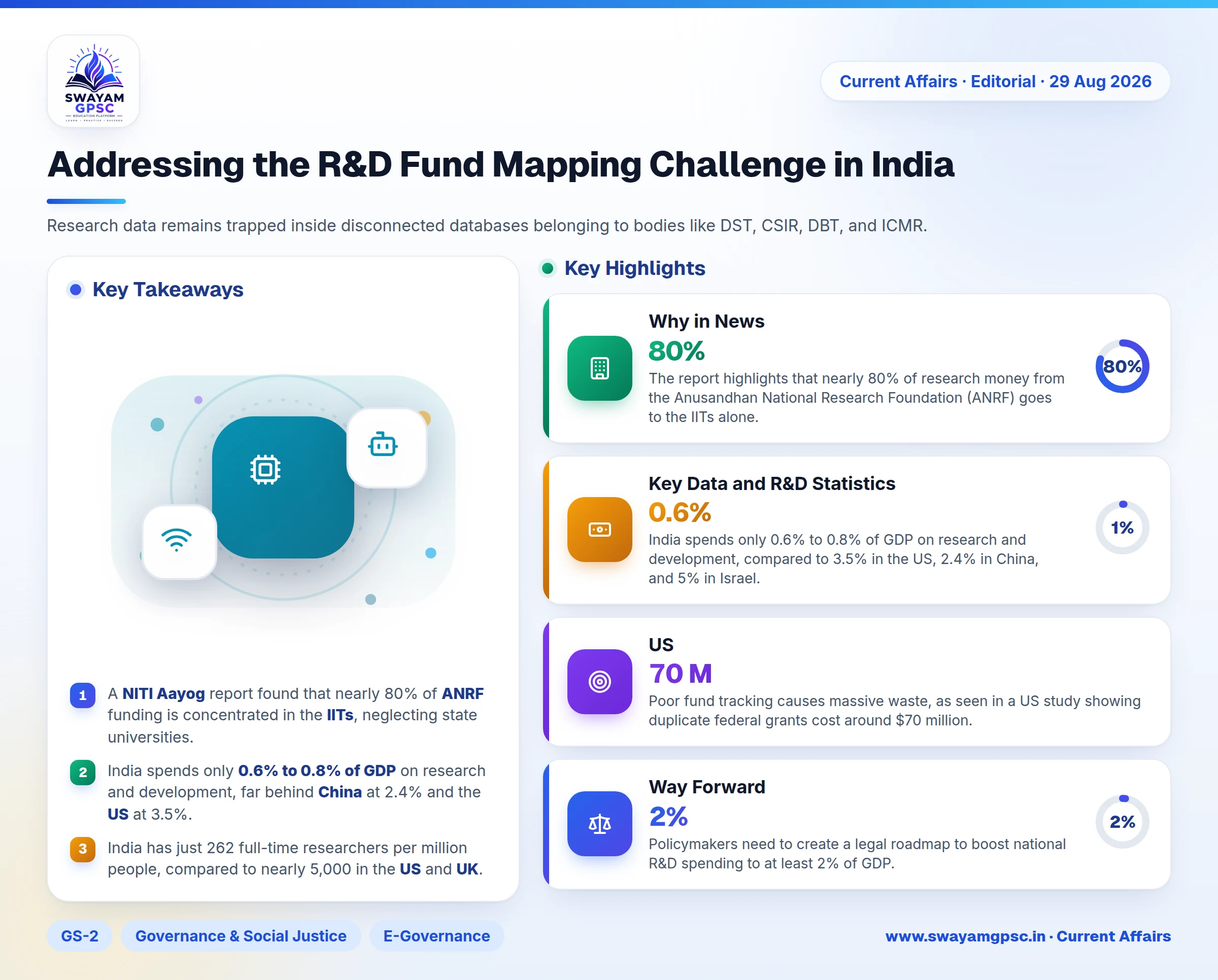
Addressing the R&D Fund Mapping Challenge in India
#GS-2 #Governance & Social Justice #E-Governance #GS-3 #Science & Technology #ICT #Research & Development #Higher Education
Key takeaways
- A NITI Aayog report found that nearly 80% of ANRF funding is concentrated in the IITs, neglecting state universities.
- India spends only 0.6% to 0.8% of GDP on research and development, far behind China at 2.4% and the US at 3.5%.
- India has just 262 full-time researchers per million people, compared to nearly 5,000 in the US and UK.
- Implementing Persistent Digital Identifiers (PIDs) in the proposed Unified Project Management System (UPMS) will eliminate duplicate grants and ensure outcome tracking.
Why in News
- A recent NITI Aayog report titled Ease of Doing R&D in India reveals significant structural imbalances in research funding distribution across the country.
- The report highlights that nearly 80% of research money from the Anusandhan National Research Foundation (ANRF) goes to the IITs alone.
- To fix this problem, the report recommends building a Unified Project Management System (UPMS) equipped with a Persistent Digital Identifier (PID) framework.
Understanding the R&D Fund Mapping Problem
- India lacks a standardized digital system to track who receives scientific funding, which ministry provides it, and what research it supports.
- Research data remains trapped inside disconnected databases belonging to bodies like DST, CSIR, DBT, and ICMR.
- These agencies record grant details in unstructured free text, making it hard to identify redundant projects or calculate actual scientific outputs.
Key Data and R&D Statistics
- The IITs absorb nearly 80% of ANRF funding, which leaves state universities and regional institutes with very few resources.
- India spends only 0.6% to 0.8% of GDP on research and development, compared to 3.5% in the US, 2.4% in China, and 5% in Israel.
- India employs around 262 full-time researchers per million people, while the UK and US employ nearly 5,000 per million.
- Poor fund tracking causes massive waste, as seen in a US study showing duplicate federal grants cost around $70 million.
The Core Missing Link: PIDs and Metadata Infrastructure
- A Persistent Digital Identifier (PID) is a unique, permanent code assigned to every grant, similar to a tax PAN number.
- Every PID stores structured attributes including the funding body, principal investigator, target institute, disbursed money, and scientific domain.
- Requiring researchers to cite grant PIDs in published papers and patents allows automated systems to track real scientific results.
- Standardized PIDs solve naming errors, helping computers distinguish between institutes like IISc Bangalore and Indian Institute of Science Bengaluru.
The Global PID Architecture
- The Funder ID mechanism managed by Crossref identifies specific funding bodies down to the ministry division level.
- The Research Organization Registry (ROR) provides an open identifier for academic institutions, eliminating naming confusion.
- The Open Researcher and Contributor ID (ORCID) gives individual scientists a unique digital ID to track their work over time.
- A Grant DOI connects a specific public grant directly to all downstream scientific publications, dataset entries, and patents.
Challenges in the R&D Funding Ecosystem
- Central funding agencies maintain separate portals that use unstructured text rather than shared data standards.
- Agencies lack automated screening tools, allowing overlapping research proposals to receive funding from multiple departments simultaneously.
- Heavy fund concentration in premier central institutes widens the infrastructure gap facing state universities.
- Rigid financial rules and administrative delays in fellowship payouts slow down the pace of scientific discovery.
- Grantees have no automated mechanisms to link their final patents or papers back to initial public grant records.
Way Forward
- India should develop the Unified Project Management System (UPMS) as a central portal that generates globally compatible Grant DOIs, ROR, and ORCID tags.
- India can learn from international models like the UK platform Gateway to Research and the European Union system CORDIS.
- The ANRF must reserve a specific percentage of its annual budget for state universities to spread research money more evenly.
- The government should make it mandatory for all researchers to include their grant PID in scientific journal papers and patent filings.
- Policymakers need to create a legal roadmap to boost national R&D spending to at least 2% of GDP.
Conclusion
- India cannot build a world-class innovation ecosystem on top of unorganized and opaque funding records.
- Adding persistent digital identifiers to the UPMS portal will make public research investments transparent and outcome focused.
- Mapping research money accurately will reduce duplicate spending, support state universities, and deliver greater returns on public funds.