Pradhan Mantri Jan Dhan Yojana: 12 Years of Financial Inclusion
#GS-2 #GS-3 #Governance & Social Justice #Economy #Banking #Poverty #Good Governance #Financial Inclusion #PMJDY
Key takeaways
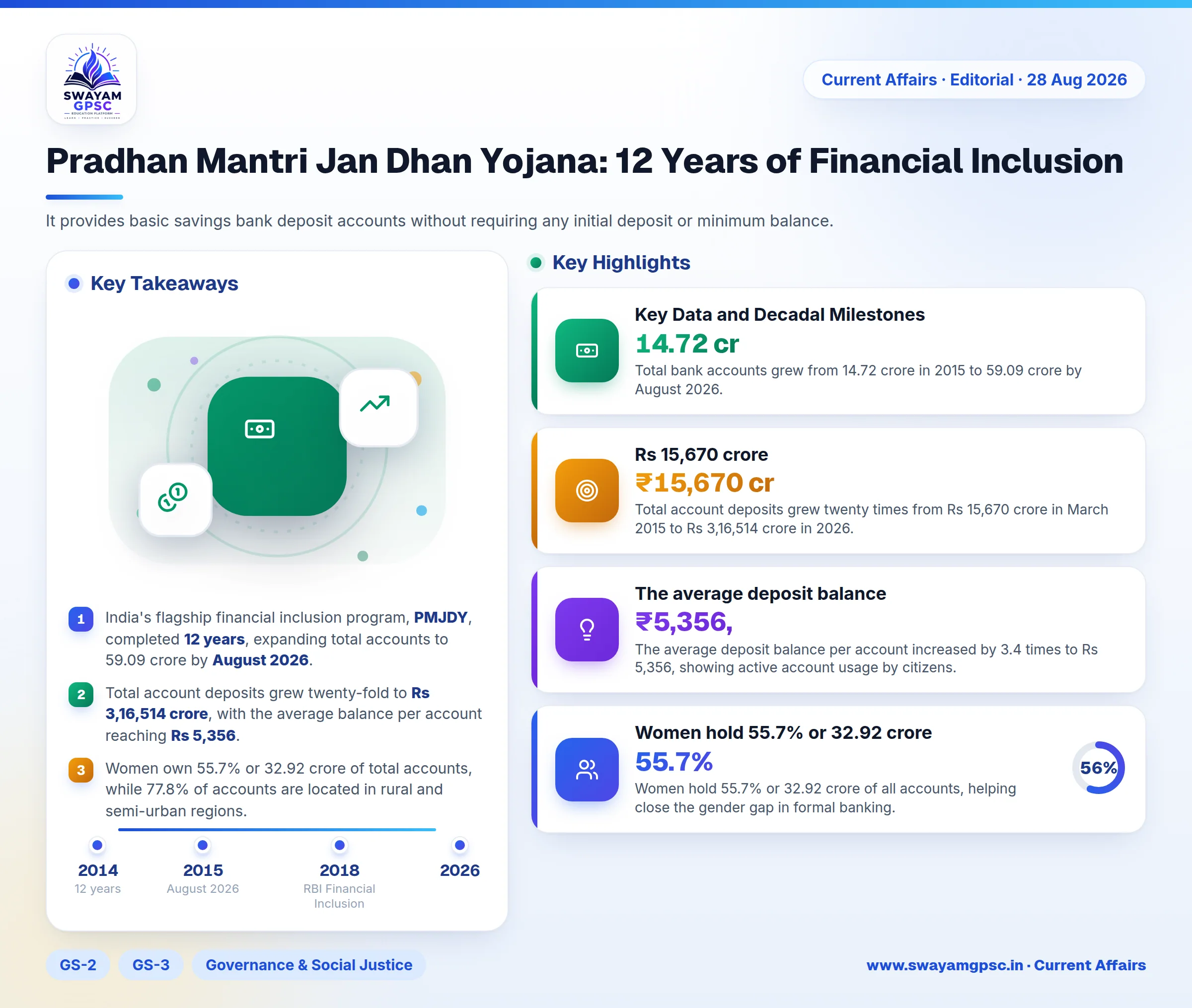
- India's flagship financial inclusion program, PMJDY, completed 12 years, expanding total accounts to 59.09 crore by August 2026.
- Total account deposits grew twenty-fold to Rs 3,16,514 crore, with the average balance per account reaching Rs 5,356.
- Women own 55.7% or 32.92 crore of total accounts, while 77.8% of accounts are located in rural and semi-urban regions.
- The RBI Financial Inclusion Index rose from 53.9 in 2018 to 67.0 in 2026, backed by over 41.29 crore issued RuPay cards.
Why in News
- The Pradhan Mantri Jan Dhan Yojana (PMJDY) completed 12 years of successful implementation after its launch in 2014.
- This national mission has transformed India by extending formal banking services to hundreds of millions of unbanked citizens.
What is Pradhan Mantri Jan Dhan Yojana?
- The government launched PMJDY as India's national mission for financial inclusion to reach unbanked adults.
- The scheme operates on three guiding principles: banking the unbanked, securing the unsecured, and funding the unfunded.
- It provides basic savings bank deposit accounts without requiring any initial deposit or minimum balance.
- The scheme integrates bank accounts with Aadhaar and mobile numbers under the JAM trinity to deliver direct benefit transfers transparently.
Key Data and Decadal Milestones
- Total bank accounts grew from 14.72 crore in 2015 to 59.09 crore by August 2026.
- Total account deposits grew twenty times from Rs 15,670 crore in March 2015 to Rs 3,16,514 crore in 2026.
- The average deposit balance per account increased by 3.4 times to Rs 5,356, showing active account usage by citizens.
- Women hold 55.7% or 32.92 crore of all accounts, helping close the gender gap in formal banking.
- Rural and semi-urban areas host 77.8% or 45.95 crore accounts, compared to 13.14 crore in urban centers.
- Banks have issued over 41.29 crore RuPay debit cards to promote digital payments across the country.
- The RBI Financial Inclusion Index improved from 53.9 in 2018 to 67.0 in 2026, reflecting better banking access and quality.
Core Pillars of the Jan Dhan Architecture
- The scheme provides zero balance accounts without charging any maintenance penalties.
- Account holders receive a free RuPay debit card with Rs 2 lakh accidental insurance cover funded by NPCI.
- Eligible households get an emergency overdraft limit of up to Rs 10,000, reducing their dependence on informal moneylenders.
- The JAM trinity connects bank accounts with digital identities to deliver leak free transfers across over 300 government schemes.
- These accounts serve as an entry point for government social security schemes and collateral free PM MUDRA Yojana micro loans.
Challenges
- Many accounts remain inactive or function only as temporary channels to withdraw government subsidies.
- Strict bank credit checks and low awareness prevent most account holders from using the Rs 10,000 overdraft facility.
- Banking correspondents face weak internet connectivity, hardware glitches, and cash shortages in remote rural areas.
- First time account holders in rural regions face higher risks of online financial fraud and cyber scams.
- Managing millions of low balance accounts increases operating costs for commercial banks without generating fee income.
Way Forward
- Banks should use transaction histories to offer small recurring deposits, micro mutual funds, and affordable working capital loans.
- The government should support banking correspondents with higher commissions, dual SIM biometric devices, and regular training.
- Gram panchayats must run local financial literacy drives to teach citizens about safe UPI usage and PIN security.
- Social security schemes like PMJJBY and PMSBY should use auto debit options to ensure continuous insurance coverage.
- Integrating accounts with the Open Credit Enablement Network (OCEN) can deliver instant credit to small vendors and artisans.
Conclusion
- Over the past twelve years, PMJDY has turned India's banking system into an inclusive financial democracy.
- Moving from simple account opening to micro credit, insurance, and wealth creation will help achieve the vision of Viksit Bharat@2047.