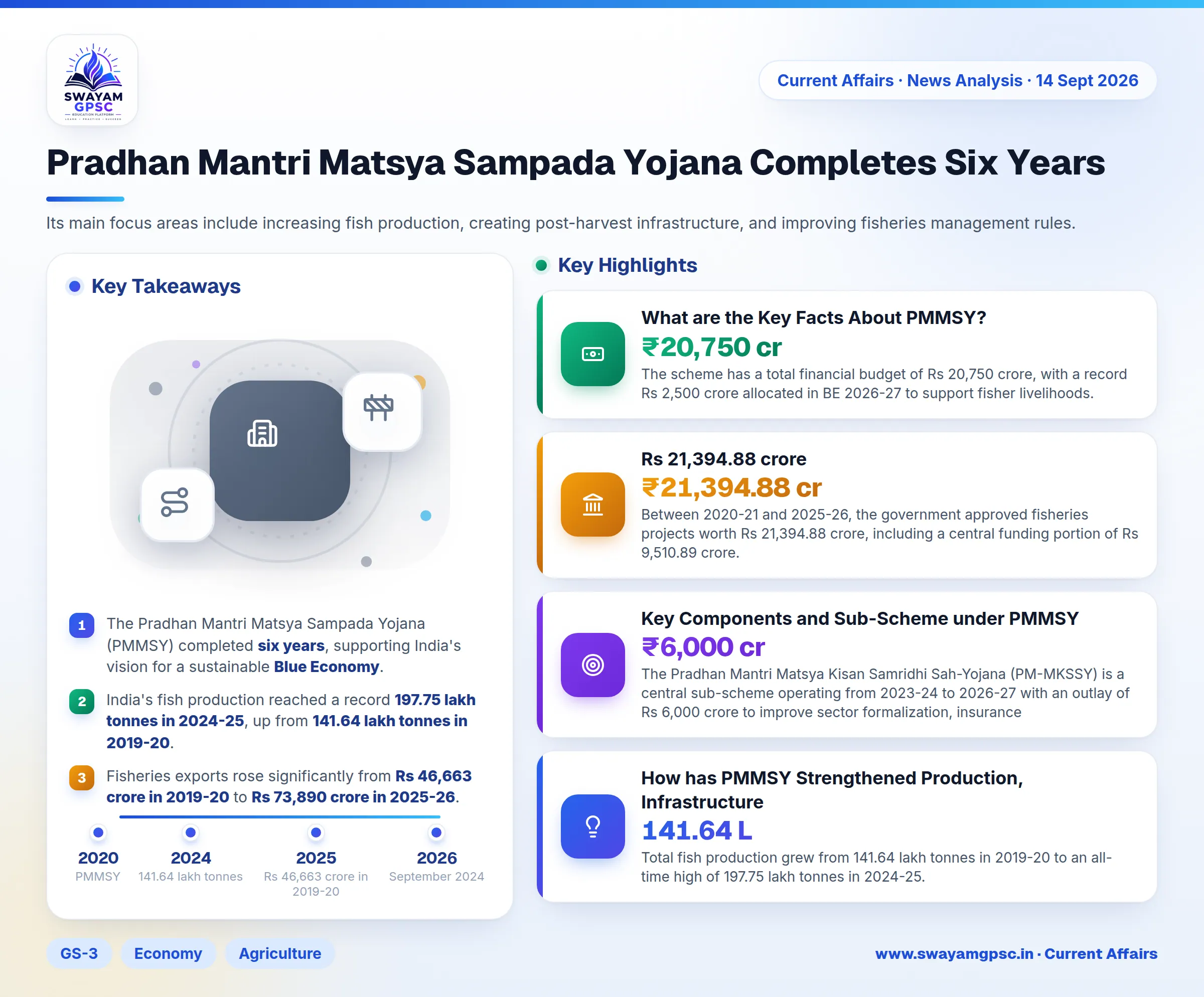
Pradhan Mantri Matsya Sampada Yojana Completes Six Years
#GS-3 #Economy #Agriculture #Infrastructure #Current Events #National
Key takeaways
- The Pradhan Mantri Matsya Sampada Yojana (PMMSY) completed six years, supporting India's vision for a sustainable Blue Economy.
- India's fish production reached a record 197.75 lakh tonnes in 2024-25, up from 141.64 lakh tonnes in 2019-20.
- Fisheries exports rose significantly from Rs 46,663 crore in 2019-20 to Rs 73,890 crore in 2025-26.
- The central sub-scheme PM-MKSSY runs with an outlay of Rs 6,000 crore to formalize the sector and improve credit access.
- The scheme has generated employment for over 58 lakh persons and supported 2,195 FFPOs across the country.
Why in News?
- The Pradhan Mantri Matsya Sampada Yojana (PMMSY) recently completed six years, marking a major milestone for India's fisheries sector.
What are the Key Facts About PMMSY?
- The central government launched PMMSY in 2020 by expanding the earlier Blue Revolution scheme to address key gaps in fish production and build a modern industry.
- The program works as an umbrella framework that combines a Central Sector Scheme and a Centrally Sponsored Scheme.
- Its main focus areas include increasing fish production, creating post-harvest infrastructure, and improving fisheries management rules.
- The scheme has a total financial budget of Rs 20,750 crore, with a record Rs 2,500 crore allocated in BE 2026-27 to support fisher livelihoods.
- Between 2020-21 and 2025-26, the government approved fisheries projects worth Rs 21,394.88 crore, including a central funding portion of Rs 9,510.89 crore.
Key Components and Sub-Scheme under PMMSY
- The Pradhan Mantri Matsya Kisan Samridhi Sah-Yojana (PM-MKSSY) is a central sub-scheme operating from 2023-24 to 2026-27 with an outlay of Rs 6,000 crore to improve sector formalization, insurance, and quality control.
- The centrally sponsored component uses modern technology to improve fish yields across inland waters, sea areas, seaweed farms, and Himalayan rivers.
- This component also builds critical facilities like fishing harbors, fish landing centers, cold storage chains, and modern fish markets.
- It safeguards fishers by providing vessel insurance, sea safety gear, monitoring systems, and income security during off-seasons.
How has PMMSY Strengthened Production, Infrastructure and Livelihoods?
- Total fish production grew from 141.64 lakh tonnes in 2019-20 to an all-time high of 197.75 lakh tonnes in 2024-25.
- The implementation of PMMSY has created direct and indirect jobs for nearly 58 lakh persons across the country.
- Fisheries export earnings increased from Rs 46,663 crore in 2019-20 to Rs 73,890 crore in 2025-26.
- The government approved 12 Integrated Aquaparks with a planned investment of Rs 713.80 crore to create modern processing centers.
- To support coastal communities, authorities approved seaweed projects worth Rs 198.17 crore between 2020 and 2025.
- The scheme promotes high-tech farming techniques, sanctioning 12,081 RAS units and 4,205 Biofloc systems to save water and land.
- It backed 2,672 ornamental fish rearing units to encourage local entrepreneurship and specialized fish breeding.
- To help small fishers pool resources, the government approved Rs 544.86 crore to set up 2,195 FFPOs between 2021-22 and 2025-26.
- Under its central component, the scheme selected 100 coastal fishermen villages as Climate Resilient Coastal Fishermen Villages, funding each with Rs 200 lakh.
- The National Fisheries Digital Platform (NFDP) launched in September 2024 has recorded over 37.01 lakh individual registrations as of 8 September 2026.
Conclusion
- PMMSY has transformed India's fisheries sector by combining higher production, modern storage facilities, advanced technology, and community welfare.
- As India develops its Blue Economy vision, this scheme remains key to ensuring sustainable and inclusive growth for all fishers.