PM Surya Sarovar Yojana: Boosting Floating Solar Energy in India
#GS-3 #Economy #Infrastructure #Environment #Sustainable Development #Renewable Energy
Key takeaways
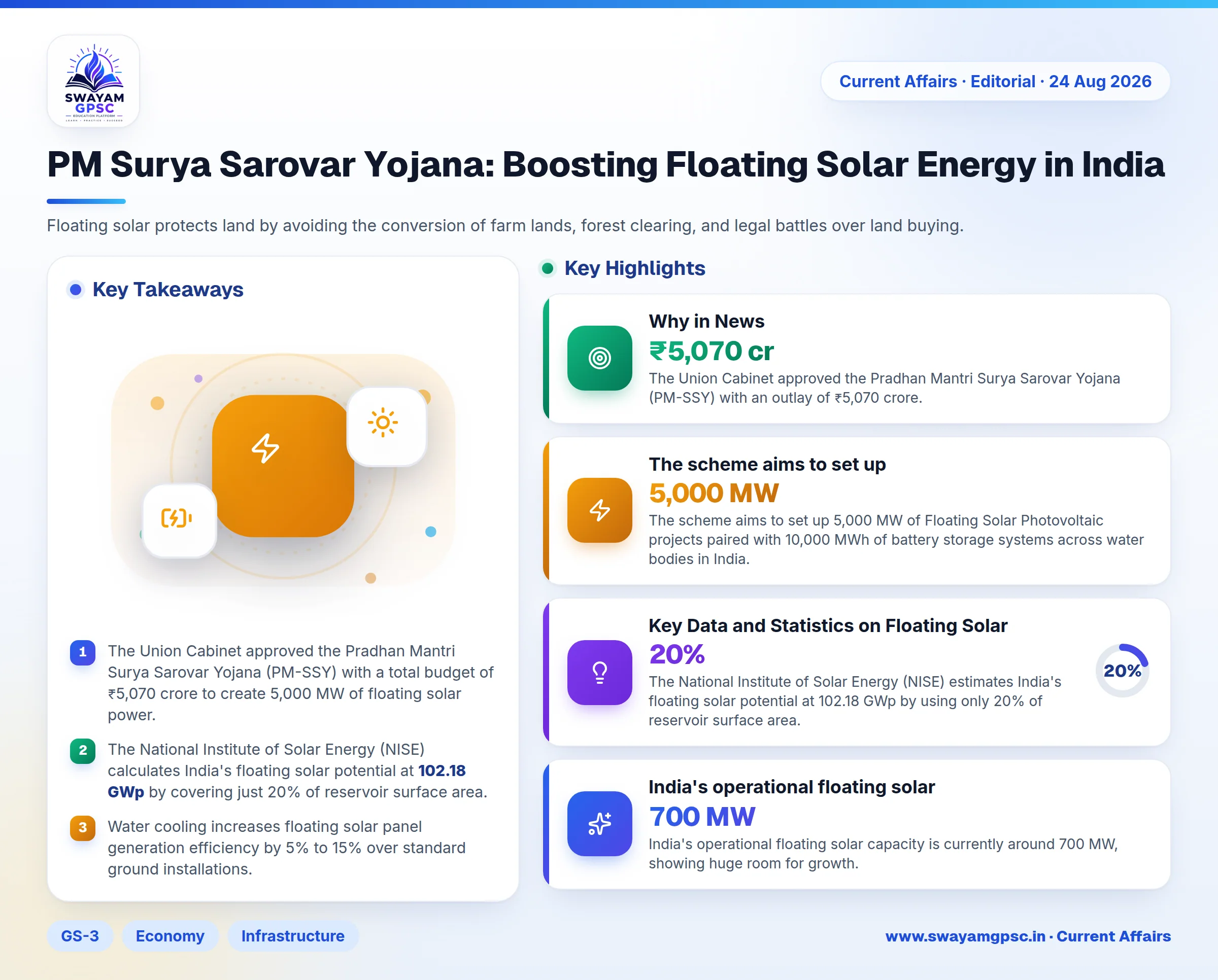
- The Union Cabinet approved the Pradhan Mantri Surya Sarovar Yojana (PM-SSY) with a total budget of ₹5,070 crore to create 5,000 MW of floating solar power.
- The National Institute of Solar Energy (NISE) calculates India's floating solar potential at 102.18 GWp by covering just 20% of reservoir surface area.
- Water cooling increases floating solar panel generation efficiency by 5% to 15% over standard ground installations.
- Floating solar projects face 15% to 25% higher upfront costs than ground installations due to specialized mooring lines and underwater cables.
Why in News
- The Union Cabinet approved the Pradhan Mantri Surya Sarovar Yojana (PM-SSY) with an outlay of ₹5,070 crore.
- The scheme aims to set up 5,000 MW of Floating Solar Photovoltaic projects paired with 10,000 MWh of battery storage systems across water bodies in India.
Overview of Floating Solar in India
- Floating solar systems mount solar panels on buoyant platforms anchored to the bed or banks of dams, reservoirs, lakes, and industrial ponds.
- Underwater cables transfer the generated power onshore, offering a land-neutral option that prevents land acquisition disputes while cutting water evaporation.
Key Data and Statistics on Floating Solar
- The National Institute of Solar Energy (NISE) estimates India's floating solar potential at 102.18 GWp by using only 20% of reservoir surface area.
- India's operational floating solar capacity is currently around 700 MW, showing huge room for growth.
- India's total solar capacity grew rapidly from 3 GW in 2016 to more than 160 GW by mid-2026.
- Major operating projects include NTPC's 100 MW Ramagundam project in Telangana, the 92 MW Kayamkulam project in Kerala, and the 600 MW Omkareshwar project in Madhya Pradesh where 278 MW is active.
Key Advantages and Relevance for India
- Floating solar protects land by avoiding the conversion of farm lands, forest clearing, and legal battles over land buying.
- Water creates a natural cooling effect that lowers panel temperature and increases electricity generation by 5% to 15% compared to ground setups.
- Covering water surfaces lowers evaporation loss significantly, saving vital drinking and irrigation water during dry summer months.
- Building floating solar on hydro reservoirs allows shared use of transmission lines, switchyards, and power grid substations.
- Blocking excess sunlight lowers water temperatures and cuts photosynthesis, which reduces harmful algal blooms and improves water quality.
Challenges Associated with Floating Solar
- Floating solar plants are 15% to 25% more expensive than ground plants because they need high-grade polymer floaters, special anchoring lines, and underwater cables.
- Water level changes exceeding 15 to 20 meters, combined with wind and wave action, can loosen anchors and damage structural parts.
- Constant shading and lower oxygen levels in water can disrupt marine life, fish breeding, and bird habitats.
- High humidity causes moisture damage, leading to frame rust and electrical breakdown in junction boxes.
- Getting approvals requires complex coordination across state irrigation departments, dam safety boards, water resources agencies, and power companies.
Salient Features of PM Surya Sarovar Yojana
- The scheme provides ₹5,070 crore to build 5,000 MW of floating solar capacity between FY 2026-27 and FY 2030-31.
- Projects must include at least 2 hours of battery storage (10,000 MWh total) to supply reliable electricity during peak evening hours.
- The government offers financial support of ₹1 crore per MW upon commissioning, plus ₹50 lakh per project for feasibility and environmental studies.
Way Forward
- Authorities must conduct detailed sonar and seabed mapping before starting projects to avoid anchor failures.
- India should offer domestic manufacturing incentives for UV-resistant polyethylene floaters and marine components.
- Creating a single portal between the Ministry of Power and Ministry of Jal Shakti will speed up water body leasing clearances.
- Combining floating solar with dam hydro turbines helps balance daytime solar power with evening hydro generation.
- Limiting floating solar coverage to 20% to 30% of a reservoir's surface will safeguard local fish species and fishing communities.
Conclusion
- The Pradhan Mantri Surya Sarovar Yojana provides a strong model to grow solar energy without using scarce land.
- Combining floating panels with battery storage helps India progress toward its goal of 500 GW non-fossil fuel capacity.
- Solving technical and regulatory hurdles will make floating solar a key part of India's clean energy transition.