PM SHRI Scheme: Transforming Indian School Education System
#GS-2 #Governance & Social Justice #Education #Government Policies & Interventions #Current Events #National
Key takeaways
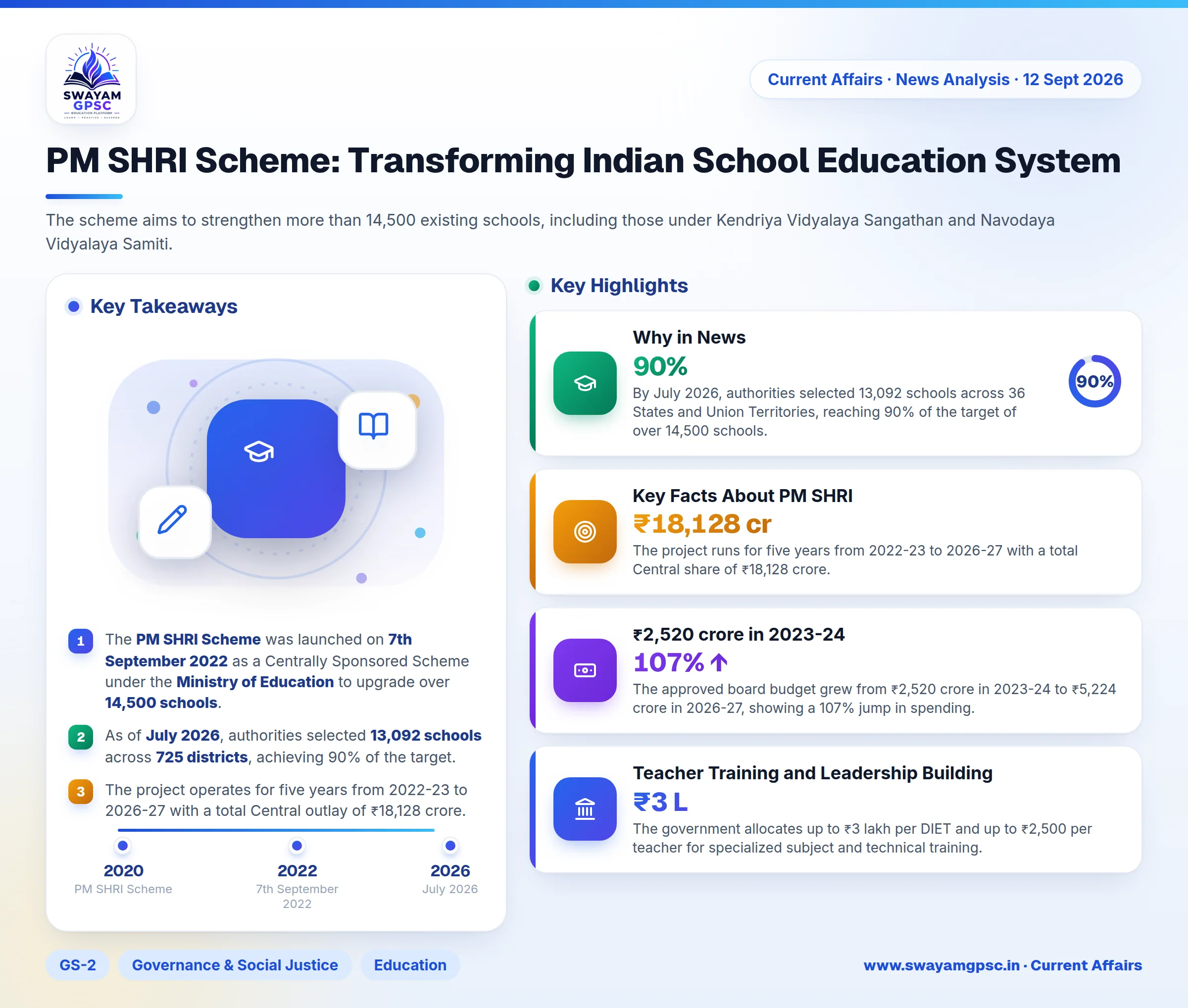
- The PM SHRI Scheme was launched on 7th September 2022 as a Centrally Sponsored Scheme under the Ministry of Education to upgrade over 14,500 schools.
- As of July 2026, authorities selected 13,092 schools across 725 districts, achieving 90% of the target.
- The project operates for five years from 2022-23 to 2026-27 with a total Central outlay of ₹18,128 crore.
- Annual spending increased by 107%, rising from ₹2,520 crore in 2023-24 to ₹5,224 crore in 2026-27.
- According to UDISE+ 2025-26 data, PM SHRI schools employ 6,102 Sanskrit teachers, 1,994 Urdu teachers, and 9,152 regional language teachers to support multilingual learning.
Why in News
- The PM SHRI Scheme is making fast progress by upgrading regular schools into exemplar institutions that follow the NEP 2020 vision.
- By July 2026, authorities selected 13,092 schools across 36 States and Union Territories, reaching 90% of the target of over 14,500 schools.
Key Facts About PM SHRI
- India is transforming school education by focusing on quality, fairness, inclusion, and modern learning under the framework of NEP 2020.
- The government launched the Pradhan Mantri Schools for Rising India scheme on 7th September 2022 as a Centrally Sponsored Scheme under the Ministry of Education.
- The scheme aims to strengthen more than 14,500 existing schools, including those under Kendriya Vidyalaya Sangathan and Navodaya Vidyalaya Samiti.
- The project runs for five years from 2022-23 to 2026-27 with a total Central share of ₹18,128 crore.
- The approved board budget grew from ₹2,520 crore in 2023-24 to ₹5,224 crore in 2026-27, showing a 107% jump in spending.
- These upgraded schools offer safe and modern environments while mentoring neighboring schools through shared best practices.
Strategic Focus of PM SHRI
- Selected institutions serve as model schools that spread NEP 2020 standards to nearby regional schools through teacher training and resource sharing.
- The initiative encourages lifelong learning to help students become active, productive, and responsible citizens.
- These schools demonstrate practical methods for delivering joyful, inclusive, and modern skill-based education.
Child-Centric Learning System
- Schools follow CBSE or state curricula mapped to the 5+3+3+4 structure of the National Curriculum Framework.
- State governments have full freedom to adjust study materials according to local needs while keeping core national values intact.
- Students learn through practical activities like bagless days, local craft workshops, cultural events, and traditional arts.
Equity, Inclusion, and Multilingual Support
- The scheme delivers equal educational opportunities by helping students from diverse backgrounds and different learning needs.
- Primary classes focus on teaching in the child's mother tongue or regional language to improve understanding.
- Data from UDISE+ 2025-26 shows that these schools employ 6,102 Sanskrit teachers, 1,994 Urdu teachers, and 9,152 regional language teachers.
- Community participation combined with local language teaching helps young students build strong foundational reading and math skills.
Technology in Classroom Education
- Schools build smart classrooms with high-speed internet, smartboards, and modern software to make learning interactive.
- Using technology daily builds digital literacy, logical thinking, and technical problem-solving skills among students.
- Portals like DIKSHA share high-quality digital textbooks and learning tools directly with teachers and students.
Holistic Development of Students
- The curriculum blends regular subjects with sports, arts, physical activities, and essential life skills.
- Classroom activities focus on building creative thinking, team leadership, emotional strength, and adaptiveness.
- Students gain practical life skills that prepare them to deal with future academic and professional challenges.
Teacher Training and Leadership Building
- District Institutes of Education and Training, known as DIETs, conduct professional development courses for school teachers.
- The government allocates up to ₹3 lakh per DIET and up to ₹2,500 per teacher for specialized subject and technical training.
- School principals receive specialized training in institutional management, academic planning, and leadership.
- Teachers complete regular modules on holistic report cards, student safety, mental wellness, and digital tools.
Expanding National Network
- The program covers 13,092 schools managed by state governments, local bodies, KVS, NVS, and NCERT.
- This expansive footprint extends across 725 districts and 8,340 blocks, bringing modern education to every corner of India.
Conclusion
- The PM SHRI Scheme marks a big shift from simple building upgrades to creating complete, modern, and inclusive learning spaces.
- By building model schools under NEP 2020, India is creating a scalable system to raise education standards nationwide.