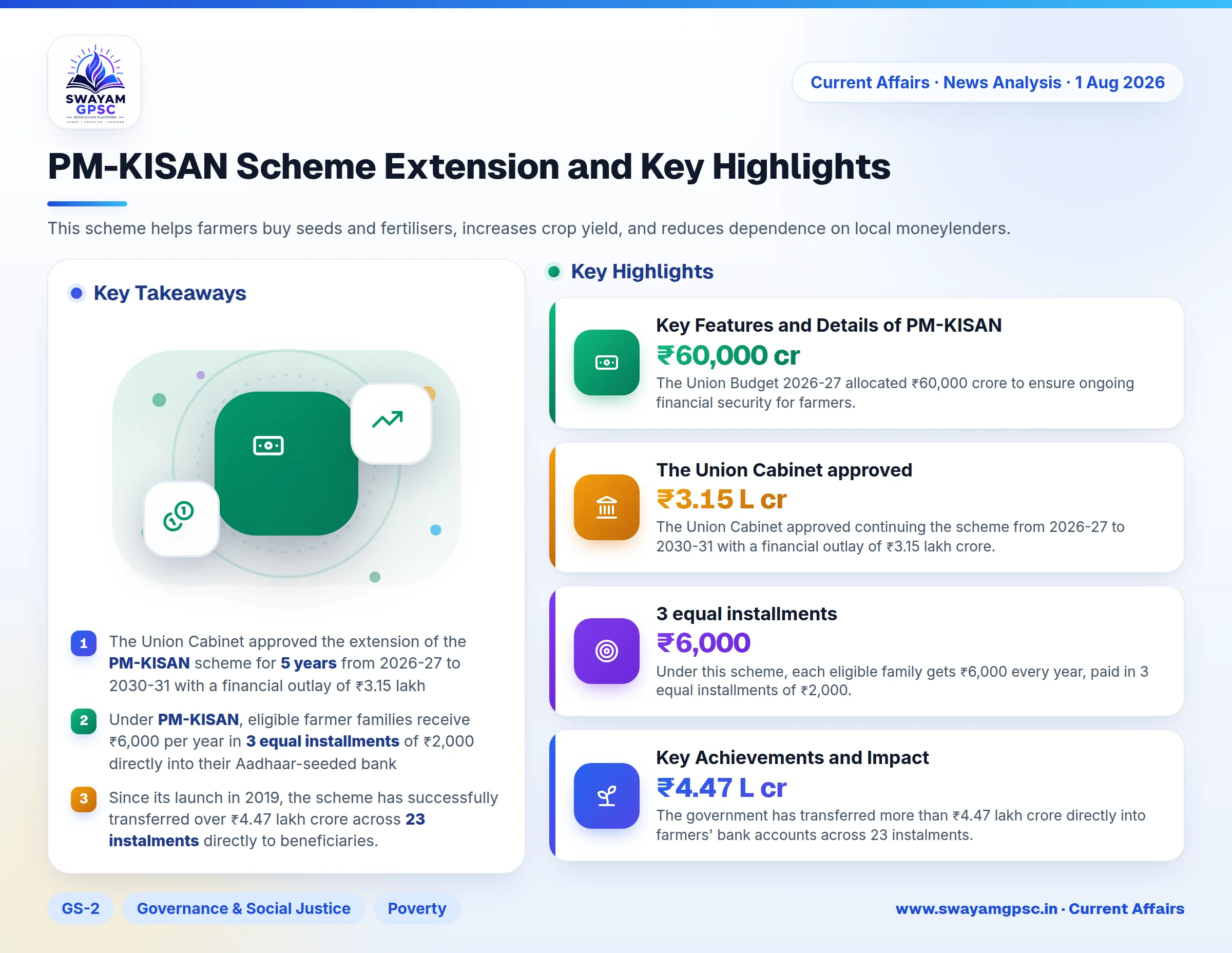
PM-KISAN Scheme Extension and Key Highlights
#GS-2 #Governance & Social Justice #Poverty #GS-3 #Economy #Agriculture #Budget #Current Events #National
Key takeaways
- The Union Cabinet approved the extension of the PM-KISAN scheme for 5 years from 2026-27 to 2030-31 with a financial outlay of ₹3.15 lakh crore.
- Under PM-KISAN, eligible farmer families receive ₹6,000 per year in 3 equal installments of ₹2,000 directly into their Aadhaar-seeded bank accounts.
- Since its launch in 2019, the scheme has successfully transferred over ₹4.47 lakh crore across 23 instalments directly to beneficiaries.
- An evaluation by NITI Aayog revealed that 92% of beneficiaries utilized the funds for agricultural investment and 85% reported higher farm incomes.
Why in News
- The Union Cabinet has approved extending the PM-KISAN scheme for another 5 years to support farmers and boost national agriculture.
Key Features and Details of PM-KISAN
- The government launched PM-KISAN in 2019 as a Central Sector Scheme to provide guaranteed income support to landholding farmer families.
- The Union Budget 2026-27 allocated ₹60,000 crore to ensure ongoing financial security for farmers.
- The Union Cabinet approved continuing the scheme from 2026-27 to 2030-31 with a financial outlay of ₹3.15 lakh crore.
- Under this scheme, each eligible family gets ₹6,000 every year, paid in 3 equal installments of ₹2,000.
- The government sends this financial help directly to Aadhaar-seeded bank accounts using Direct Benefit Transfer (DBT).
- This scheme helps farmers buy seeds and fertilisers, increases crop yield, and reduces dependence on local moneylenders.
- State Governments identify eligible farming families and maintain details like Aadhaar numbers, bank accounts, and mobile numbers.
- A multi-tier setup at national, state, and district levels monitors the scheme, with top national reviews led by the Cabinet Secretary.
- The PM-KISAN portal and mobile app facilitate fast registration, document verification, tracking of payments, and e-KYC.
Key Achievements and Impact
- The government has transferred more than ₹4.47 lakh crore directly into farmers' bank accounts across 23 instalments.
- During the Covid-19 pandemic, the scheme disbursed over ₹1.71 lakh crore, while women farmers received over ₹1.06 lakh crore.
- A study by NITI Aayog showed that over 92% of beneficiaries spent this money on farming, while 85% saw higher income and less debt.
- Between 2020-21 and 2025-26, cultivated land expanded by 9.65%, productivity rose by 10.53%, and total foodgrain output grew by 21.18%.
Significance of the Scheme
- Extending this scheme helps farmers invest more in modern farming, protects them from market risks, and strengthens the rural economy.