PM CARES Fund: Financial Analysis, Transparency, and Governance Issues
#GS-2 #Governance & Social Justice #Good Governance #Indian Polity & Constitution #Executive #Current Events #National #PM CARES Fund #Transparency & Accountability
Key takeaways
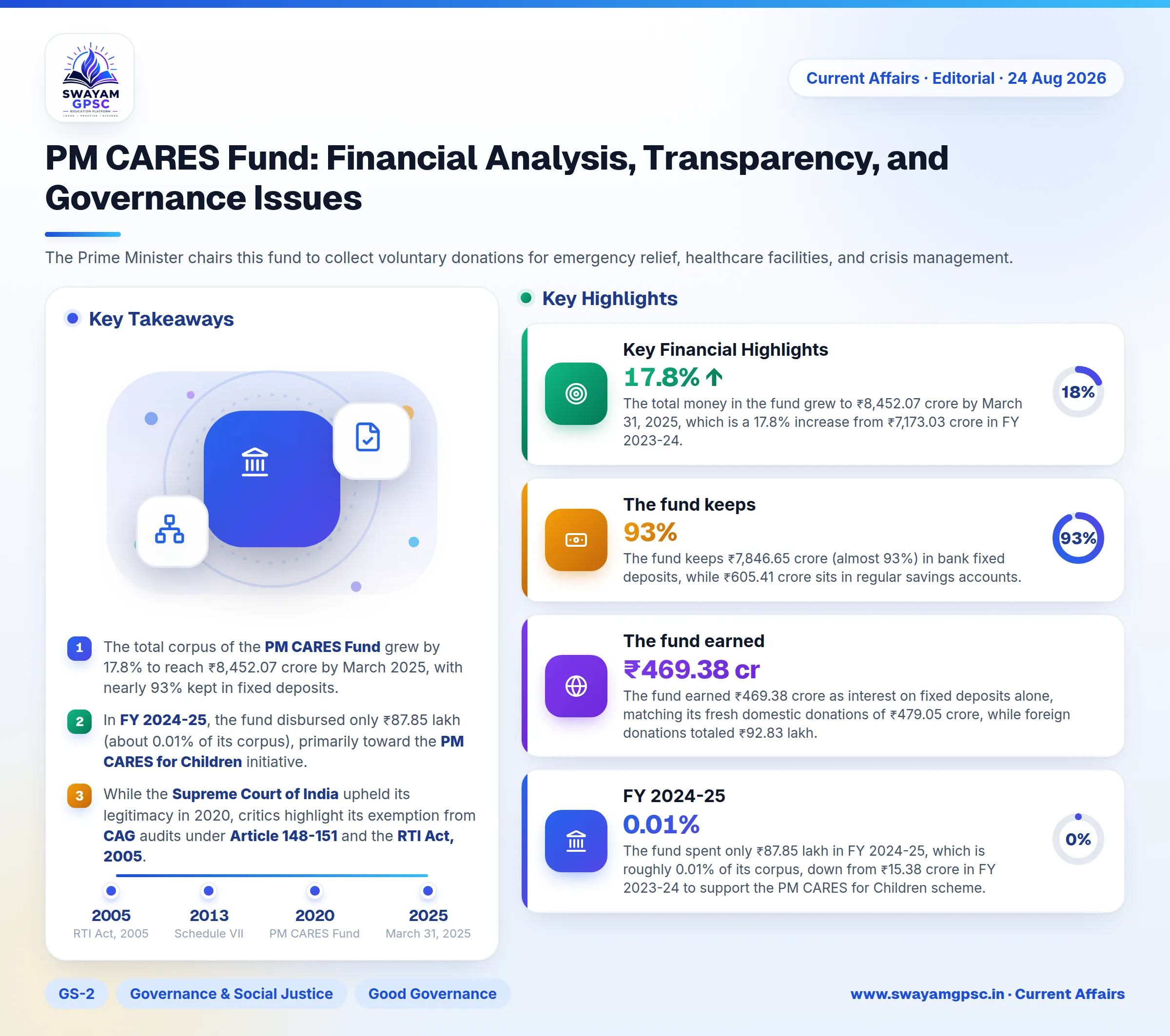
- The total corpus of the PM CARES Fund grew by 17.8% to reach ₹8,452.07 crore by March 2025, with nearly 93% kept in fixed deposits.
- In FY 2024-25, the fund disbursed only ₹87.85 lakh (about 0.01% of its corpus), primarily toward the PM CARES for Children initiative.
- While the Supreme Court of India upheld its legitimacy in 2020, critics highlight its exemption from CAG audits under Article 148-151 and the RTI Act, 2005.
- Donations to PM CARES count as CSR spending under Schedule VII of the Companies Act, 2013, whereas state Chief Minister Relief Funds generally do not enjoy this benefit.
Why in News
- The government published the audited financial statements of the PM CARES Fund for FY 2023-24 and FY 2024-25.
- This release restarted debates about managing public money, government accountability, and transparency in emergency relief funds.
About PM CARES Fund
- The government created the PM CARES Fund in 2020 as a public charitable trust.
- The Prime Minister chairs this fund to collect voluntary donations for emergency relief, healthcare facilities, and crisis management.
Key Financial Highlights
- The total money in the fund grew to ₹8,452.07 crore by March 31, 2025, which is a 17.8% increase from ₹7,173.03 crore in FY 2023-24.
- The fund keeps ₹7,846.65 crore (almost 93%) in bank fixed deposits, while ₹605.41 crore sits in regular savings accounts.
- The fund earned ₹469.38 crore as interest on fixed deposits alone, matching its fresh domestic donations of ₹479.05 crore, while foreign donations totaled ₹92.83 lakh.
- The fund spent only ₹87.85 lakh in FY 2024-25, which is roughly 0.01% of its corpus, down from ₹15.38 crore in FY 2023-24 to support the PM CARES for Children scheme.
Core Concerns and Criticism
- Critics ask why the fund holds huge cash reserves and earns bank interest instead of spending money immediately on flood relief or healthcare upgrades.
- Parliament cannot debate or question this fund because it does not draw money from the Consolidated Fund of India.
- The RTI Act, 2005 does not cover this trust under Section 2(h), which prevents citizens from requesting detailed donor lists or project approvals.
- Private Chartered Accountants audit the fund, keeping it outside the official constitutional audit of the CAG under Article 148-151.
- Under Schedule VII of the Companies Act, 2013, corporate donations to PM CARES count as CSR spending, but donations to Chief Minister Relief Funds usually do not.
Government Rationale
- Supporters argue that maintaining a ready cash reserve allows India to act fast during sudden crises like pandemics without bureaucratic delays.
- During the peak COVID-19 pandemic, the fund released over ₹4,000 crore within two years to buy 50,000 ventilators, build temporary hospitals, fund Covaxin trials, and set up oxygen plants.
- The fund relies entirely on voluntary contributions and takes zero money from taxpayer budgets.
- The trust posts its audited financial statements online to keep disclosures open while maintaining speed.
- The Supreme Court of India upheld the fund in CPIL v. Union of India, 2020, ruling that it is a valid trust separate from the NDRF.
Governance Analysis
- The fund uses government logos, the Prime Minister designation, and official web portals, which makes citizens expect standard public accountability.
- Giving CSR benefits mainly to the central trust diverts corporate money away from state disaster funds, causing financial unfairness.
- Ethical standards like the Nolan Principles demand openness and clear explanations when large public donations lie idle in bank deposits.
- Running multiple relief funds like PM CARES, PMNRF, and the statutory NDRF creates operational confusion and overlapping duties.
Way Forward
- The trust should voluntarily follow Section 4(1)(b) of the RTI Act to share state-wise grants and project details publicly.
- Experts recommend independent social audits to check if schemes like PM CARES for Children deliver real results on the ground.
- The government should give equal CSR status to State Disaster Relief Funds under the Companies Act to support state governments.
- Placing an annual summary report before Parliament would keep lawmakers informed without slowing down emergency responses.
Conclusion
- Combining speed in emergency response with clear public disclosures will protect citizen trust and strengthen overall governance.