Pickaxe Mountain and Strategic Nuclear Restraint
#GS-1 #Geography #Physical Geography #GS-3 #Current Events #International #Science & Technology #Defence #Iran Nuclear Programme #Pickaxe Mountain #Nuclear Restraint
Key takeaways
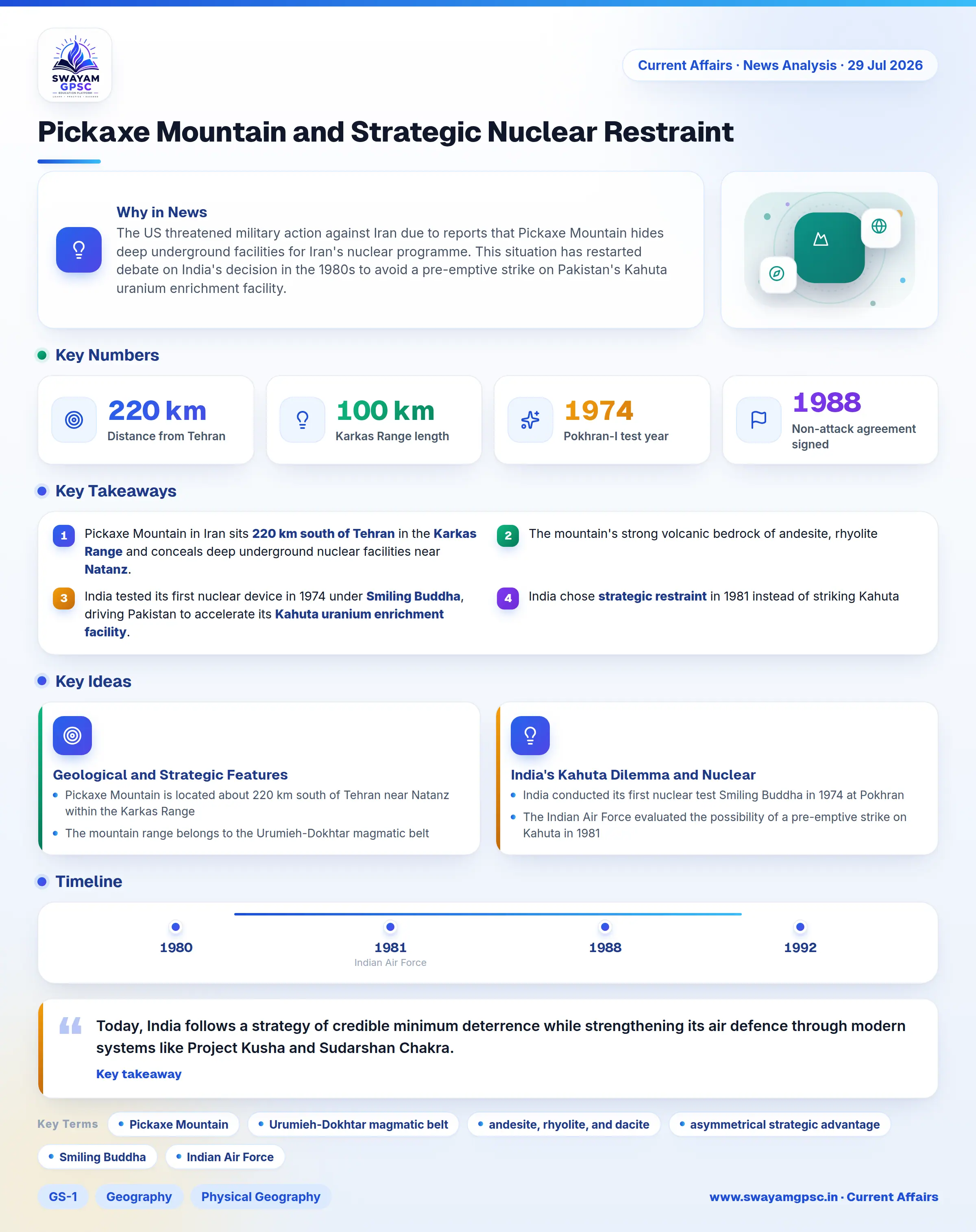
- Pickaxe Mountain in Iran sits 220 km south of Tehran in the Karkas Range and conceals deep underground nuclear facilities near Natanz.
- The mountain's strong volcanic bedrock of andesite, rhyolite, and dacite offers Iran an asymmetrical strategic advantage against kinetic air strikes.
- India tested its first nuclear device in 1974 under Smiling Buddha, driving Pakistan to accelerate its Kahuta uranium enrichment facility.
- India chose strategic restraint in 1981 instead of striking Kahuta, eventually signing the Agreement on the Prohibition of Attack against Nuclear Installations in 1988.
Why in News
- The US threatened military action against Iran due to reports that Pickaxe Mountain hides deep underground facilities for Iran's nuclear programme.
- This situation has restarted debate on India's decision in the 1980s to avoid a pre-emptive strike on Pakistan's Kahuta uranium enrichment facility.
Geological and Strategic Features of Pickaxe Mountain
- Pickaxe Mountain is located about 220 km south of Tehran near Natanz within the Karkas Range, which spans over 100 km between Kashan and Ardestan.
- The mountain range belongs to the Urumieh-Dokhtar magmatic belt, created when the Neo-Tethyan Ocean subducted under the Iranian plate over the last 66 million years.
- The bedrock consists mainly of tough volcanic rocks like andesite, rhyolite, and dacite, along with pyroclastic deposits and volcanic tuffs.
- Complex internal networks of fault zones and varying rock densities scatter kinetic shockwaves, making military blast penetration hard to calculate.
- The thick volcanic layers provide natural underground protection, giving Iran an asymmetrical strategic advantage near vital sea lanes like the Strait of Hormuz.
India's Kahuta Dilemma and Nuclear Restraint
- India conducted its first nuclear test Smiling Buddha in 1974 at Pokhran, which led Pakistan to speed up work on its Kahuta uranium enrichment facility.
- The Indian Air Force evaluated the possibility of a pre-emptive strike on Kahuta in 1981, but India never launched an official military attack.
- India chose strategic restraint, allowing Pakistan to gain nuclear capability by the late 1980s, which changed the strategic balance of South Asia.
- To reduce risks to nuclear plants, India and Pakistan signed the Agreement on the Prohibition of Attack against Nuclear Installations and Facilities in 1988.
- Both countries have annually exchanged lists of their nuclear installations every year since 1992.
- Today, India follows a strategy of credible minimum deterrence while strengthening its air defence through modern systems like Project Kusha and Sudarshan Chakra.