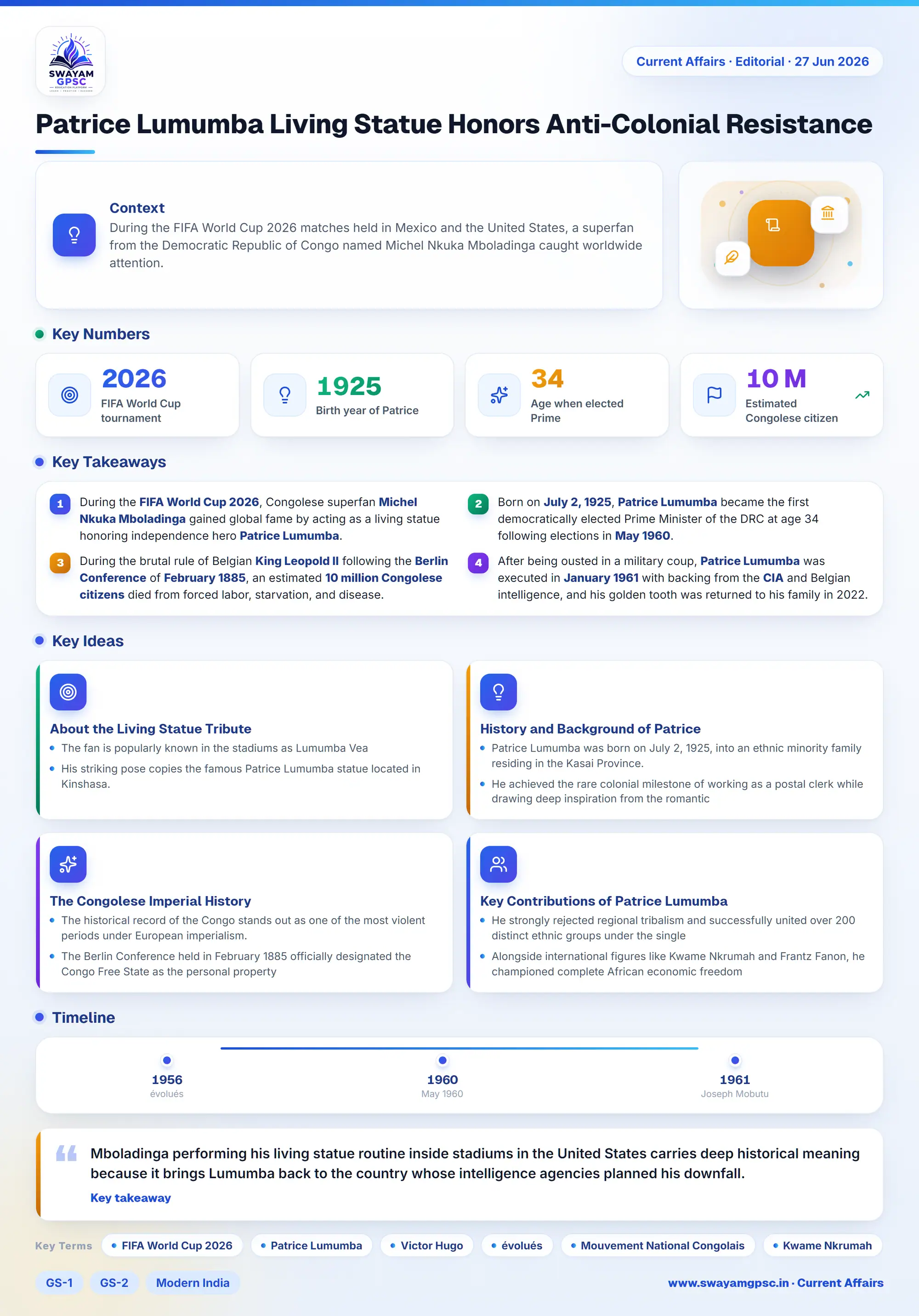
Patrice Lumumba Living Statue Honors Anti-Colonial Resistance
#GS-1 #GS-2 #Modern India #Freedom Struggle #Effects of Globalization #International #Current Events
Key takeaways
- During the FIFA World Cup 2026, Congolese superfan Michel Nkuka Mboladinga gained global fame by acting as a living statue honoring independence hero Patrice Lumumba.
- Born on July 2, 1925, Patrice Lumumba became the first democratically elected Prime Minister of the DRC at age 34 following elections in May 1960.
- During the brutal rule of Belgian King Leopold II following the Berlin Conference of February 1885, an estimated 10 million Congolese citizens died from forced labor, starvation, and disease.
- After being ousted in a military coup, Patrice Lumumba was executed in January 1961 with backing from the CIA and Belgian intelligence, and his golden tooth was returned to his family in 2022.
Context
- During the FIFA World Cup 2026 matches held in Mexico and the United States, a superfan from the Democratic Republic of Congo named Michel Nkuka Mboladinga caught worldwide attention.
- He honors the famous independence hero Patrice Lumumba by standing completely still like a living statue in the football stadium stands.
About the Living Statue Tribute
- The fan is popularly known in the stadiums as Lumumba Vea, and he turns ordinary football seating areas into places for political solidarity and historical memory.
- His striking pose copies the famous Patrice Lumumba statue located in Kinshasa.
- By staying completely motionless throughout the games, Mboladinga uses the FIFA World Cup 2026 platform to highlight African pride, decolonization, and national sovereignty.
History and Background of Patrice Lumumba
- Patrice Lumumba was born on July 2, 1925, into an ethnic minority family residing in the Kasai Province.
- He achieved the rare colonial milestone of working as a postal clerk while drawing deep inspiration from the romantic and enlightenment literature of Victor Hugo and Voltaire.
- He initially engaged with the évolués, which was a social circle of Western-educated Africans, but his political views hardened after spending time in prison in 1956.
- Upon gaining freedom, he helped establish the Mouvement National Congolais, which functioned as the nation's first genuine nationalist and trans-ethnic political organization.
- Influenced by Kwame Nkrumah and his successful anti-colonial efforts in Ghana, his party drove massive protests and boycotts against Belgian colonial rule.
- He led his party to a landslide win in the general elections held in May 1960, making the 34-year-old leader the first democratically elected Prime Minister of the DRC.
- On Independence Day, which was June 30, 1960, he delivered an unvetted and legendary speech in front of King Baudouin of Belgium and President Joseph Kasa-Vubu, stating that independence was hard-won through severe struggles and racial abuse.
- Just seven months into his tenure, amid a civil war fueled by Western powers and the secession of the mineral-rich Katanga province led by Moise Tshombe, President Joseph Kasa-Vubu dismissed him from office.
- Army Chief Colonel Joseph Mobutu led a military coup that captured him, and in January 1961, with direct backing from the U.S. Eisenhower administration, the CIA, and Belgian authorities, he faced torture and a firing squad before his body was dissolved in sulfuric acid.
- In 2022, a single golden tooth preserved by a Belgian officer finally returned to his relatives for a proper symbolic funeral.
The Congolese Imperial History
- The historical record of the Congo stands out as one of the most violent periods under European imperialism.
- The Berlin Conference held in February 1885 officially designated the Congo Free State as the personal property of Belgian King Leopold II.
- Under the guise of introducing Christianity and humanitarian civilization, the King transformed the resource-rich territory into a giant forced labor camp to harvest wild rubber, uranium, cobalt, gold, diamonds, and nickel.
- By the time the Belgian government took direct administrative control in 1908, roughly 10 million Congolese citizens perished due to engineered corporate executions, starvation, and disease.
- The Belgian administration enforced strict racial segregation for the next fifty years, leaving the local population largely uneducated.
- When independence arrived in 1960, fewer than 30 Congolese citizens held a university degree.
Key Contributions of Patrice Lumumba
- He strongly rejected regional tribalism and successfully united over 200 distinct ethnic groups under the single umbrella of the Mouvement National Congolais.
- Alongside international figures like Kwame Nkrumah and Frantz Fanon, he championed complete African economic freedom, maintaining that political freedom meant nothing if Western firms controlled local mineral wealth.
- He demanded absolute national sovereignty and refused to accept a puppet government arrangement, thereby setting a brave precedent for global anti-imperialist movements.
- His life story and writings served as a foundational guide for later African freedom fighters and leaders such as Nelson Mandela and Thomas Sankara.
Significance of the Tribute and Legacy
- Mboladinga performing his living statue routine inside stadiums in the United States carries deep historical meaning because it brings Lumumba back to the country whose intelligence agencies planned his downfall.
- As the modern DRC struggles with resource exploitation and regional security conflicts, the vision of Lumumba acts as a powerful symbol of enduring national resilience.
- This stadium tribute proves that Lumumba remains a living symbol of anti-colonial dignity rather than just a name confined to history textbooks.
- As philosopher Frantz Fanon noted, Lumumba remained an unyielding leader who could never be bought or controlled by external global superpowers.
Conclusion
- By mimicking the posture of Patrice Lumumba, the fan connects historical colonial trauma with the ongoing modern fight of Congolese people for total independence.
- Even though his physical life ended in 1961, his anti-imperialist principles remain unbroken and continue to inspire the global African diaspora directly from the football stands.