Parliamentary Disruptions and Democratic Accountability
#GS-2 #Indian Polity & Constitution #Governance & Social Justice #Parliament #Executive #Constitution #Good Governance #Representation of People's Act
Key takeaways
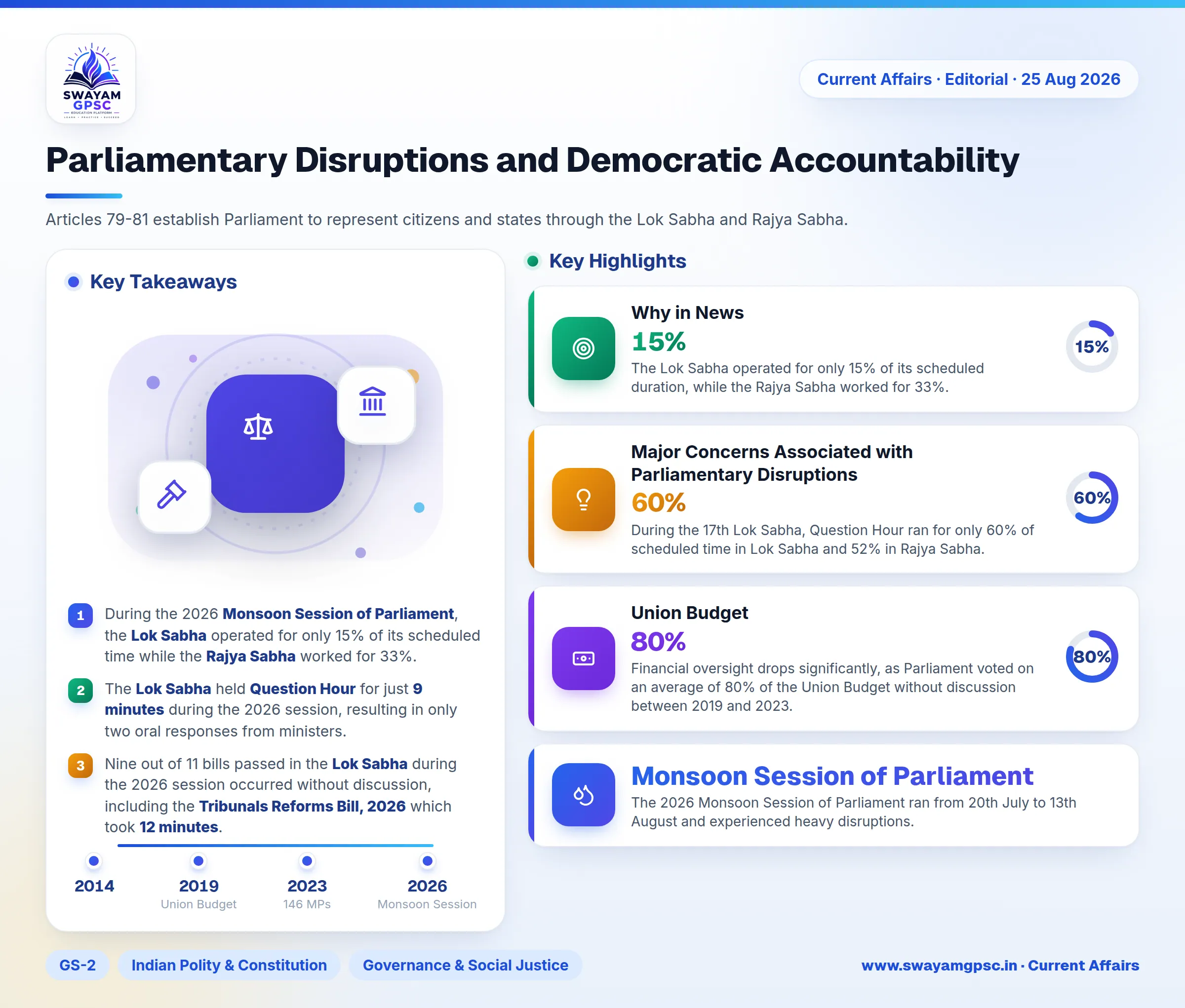
- During the 2026 Monsoon Session of Parliament, the Lok Sabha operated for only 15% of its scheduled time while the Rajya Sabha worked for 33%.
- The Lok Sabha held Question Hour for just 9 minutes during the 2026 session, resulting in only two oral responses from ministers.
- Nine out of 11 bills passed in the Lok Sabha during the 2026 session occurred without discussion, including the Tribunals Reforms Bill, 2026 which took 12 minutes.
- Between 2019 and 2023 in the 17th Lok Sabha, Parliament voted on an average of 80% of the Union Budget without legislative discussion.
- The NCRWC recommended setting a mandatory annual calendar of 120 sittings for Lok Sabha and 100 sittings for Rajya Sabha to ensure thorough scrutiny.
Why in News
- The 2026 Monsoon Session of Parliament ran from 20th July to 13th August and experienced heavy disruptions.
- The Lok Sabha operated for only 15% of its scheduled duration, while the Rajya Sabha worked for 33%.
- The Lok Sabha held Question Hour for just 9 minutes, which allowed only two oral responses from ministers.
- These frequent disruptions renewed national debate over opposition protests, government debate space, and executive oversight.
- Maintaining parliamentary productivity is a shared institutional responsibility, but the government and presiding officers hold primary accountability.
Constitutional Provisions Regarding the Functioning of Parliament
- Articles 79-81 establish Parliament to represent citizens and states through the Lok Sabha and Rajya Sabha.
- Articles 107-111 authorize Parliament to debate and pass laws while checking their constitutional validity and public impact.
- Article 75(3) makes the Council of Ministers collectively responsible to the Lok Sabha through tools like the no-confidence motion.
- Articles 112-117 require legislative approval for all spending and taxes through the Annual Financial Statement and Demands for Grants.
- Articles 105 and 118 allow detailed committee review of bills through bodies like the Public Accounts Committee and Estimates Committee.
- Article 118 grants each House full procedural autonomy to create rules for conducting daily debates and business.
- Article 105 guarantees freedom of speech to members in Parliament and protects them from legal actions over legislative statements.
- Articles 121-122 restrict court interference in parliamentary proceedings, protecting the independent authority of the legislature.
Key Reasons Behind Parliamentary Disruptions
- Disruptions occur when presiding officers reject opposition requests for debates, adjournment motions, or discussions under Rule 267.
- The lack of formal communication between the government and opposition turns simple political policy differences into procedural standoffs.
- Shrinking time for private members' business and opposition debates encourages parties to use disruption to force their agenda.
- Government reluctance to discuss sensitive matters or form a Joint Parliamentary Committee (JPC) pushes opposition members to protest.
- Entering the Well of the House and shouting slogans attract quick news media attention, turning disruption into political messaging.
- Political parties use legislative protests to mobilize local voters and gain advantages over political rivals before upcoming elections.
- Strict party whips under the Tenth Schedule prevent independent member opinions and block flexible cross-party compromise.
- Perceptions of biased rulings by presiding officers regarding member discipline or expunging remarks reduce trust among political parties.
- Current House rules lack effective mechanisms to penalize lost parliamentary time, allowing disruptions to repeat without consequence.
Democratic Justification of Parliamentary Disruptions
- Disruption can serve as a legitimate last resort when members exhaust formal mechanisms like questions, notices, and committee reviews.
- Protests carry democratic weight when the government ignores major constitutional violations, widespread violence, or urgent national crises.
- Interruption becomes understandable when ministers refuse to make official statements or permit structured debates on important public issues.
- Peaceful symbolic protests that avoid property damage or physical threats serve to highlight neglected public concerns.
- Disruption remains acceptable only if members seek to draw focus to crucial issues rather than halting the whole session.
- Protests hold democratic validity when members seek public disclosure and government answers rather than simple electoral publicity.
- Parties cannot justify continuous routine obstruction or blocking the exact discussions that they initially demanded.
- Physical threats, tearing official papers, damaging public property, or blocking presiding officers destroy legislative decorum.
- Staging protests for personal publicity or political strategy degrades the institutional dignity of the elected assembly.
- Disrupting essential work like Question Hour or budget reviews deprives other elected representatives of their right to participate.
- Protests become unjustified when opposition members continue disrupting after the government agrees to hold a structured debate.
- Former President Pranab Mukherjee noted that Parliament exists for debate, discussion, and decision, not continuous disruption.
Responsibility of Stakeholders in Parliamentary Disruptions
- Opposition parties hold direct responsibility when they enter the Well of the House, shout slogans, and stall Question Hour.
- The government carries larger systemic responsibility because it controls the legislative schedule and must allow space for opposition debate.
- Presiding officers must act neutrally, allow legitimate discussions, and apply disciplinary measures like suspensions fairly.
- The opposition must not use disruption as a weapon, while the ruling party must not use its majority to bypass scrutiny.
Major Concerns Associated with Parliamentary Disruptions
- Disruptions undermine executive accountability by preventing members from asking oral questions and follow-up questions during Question Hour.
- During the 17th Lok Sabha, Question Hour ran for only 60% of scheduled time in Lok Sabha and 52% in Rajya Sabha.
- Disruptions lead to hasty lawmaking, as the government passes major bills amid chaos without proper parliamentary debate.
- In the 2026 Monsoon Session, Parliament passed 11 bills, with nine bills passed in the Lok Sabha without any debate.
- The Lok Sabha passed the Tribunals Reforms Bill, 2026 in just 12 minutes without active participation from any member.
- Continuous disorder silences smaller regional parties and independent members who rely on limited speaking time to address local concerns.
- Mass suspensions, such as the suspension of 146 MPs during the Winter Session 2023, harm representative democracy during key bill passes.
- Financial oversight drops significantly, as Parliament voted on an average of 80% of the Union Budget without discussion between 2019 and 2023.
- Parliamentary paralysis causes executive dominance, encouraging the government to rely on ordinances and bypass checks and balances.
- Frequent disruptions in the Rajya Sabha weaken its constitutional function as the Council of States in defending state interests.
- Repeated suspensions create a bad cycle of confrontation, disturbing the balance between maintaining order and protecting representative rights.
- Televised parliamentary disorder creates public cynicism and damages the institutional credibility of democratic governance across the nation.
Way Forward and Needed Reforms
- Parliament should establish a fixed calendar of 120 sittings for Lok Sabha and 100 sittings for Rajya Sabha as recommended by the NCRWC.
- India should establish dedicated Opposition Days to grant opposition parties fixed dates to select debate topics and set the agenda.
- Presiding officers must protect Question Hour by rescheduling disrupted questions to alternate slots instead of cancelling them completely.
- The government should enforce the Pre-Legislative Consultation Policy, 2014 by publishing draft bills with detailed impact reports for public feedback.
- Parliament needs a clear, graded code of conduct to enforce fair, proportionate sanctions for different levels of member misconduct.
- Presiding officers should maintain neutrality by offering reasoned rulings and ensuring the prompt election of a Deputy Speaker from opposition ranks.
- Parliament should publish an official productivity index detailing sitting hours, committee referrals, and discussion time per bill for public transparency.
Conclusion
- India must shift from a politics of mutual obstruction to a healthy culture of structured debate and constitutional decorum.
- The ruling majority must govern while letting the minority question, ensuring both groups operate effectively within the legislative framework.
- A healthy parliamentary system requires productive order with scrutiny, combining symbolic protest with meaningful legislative deliberation.