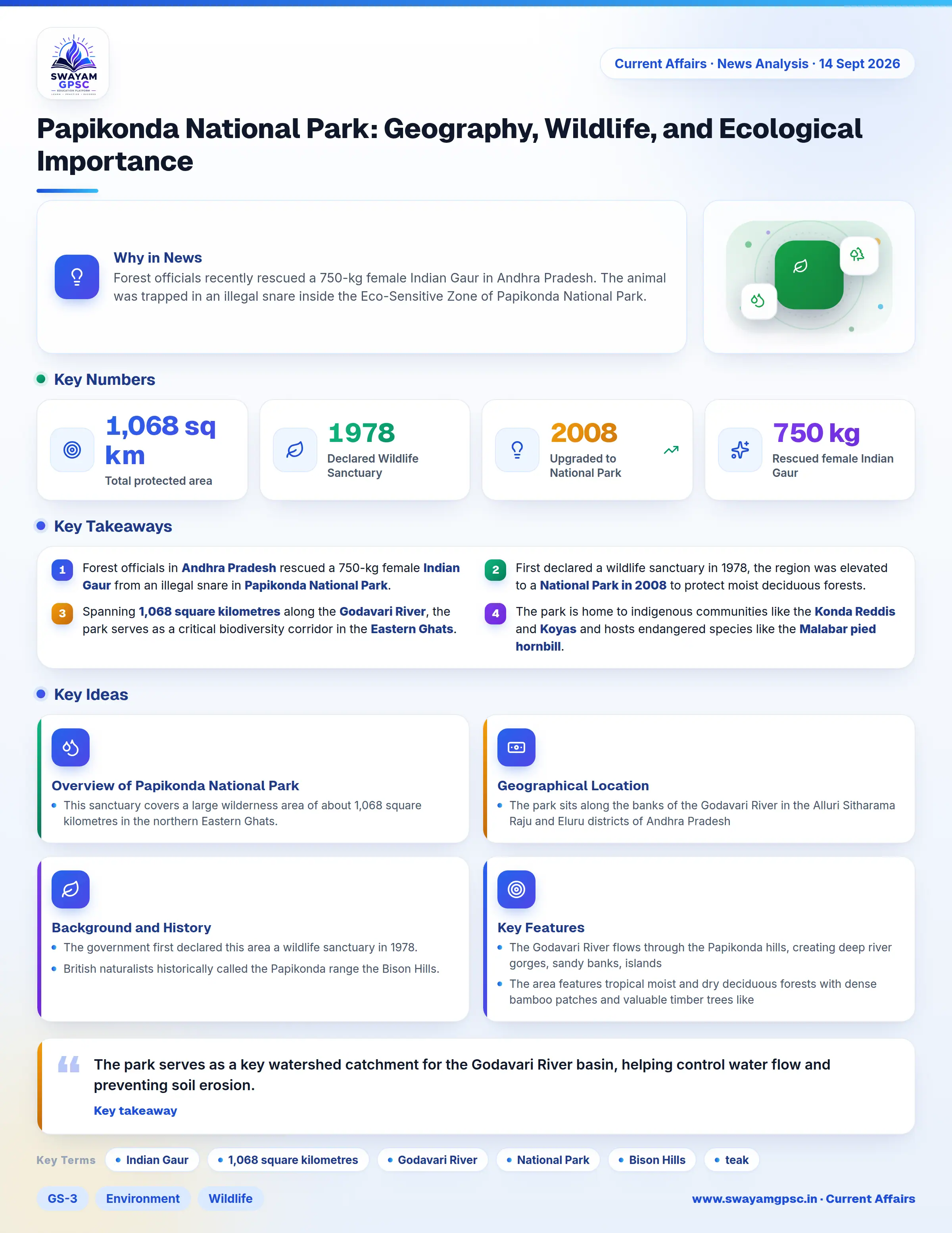
Papikonda National Park: Geography, Wildlife, and Ecological Importance
#GS-3 #Environment #Wildlife #Biodiversity #Geography #Physical Geography #GS-2 #Current Events #National #Papikonda National Park
Key takeaways
- Forest officials in Andhra Pradesh rescued a 750-kg female Indian Gaur from an illegal snare in Papikonda National Park.
- First declared a wildlife sanctuary in 1978, the region was elevated to a National Park in 2008 to protect moist deciduous forests.
- Spanning 1,068 square kilometres along the Godavari River, the park serves as a critical biodiversity corridor in the Eastern Ghats.
- The park is home to indigenous communities like the Konda Reddis and Koyas and hosts endangered species like the Malabar pied hornbill.
Why in News
- Forest officials recently rescued a 750-kg female Indian Gaur in Andhra Pradesh. The animal was trapped in an illegal snare inside the Eco-Sensitive Zone of Papikonda National Park.
Overview of Papikonda National Park
- This sanctuary covers a large wilderness area of about 1,068 square kilometres in the northern Eastern Ghats. It features rugged hills, river gorges, and rich plant and animal life.
Geographical Location
- The park sits along the banks of the Godavari River in the Alluri Sitharama Raju and Eluru districts of Andhra Pradesh, extending slightly into Telangana.
Background and History
- The government first declared this area a wildlife sanctuary in 1978. Later in 2008, officials upgraded it to a National Park to protect local biomes and wild habitats.
- British naturalists historically called the Papikonda range the Bison Hills. They gave it this name because of the dense population of Indian Gaur living in the region.
Key Features
- The Godavari River flows through the Papikonda hills, creating deep river gorges, sandy banks, islands, and rich water habitats.
- The area features tropical moist and dry deciduous forests with dense bamboo patches and valuable timber trees like teak and rosewood.
- Recognized as an Important Bird Area, the park shelters major species like tigers, leopards, sloth bears, and the rare Malabar pied hornbill.
- Indigenous communities such as the Konda Reddis and Koyas live here, using traditional knowledge to live in balance with the forest.
Ecological Significance
- The park serves as a key watershed catchment for the Godavari River basin, helping control water flow and preventing soil erosion.
- It provides a vital wildlife corridor in the Eastern Ghats, where authorities work to control illegal poaching while managing infrastructure development.